
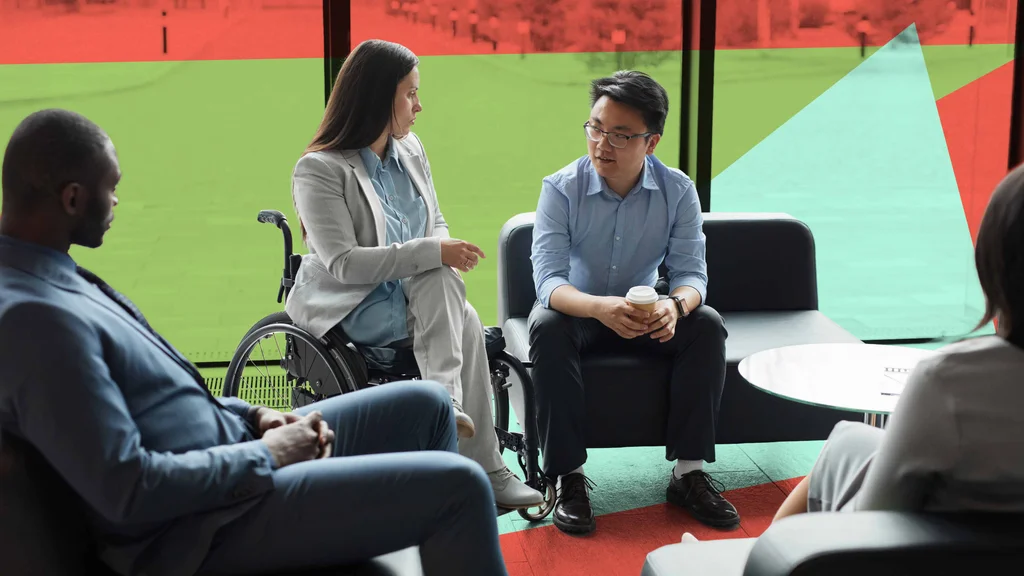

It’s no secret that the workplace has changed forever—the new era of employee empowerment has raised expectations for where, why, and how corporate workers do their jobs. Gone are the days of corner offices and endless rows of identical gray cubicles. The offices of 2024 are more inviting and modern, complete with open layouts, lounge space, and hot desks.
Over the course of my 20-year career as an architect and designer, I have seen countless office trends come and go. While many of these concepts failed to resonate, others have proven to effectively promote engagement and productivity.
To meet elevated workplace expectations and design offices that match modern employee needs and demands, organizations should follow four key pillars—flexibility, accessibility and inclusivity, connectivity, and localization—to build dynamic workspaces and better support their workers.
1. FLEXIBILITY
Flexibility means more than letting employees work from home on Fridays; it’s a mindset that companies can adopt in everything they do, including their office designs. Flexible office design means that spaces can cater to multiple purposes throughout a workday. It also has the added benefit of helping employers more quickly adapt office layouts to match evolving employee demands.
With the majority of companies embracing hybrid schedules, it’s crucial to accommodate changing workspace needs depending on employee habits and patterns. For example, consider a large conference room used for company-wide meetings. If designed properly, this can also function as a collaborative space for different teams or a central location for social events and celebrations.
Going a step further, one of our London locations offers a unique event space that can be rented in conjunction with adjacent meeting rooms and a terrace, which enables a wide range of use cases depending on an organization’s size and needs.
These flexible spaces create a sense of dynamism that keeps the workplace fresh and effective.
2. ACCESSIBILITY AND INCLUSIVITY
Modern offices should also cater to individuals of all physical abilities and backgrounds to ensure that every employee can navigate the workspace with comfort and ease.
One way to promote inclusivity is to designate certain private spaces, such as meeting rooms, as multipurpose wellness rooms which can be used for prayer, meditation, or new parents’ rooms depending on workers’ needs. This type of proactive inclusivity has a demonstrated positive impact on employee effectiveness, engagement, and morale at a minimal cost to the organization. In fact, at WeWork, we’ve seen a 257% increase in bookings for these types of rooms over the past three years.
Organizations can also work to optimize their workspaces for accessibility beyond basic ADA compliance by investing in height-adjustable desks, adding low sections to pantries or community bars, and installing doors that open outwards or slide to allow for wheelchair movement.
In addition, wayfinding solutions are an important option for making workspaces more inclusive for all employees and visitors. WeWork recently revamped its wayfinding program and signage across several buildings. In some buildings, we’ve added braille to permanent signage, and in many of our international locations, we translate messages in multiple languages.
Remaining accessible and inclusive should be a constant work in progress for companies and should also work to reflect the needs and wishes of employees.
3. CONNECTION
One of the main advantages of flexible work is the ability to engage with teammates beyond your immediate office to foster collaboration, idea generation, and meaningful relationships.
When designing our locations, we view workspaces as collaboration hubs that encourage individuals and teams to do their best work. This can include transforming single desks into communal meeting spaces, implementing more advanced connective technology, or adopting booking software to ensure remote workers feel as connected as those who are in the office.
Connection is especially important for promoting engagement among younger employees, many of whom began working during the pandemic and haven’t had the same opportunities to develop professional skills or relationships as a result. We’ve long found that soft seating helps support better one-on-one connections in an office. People naturally flock to couches and armchairs for more constructive connection and these spaces quite literally lower the conversation to a more comfortable position.
4. LOCALIZATION
Localization is a great way to boost engagement by creating workspaces that infuse local materials and art from the surrounding area. For example, in Madrid, we commissioned a local artist to paint a Goya mural on the building’s terrace, and in Singapore, we restored original tiles and embedded them in the risers of the internal staircase. An Austin office will—and should—look different from one in New York, and even small changes can go a long way in creating a unique flair that differentiates your workspace from antiquated office designs.
Above all else, your office should reflect your organization’s culture as well as the people who work there. Too often, I get asked, “How does this large tech company design their office?” when instead decision makers should be focusing on how they can reflect their own business in their spaces. For example, a study from the University of Exeter found that employees in enriched workspaces (decorated with plants and artwork) were 17% more productive than their counterparts in lean workspaces (bare and functional).
If employers want workers to come back to the office, pizza lunches and casual Fridays aren’t going to cut it. The pandemic has permanently transformed the way people work, presenting an exciting opportunity to improve, innovate, and redefine the modern office to increase employee engagement and productivity.