

Innovation lies between an organization’s silos. That’s because the collective intelligence of a company isn’t just the sum of its employees; it’s in the discoveries they make together—the sparks that fly when different types of minds circle a business challenge.
Unlock this level of collaboration and you can transform performance across your entire company. Everyday sticking points can become more fluid. Insights gain context. Groundbreaking ideas can flare and catch wind.
For companies exploring remote and hybrid work, the metaverse can make it easier to forgo silos and let people connect to uncover new ideas, products, and services. Here, we’ll explore how you can leverage virtual frameworks to break down silos and surface innovation.
ENABLING REMOTE COLLABORATION
Restoring organic collaboration is the first step to rebuilding a culture of innovation with remote and hybrid workforces.
Over the past few years, video has played a fundamental role in remote work. It isn’t going anywhere—nor should it—but its inherent limitations can stifle your company’s competitive advantages. If video meetings are your organization’s only form of remote collaboration, your market position may be at risk.
That’s because an overreliance on video can cause silos. Meetings happen either in sequence or in parallel. They have fixed attendance and fixed start and end times. There is none of the serendipity that happens in side conversations before or after meetings.
Many times, these meetings are hierarchical. Someone owns the meeting, owns an agenda, and decides who can share. Singular ownership, in turn, can threaten transparency. It’s difficult to know who is meeting with whom and when. Relationships weaken or never form—basically, the opposite of collaboration.
A Northeastern University survey of C-level executives in December 2021 spotlighted the issue: over 50% said they were worried about the effects of a primarily remote work environment on their workforce’s ability to be creative and innovative.
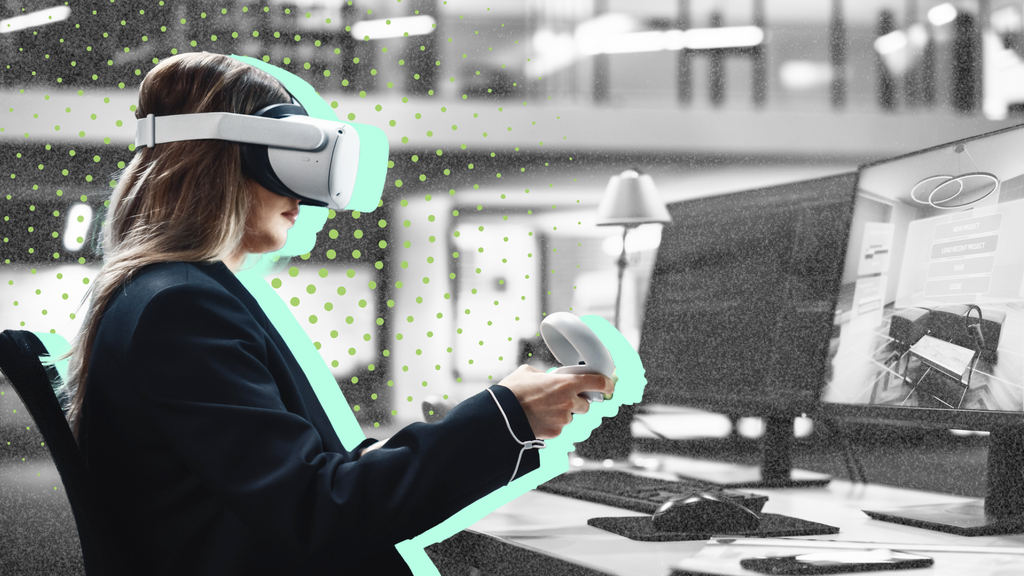
This is where the development of the enterprise metaverse can be helpful to companies with complex global objectives. In these platforms, 3D graphic representations of a work campus provide a place where all employees can show up, regardless of their geographical location. Much like walking into a physical office, there is movement, social collision, and a sense of energy.
This sense of place is incredibly important to innovation. It promotes the kind of collaboration that has been missing from remote work. In the metaverse’s immersive workspaces, you can create opportunities for people to say hello, walk to their offices together, and talk about their projects during unstructured time. These conversations give them ways to casually highlight their contributions in groups or get on a first-name basis with people in other departments.
Not every greeting will lead to the next big market disruption, but it can help foster a sense of community that encourages teams to connect and explore internal partnerships. This connectivity doesn’t happen over video alone. It requires a mix of work platforms that includes a spatial option.
INCREASING ENGAGEMENT
With collaborative frameworks in place, innovation can begin to percolate again. Virtual worlds let you design your organization to build engagement. These immersive spaces have great potential to inspire and engage employees across all departments. Some of this comes down to the novelty of virtual worlds. They’re relatively new to everyone, even those who are early adopters.
Geeking out can be good for business, though. The delighters of virtual space—like outdoor-themed environments or auditoriums that fit your whole company—let people feel like they’re already working at an innovative company. People can bring their best selves to work when they aren’t stuffed into a blazer or wondering if all those camera-off attendees are even listening.
Avatars drive connectivity here. Avatars are graphical representations of people. Everyone interacts in avatar form in virtual offices, self-selecting their appearance for work and changing it as often as they like.
In advanced virtual workspaces, avatars signal their engagement much like we do in the real world. You turn toward whoever is speaking or pivot your gaze between presentation boards. It doesn’t take long for most people to stand a respectful distance apart or scoot down when someone else joins a group.
It also means that you can hold meetings with a dozen people—or many, many more—and everyone can sit around the same table to engage. Experiences become shared instead of individually experienced, helping lead to stronger teamwork grounded in trust and cross-functional understanding.
THE VALUE OF A PERSISTENT ENVIRONMENT
Knocking out silos is a company-wide initiative—partly by nature and partly because you’re more likely to succeed in your quest for innovation that way. McKinsey & Company found that scope is a primary indicator of successful organizational change: go big for worthwhile impact.
The persistence of virtual reality allows it to create this level of impact. In this context, persistence means the environment doesn’t disappear. Physical offices are persistent in a sense, too, but in the metaverse, the persistence is available across time zones, language settings, and individual abilities or lifestyles.
This frees a company’s leadership to focus on uniting teams around the same objectives. As cross-functional teams become immersed in their work, they can identify new ways to innovate. Leadership ranks can become more connected to each other and their teams, too, because they’re able to circulate in the spatial environment, ask and answer questions, and help spur innovation.
Over time, as more organizations enter virtual worlds, those that have made the transition earlier can maintain the competitive advantage. A culture of innovation can become the present reality, not another problem to solve in the midst of global change.
Alex Howland, Ph.D., is President and Co-Founder of Virbela, an immersive virtual world platform for work, events and education.