
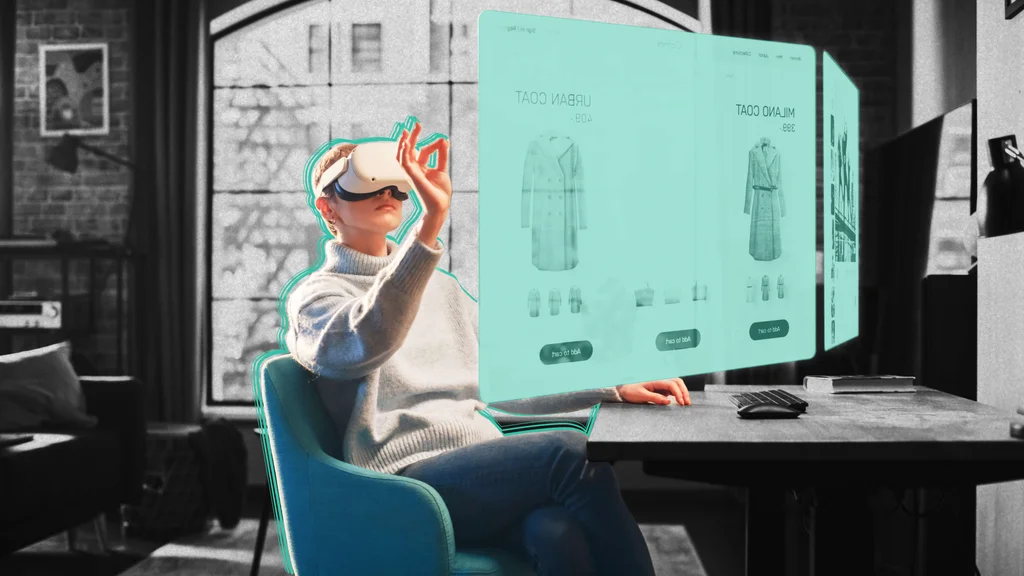

The relationship between physical and digital commerce hasn’t always been smooth, but we’ve seen a paradigm shift emphasizing the importance of bridging the physical and digital realms.
For example, an in-store experience (paywall) that goes well can positively impact future online purchases, thereby building customer loyalty across channels. By treating digital and in-store touchpoints as part of the same customer journey, rather than as distinct silos, retailers have been successful in introducing services like curbside pickup and endless aisle.
My last article primarily focused on making sense of the metaverse. And while I mentioned some examples of early-adopter brands, now let’s look at the metaverse in a broader retail context.
DISRUPTION DEJA VU
This notion of seamless integration between channels—commonly referred to as omnichannel retail—encompasses every touchpoint from brick-and-mortar stores to websites, wearables, and more recently, the metaverse. But just as e-commerce didn’t bring about the end of days for physical retail, the metaverse likely won’t either.
Instead, it will present us with a fragmented landscape where different stores, formats, and expectations exist with little interoperability between platforms—just as we saw in the early days of the web. However, as the effects of the metaverse disruption continue to spread, we’ll likely see more robust and consistent integration within the larger retail network.
VIRTUAL STORES MAY SHAPE CONSUMER EXPECTATIONS
Apart from brands like Nike and Gucci experimenting on virtual gaming platforms, the idea of virtual storefronts—simulations of physical stores—could very well be the next step in the evolution of the metaverse.
In these stores, customers would be able to shop the “aisles” to see the products a store has in stock. Theoretically, they could add these products to a shopping cart to be delivered to their homes or picked up in-store. In fact, several trademarks filed by McDonald’s indicate the fast-food chain intends to create a virtual restaurant that will deliver food online and in person. Order it in the metaverse; have it delivered to your physical door.
Without physical-world constraints in the metaverse, brands have the opportunity to offer customers novel experiences that they couldn’t in a store or through a website. But while this is an exciting time for leading brands to venture into the unknown, there are some caveats.
Appealing to a customer’s senses is one of the most effective ways to create a compelling retail environment, but virtual storefronts are limited to sight and sound—at least for now. Designers of metaverse retail will have to go to great lengths to create appealing visuals and captivating soundscapes, depending on the experience they’re trying to emulate. And because consumers can’t physically interact with products, expect to see a rise in marketing tactics like free delivery and tester products to encourage shoppers to purchase items, having tried them out risk-free.
Conversely, the limitations of the metaverse may point to new opportunities and store services in the physical realm. After all, the disruptive emergence of smartphone technology led to a number of in-store retail innovations like mobile payment options and the ability to buy online and pickup in-store.
STORE DISRUPTION WILL COME FROM AR MORE THAN VR
It’s impossible to predict how, when, or even if the metaverse will achieve maturity, but we can track its evolution from isolated VR experiences to the more immersive AR experiences that have a bearing on the real world today. Through AR, users can import and interact with virtual items in real time, in the real world. From Snapchat’s use of entertaining lens filters to Amazon’s Room Decorator, which allows you to see what furniture and decor will look like in your space, the boundary between physical and virtual worlds is becoming even more blurred.
This has become especially apparent in recent months. At the height of the global health pandemic, VR and AR were game-changers for many eCommerce shops selling products traditionally more difficult to sell online.
A PLATFORM IN AND OF ITSELF
The metaverse shouldn’t be treated as a mere extension of a website or app. The fact that it has the potential to impact both our virtual and physical worlds makes it a powerful platform in its own right.
If you went shopping just thirty years ago, you went to a store in the three-dimensional physical world. Then, with the introduction of the internet, shopping evolved into a two-dimensional shopping experience through a screen. The internet brought about a functional and spatial change in how we interact with the commercial world. Now, with the introduction of the metaverse, we are journeying toward an immersive three-dimensional buying experience.
Have you ever bought an item online and picked it up in-store? Have you ever spoken to an associate in-store and had an item shipped to you? Just as we shape the technologies and interfaces we use, those same technologies and interfaces shape us.
Jason Cottrell is CEO & Founder of Myplanet, specialists in digital transformation programs that tackle complex commerce challenges.