
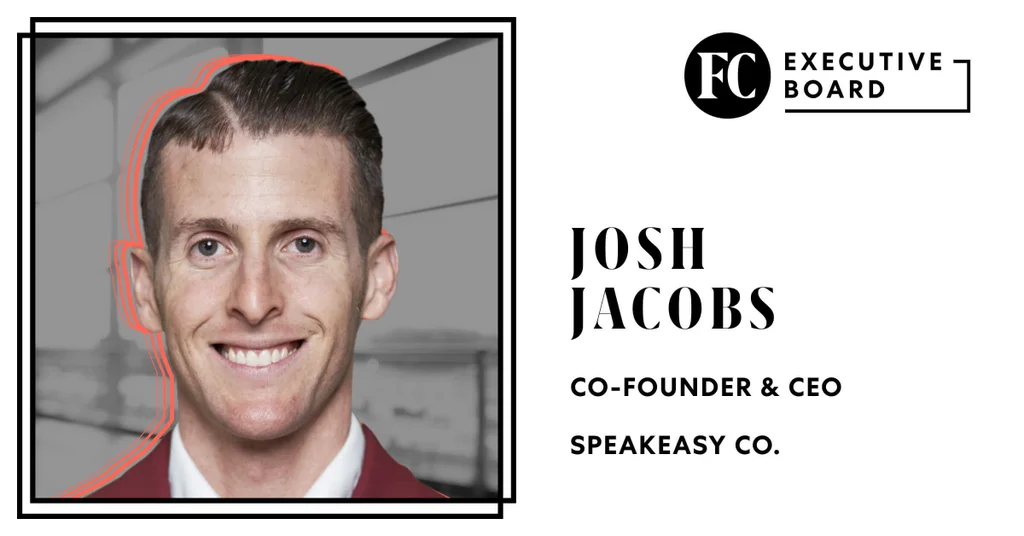

Way back in 2015, Josh Jacobs—co-founder and CEO of spirits e-commerce platform Speakeasy Company—and his business partners were trying to figure out the next “big thing” in subscription boxes. With brands like Birchbox and IPSY delivering cosmetics, and HelloFresh and Blue Apron delivering meal ingredients, Jacobs and his partners set out to create a subscription box for spirits so that consumers could mix their own designer drinks. “No one knows how to make craft cocktails at home,” says Jacobs. “So the initial mission was to create another Blue Apron, where we were taking something as intimidating as whipping up a gourmet meal at home, and democratizing that.”
Jacobs and his partners realized that a major obstacle for many consumers was the sheer expense of craft cocktail ingredients. One way to diminish this expense, they determined, was to use sample sizes, like in some of the cosmetics box subscriptions. “It was our mission right out of the gate to not just introduce subscribers to new cocktail recipes, but to the most important ingredient in a cocktail: the spirits,” says Jacobs. “We naturally gravitated towards incorporating craft distilleries so we could introduce our subscribers to new, unusual and different spirits.”
The business took off faster than expected—so much so that Jacobs remembers standing in his partners’ living room, surrounded by boxes, bottles of syrup, and “fruit everywhere,” and realizing, “We need some help on the fulfillment side.” But by this point, Jacobs had gained significant industry knowledge from his brand partners—and they were all too familiar with the confines of the existing regulatory environment in the U.S.
The alcohol industry works in a three-tier system. The brands (tier one) sell to the distributors (tier two), and they sell to bars, restaurants, and liquor stores (tier three). “What we learned was that there’s a global challenge around this lack of connectivity, and this lack of fluid movement of data, goods and money across tiers,” Jacobs says. Where there should be data and automation, he found paper invoices and an overall lack of technology.
Jacobs and his co-founder and COO, Michael Bowen, sunsetted the cocktail subscription boxes and began focusing directly on brands’ needs for control—control over their data and their customer relationships. “Our main mission is to empower our partners, putting them back in control over their own destiny, as opposed to being reliant upon partners for the longevity of their business,” Jacobs says.
Further, Speakeasy addresses a problem of visibility. “These products are born to live online,” Jacobs says. “Hard-to-find, premium brands simply lack enough inventory to stock liquor stores around the country, a process which is also incredibly complex to navigate.” Having their bottle label on a shelf or name on a menu isn’t enough to yield broad discovery and brand loyalty. “That’s not enough real estate to share their story, engage with consumers, and have any hope of altering their buying behavior,” he explains.
Speakeasy’s mission to elevate spirits brands is an extension of the democratizing force that Jacobs and his partners hoped to effect through their subscription box nearly a decade ago. “Our goal is to empower the brands to take control over their data to better understand their core customers and consumer relationships. They’ve never had access to data quite like this before,” Jacobs says. “Historically, they have had to rely on these other partners for their success, but even through them, they could not access the same level of critical business information.”
Speakeasy helps brands leverage data from sources such as Google Analytics, Facebook pixels, CRM integrations, and a full suite of e-commerce tools. “But on the back end, the financials are flowing through the three-tier system,” Jacobs says, in order to remain fully compliant within the alcohol regulatory system. “We’re not circumventing the system,” he explains. “Rather, we’re collapsing it in a really seamless fashion and enabling these brands to scale online. It’s an opportunity for them to have access to new sales channels, new data, and to own those customer relationships for the first time.”
Speakeasy, like the brands it works with, has continued to scale since its inception with over 280 partners on the platform; it now represents not only small craft labels, but also some largest spirits companies in the world. Part of the appeal to these big brands, says Jacobs, is that Speakeasy offers an entirely new revenue stream through e-commerce in addition to maintaining three-tier compliance for the suppliers they partner with. Recently the company has been involved in some particularly high-profile projects, including the release of Tesla Tequila and the launch of House of Hazelwood (a William Grant & Sons brand). They also launched Nick Jonas’ and John Varvatos’ ultra-premium tequila brand, Villa One, part of the Stoli group—one of the many major suppliers with whom they have worked and built relationships.
Looking ahead, Speakeasy will continue to learn from and innovate with these brands. “As we continue to scale, candidly, we’re continuing to hone the model,” he says. For all its brands, large and small, Speakeasy hopes to help them stake out a unique, recognizable brand identity and market share. “At the end of the day, we’re really trying to increase consumer access to unique products while empowering brands in an unparalleled fashion,” Jacobs says.