
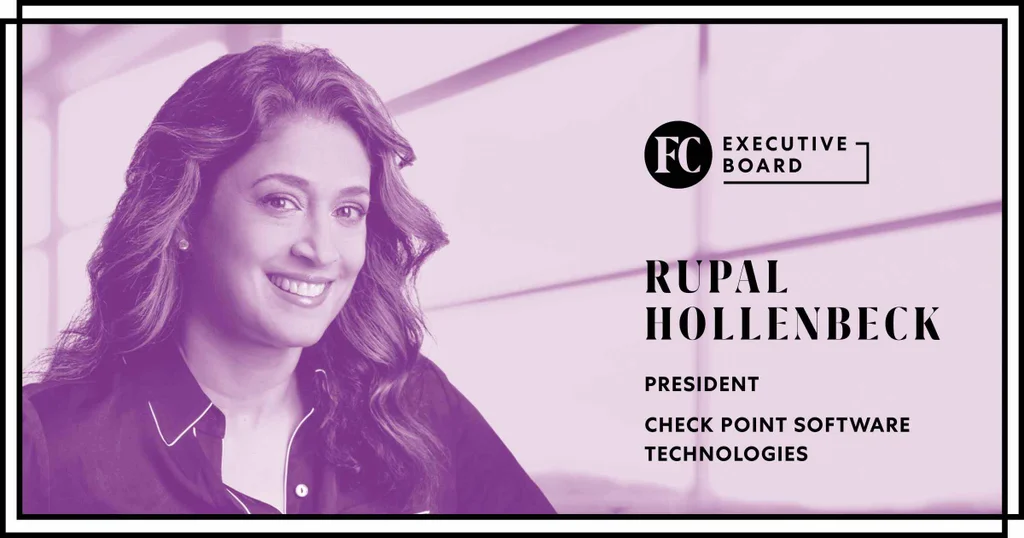

When Check Point was founded in 1993, it gave the market technology it desperately needed: a firewall.
The company’s president, Rupal Hollenbeck, explains that the product, FireWall-1, “birthed the cybersecurity industry.” But three decades later, Check Point has transformed itself—once a product company, it is now a platform company.
“We went from having a line of firewall products to providing security across the entire threat landscape,” Hollenbeck says. “Our mission today is to boost organizations’ cyber resilience and keep their people, processes, and technologies safe from cybercrime.”
ADDITIVE INNOVATION: THE START OF CHECK POINT’S TRANSFORMATION
When people in the corporate world think about innovation, they typically picture internal innovation or intrapreneurship—in other words, teams that develop new products and services in-house.
But Hollenbeck notes that “additive innovations” (mergers and acquisitions) commonly spur transformations for companies. They give companies a launching pad to reinvent what they do, how they operate, and who they serve.
“Additive innovations fueled our transformation journey as a company,” Hollenbeck says. “We made strategic acquisitions, such as Dome9 in 2018, that led to internal innovation, resulting in the establishment of new product lines. But having a strong reputation in cybersecurity from the very beginning got us to where we are today.”
THE IMPORTANCE OF COMPARTMENTALIZING TRANSFORMATION
Today, says Hollenbeck, Check Point has four robust product lines and a portfolio of cybersecurity offerings. But she emphasizes that the company did not get to where it is now overnight.
Hollenbeck recommends that leaders compartmentalize corporate transformation initiatives by nurturing startup-like innovation throughout departments. At Check Point, she says, these initiatives are called “rockets.”
“Rocket teams have the leeway to bring ideas to the table, implement them, and iterate accordingly,” Hollenbeck says. “We use rockets as trial grounds of sorts—when we see ideas and processes that work, we apply them at scale throughout the broader organization. In effect, this system creates miniature innovation pods that ultimately enable the entire company to start thinking about its story differently. In other words, what new identity does the company want?”
A company’s identity, Hollenbeck stresses, is a key factor leaders should consider during transformation initiatives.
“Leaders shouldn’t simply direct top-down product changes or make acquisitions without encouraging their team members to think about telling the company’s story differently,” Hollenbeck says. “If the Check Point team hadn’t thought about how to tell our story differently, we’d still be primarily known for FireWall-1.”
Moreover, she notes that too often, leaders get caught up in trying to develop the next big product that will become a mainstay in the market. But she stresses that small disruptors can spark some of the most significant shifts for companies, especially in the technology sector. Compartmentalized focus gives small disruptors room to grow.
“As they mature and grow, established companies like Check Point run the risk of slowing down their pace of innovation,” she says. “But to survive, companies must move past rigid processes and ways of thinking and nurture innovation at every level.”
Then there’s the importance of maintaining momentum. Hollenbeck says that when overseeing corporate transformations, leaders can become laser-focused on their end goals. But in doing so, they risk losing momentum.
“You have to celebrate small wins along the way; you have to distribute transformation efforts to encourage progress in each segment and to keep people motivated,” Hollenbeck says. “If you don’t acknowledge the milestones along the way, you and your team can become discouraged during the process.”
WHAT’S ON THE HORIZON FOR CHECK POINT
To that end, Check Point has celebrated many milestones lately. In 2023, Check Point completed two important acquisitions to accelerate its Quantum SASE solution. It acquired Atmosec, a startup specializing in application security, as well as Perimeter 81, a security service edge (SSE) provider. The acquisition of Perimeter 81, Hollenbeck notes, is Check Point’s biggest acquisition to date. Check Point combined its existing technology with Perimeter 81’s and Atmosec’s to build a powerful secure access service edge (SASE) solution to leapfrog competitors who were already established in the market.
“Our acquisition of Perimeter 81 enables us to differentiate in SASE, one of the most important emerging cybersecurity segments for modern businesses everywhere,” she says. “SASE is important to the future of secure network architecture, and it’s important for us to have a foothold in the future so we can fill customer needs seamlessly as they evolve.”
As the threat landscape evolves, Hollenbeck says, Check Point needs to evolve, too.
“Bad actors aren’t slowing down in the cyber world,” Hollenbeck says. “So we’re not slowing down either. As we acquire companies, we also increase our internal investment in research and development. We consistently release new offerings that differentiate us in the marketplace and help our clients safeguard themselves.”
In a rapidly changing industry like cybersecurity, says Hollenbeck, being in constant learning mode is the key to success.
“We don’t have all the answers,” she explains. “But with over 30 years at the cutting edge of innovation in cybersecurity, our unique balance of organic innovation and smart acquisitions has enabled us to serve our customers through every era of network threat while simultaneously retaining our position as a perennial market leader in any segment we enter. We focus on being the best cybersecurity partner we can be to our customers—and that means we evolve as they evolve. At the end of the day, if they’re safe, we’re successful.”