
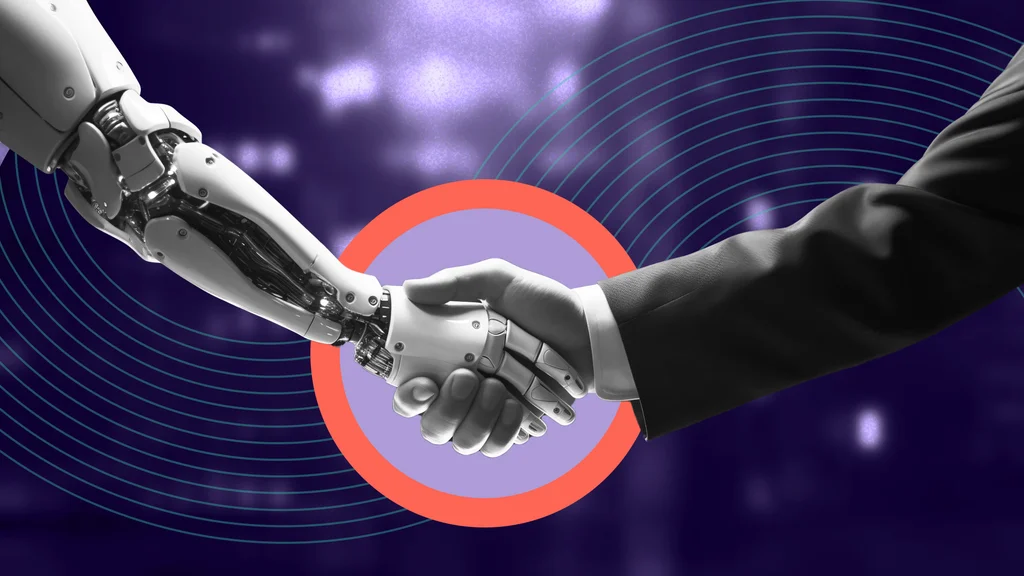

When you start automating enterprise business processes as much as possible, humans often perceive it as a potential threat. This perception is not entirely ill-founded—machines are good at automating repetitive and manual tasks that are traditionally performed by humans.
But despite all the talk of generative AI and AI-making machines sentient, artificial general intelligence is still far from replacing humans. In a survey of AI experts, more than half of respondents thought there is about a 50% chance that human-level AI will be developed before some point in the 2060s.
As automation has taken root in enterprises, there have been attempts to ensure humans are in the loop during automation, so that the technology does not go astray. Terms like “human-attended automation” and” human-in-the-loop automation” come to mind. While human-attended automation has involved humans as an obligatory part of the automation cycle to provide necessary information or action, it does lead to slowing down the automation process. Also, the machines and humans don’t learn from each other and continue to be mere cogs in the automation cycle.
The human-in-the-loop model (HITL) is a term also used in AI to ensure that humans can provide feedback to guide the models in cases where the machine learning model is behaving below set thresholds. In this case, the machine learning models learn from humans and improve their performance.
WHAT IS HYPERAUTOMATION?
Per Gartner, the hyperautomation (also called intelligent process automation by IDC and digital process automation by Forrester) market will reach almost $860 billion by 2025.
Hyperautomation is an umbrella term that brings together document ingestion, RPA, AI-powered intelligence, process mining, business process management, and iPaaS. According to a McKinsey study, businesses that have adopted hyperautomation tools were able to:
- Achieve automation of approximately 50% to 70% of tasks
- Scale down processing times from 50% to 60%
- Reduce annual labor expenditure by 20% to 30%
- Realize triple-digit ROI
HUMAN-CENTERED AI
A human-centered AI approach is meant to amplify, augment, and enhance human capabilities and provide them “superpowers.” In his 2008 article, “On Human-Machine Symbiosis,” Mike Cooley mentions that in a human-centered system, humans and machines will have a symbiotic relationship where humans handle the subjective qualitative decisions while machines handle the quantitative decisions.
With all the recent developments in AI and generative AI, however, the boundaries of these tasks are getting blurred and will continue to do so in the future, where machines may be expected to at least assist in, if not perform, some of the subjective qualitative decision making in addition to quantitative decisions.
It may be worthwhile to use additional criteria for human-centered AI, primarily to address the concerns about AI not meeting human standards in the short term or going rogue in the future. Humans should be able to supervise such operations. They should be able to assume control as and when needed, especially in case anomalies show up or if AI goes out of control in a well-designed human-centered offering.
HUMAN-CENTERED HYPERAUTOMATION
In a human-centered hyperautomation approach, it is essential to bring together concepts of human-centered AI and hyperautomation together. In such an approach, it’s important to have humans be able to delegate quantitative tasks to begin with while keeping complex qualitative tasks for themselves. While doing so, humans should be in a supervisory role and assume control if needed. Human-centered hyperautomation is also critical for its success. Creating a positive human experience also leads to easier adoption of such AI-powered automation initiatives.
Seasoned executive with roles at LexisNexis, HP, Dell, VMware & scaled startups to successful exits. Chief Product Officer at Kanverse.ai