
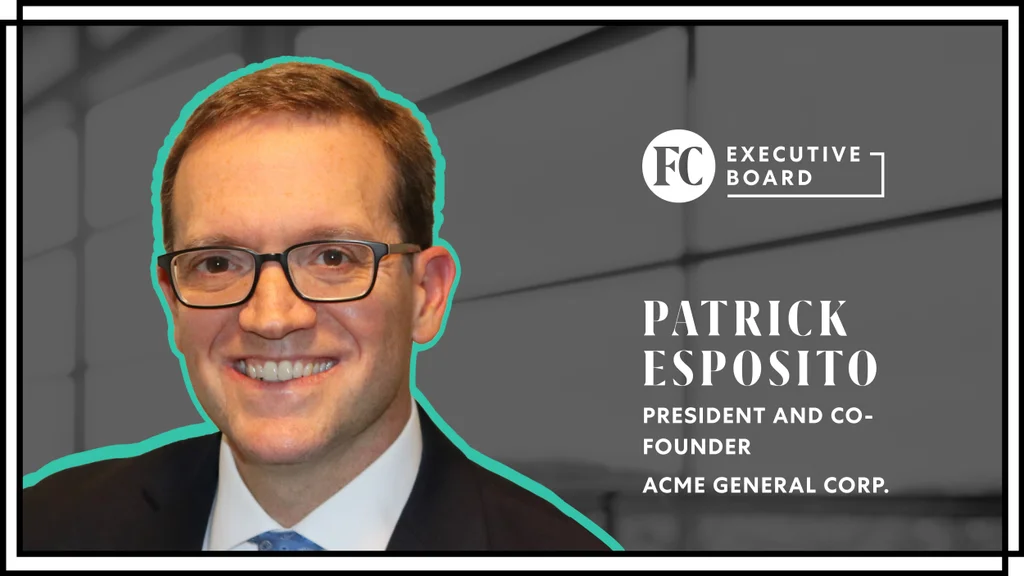

Before Patrick Esposito co-founded ACME General Corp.—a company that helps bridge the gap between government organizations trying to solve problems and technology companies building innovative solutions—he was a serial entrepreneur himself, navigating the same challenges his current clients face.
Esposito co-founded two startups: Augusta Systems, an early Internet of Things middleware company, and Resilient Technologies, a non-pneumatic tire company. Both companies went on to do work with government agencies and were ultimately acquired by large multinational enterprises. One of the main reasons Esposito started ACME was to share his hard-won knowledge with other tech company leaders pursuing similar paths.
“With both companies, there were definitely some valuable lessons learned, largely by experience, not by reading insights to understand the shortcut path,” said Esposito. “We try to apply them to help government customers source and mature cutting-edge technologies from startups into solution architectures with prime contractors that they can then witness being delivered to the field quickly. And we try to help small technology companies find the right pathways to find government research and development funds to help mature and validate technologies, as well as find the right channel partnerships and, if sought, acquisition pathways.”
Esposito shared four important takeaways for leaders who are exploring opportunities with government agencies, particularly in the defense sector.
1. LOOK TO THE GOVERNMENT FOR R&D, NOT SALES
Startups may have success acquiring government funding for R&D and validation of new technologies, but direct sales to government agencies are far more challenging. Focus on forging partnerships with prime contractors and large subcontractors that are more likely to integrate innovative solutions into their offerings for government clients.
“Early on with the first two companies, I was initially looking for government customers to purchase the technologies directly,” said Esposito. “And while for some types of products, that certainly is a pathway, I discovered that direct government engagement was terrific for additional R&D for funding technology enhancements, but for actual use—product sales, software licenses, and a pathway to do the work at scale—you had to go through prime contractors or first- or second-tier subcontractors who had a requirement for something like your product to end up in their solution.”
2. EXPLORE OPPORTUNITIES FOR CHANNEL PARTNERSHIPS
When bidding on government contracts, prime contractors often seek to highlight innovative technologies that will help their proposals stand out from those of their competitors. Look for collaboration opportunities that are mutually beneficial.
“It is rare that the government issues RFPs for components,” said Esposito. “When you’re selling your product, you have to think about what it looks like in a solution architecture and try to develop long-lasting channel partnerships. Figure out how to connect your technologies to solutions that the government wants to purchase. There are often large initiatives where a prime contractor is collecting a team to bid on a contract, and a technology differentiation can be a really important factor. Sometimes if you take an off-the-shelf technology and modify it, you get to a solution more quickly.”
3. UNDERSTAND AND PREPARE FOR LONG SALES CYCLES
Sales cycles in government, and especially in the defense sector, are notoriously lengthy. Be patient and plan strategically to overcome complex procurement processes.
“Prime contractors and large subcontractors are accustomed to long sales cycles,” said Esposito. “Most government acquisition opportunities are going to take much more time than commercial opportunities. If a commercial company wants to access your technologies, they can generally make a purchase without going through a formal RFP and contracting process that can take months and months—or even longer. So if you’re looking at working with the government because you believe in the purpose or because it looks like a great market, you just have to be prepared that it will take some time. But also, once you get that sales cycle going, it can be a great way to sustain the organization.”
4. PACKAGE OFFERINGS FOR COMPLIANCE
Government agencies can purchase technologies in a variety of ways. Sometimes they are just interested in purchasing the product; other times, they want to add services as well. Think about how you’re going to package and sell your offerings. What are the rules and regulations for each product or service? How can you remain in compliance?
“I encourage a lot of small technology companies to bundle their services with their product,” said Esposito. “There are three main types of government contracts: cost-based, time-and-materials, and firm-fixed-price. Services with cost-based and time-and-materials contracts often require additional financial compliance, which can put a significant overhead burden on your business and distract you from making and selling products. Do as much of the services work as possible on a firm-fixed-price basis. It’s a win for the government, a win for the small technology company, and a win for the subcontractors and prime contractors in between because there’s more assurance on price.”
Ultimately, the key to finding success in government contracts is designing the optimal framework to solve the agency’s problem.
“If you’re doing something new and innovative, you can either build the whole thing from scratch, or you can try to find people who provide components of it and create the fabric to connect them all,” said Esposito. “We’ve had tremendous opportunity to identify these commercial components that can go into prime contractor solution frameworks, and they’re faster to deploy because they already exist. They may need to be modified, hardened, and tested, but they give a strategic advantage, from the identification of a potential fit for a need to the actual use in the field.”