

The majority of talk around AI in the workforce has been focused on its impact on white-collar jobs. Predictions include Forrester’s prediction of 2.4 million U.S. jobs being replaced by AI by 2030, and other more frightening predictions of automation in the white-collar world. But what about those who make this world go? What about those who build the buildings, run the fiber, and lay the wire for the world where white-collar workers perform all their work?
The blue-collar world is also experiencing an AI revolution. With only 1% of blue-collar jobs at risk of being replaced by AI, the future of blue-collar work is bright, even with help from AI. Let’s take a look at how AI is transforming a few of these industries:
THE CONSTRUCTION INDUSTRY
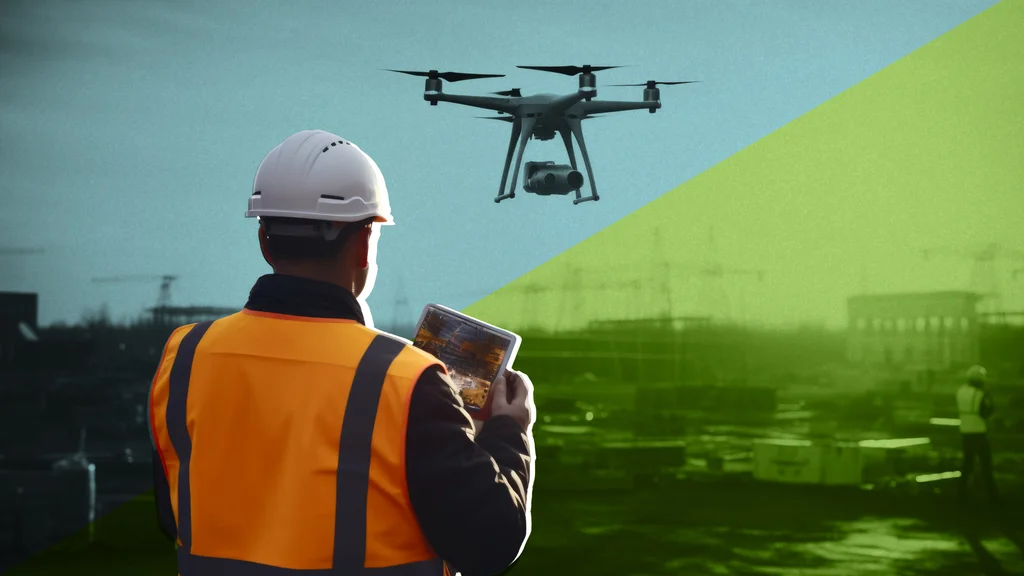
AI’s projected growth in the construction industry from $2.57 billion in 2022 to $15.16 billion in 2032 heralds a new era of enhanced safety and efficiency. By automating routine tasks, AI is empowering human workers to focus on specialized work, blending technology with human expertise for optimal results.
Despite these advancements, AI is not poised to replace human workers completely. Instead, it is reshaping business models, curtailing errors and injuries, and streamlining operations. Human workers will focus on intricate tasks like plumbing, HVAC, and electrical systems, while AI handles repetitive or hazardous tasks. This symbiotic relationship between AI and humans promises to revolutionize construction practices, driving innovation and efficiency while preserving the irreplaceable skills of human workers.
THE TRANSPORTATION INDUSTRY
In transportation, AI’s advancements promise to drastically reduce road fatalities and optimize logistics. The implementation of AI is poised to reduce or eliminate the 43,000 fatalities that occur on American roads every year. Self-driving technology and AI-enhanced safety systems, such as driver assistance and predictive maintenance, are at the forefront, improving safety and efficiency for drivers and traffic management alike.
The buzz around self-driving vehicles has dominated headlines for years, but widespread deployment remains a distant dream in densely populated areas. However, don’t write off AI’s potential to revolutionize the safety and efficiency of delivery and truck drivers.
With AI in the driver’s seat, safety takes center stage. Driver assistance systems are on high alert, ready to swoop in with real-time alerts and interventions at the first sign of trouble. Predictive maintenance plays fortune teller, foreseeing mechanical issues before they wreak havoc on the road, slashing breakdowns and accidents. Route optimization is the GPS guru, navigating the most efficient paths through traffic and weather woes, minimizing fatigue and accident risks.
Fatigue monitoring acts as the guardian angel, detecting signs of exhaustion and steering drivers toward much-needed breaks. Cargo monitoring stands guard, ensuring goods reach their destination unscathed by monitoring temperature and security. And when it comes to mastering the road, AI-driven training and simulation provide the ultimate practice ground, equipping drivers with the skills to handle any situation that comes their way. With AI at the wheel, the road ahead is paved with safety, efficiency, and unstoppable innovation.
THE HOME SERVICES INDUSTRY: PLUMBERS AND ELECTRICIANS
AI is revolutionizing home services, offering advanced diagnostic tools and AR for real-time repair guidance. These technologies improve efficiency and accuracy, ensuring plumbers and electricians can provide top-notch service with the aid of AI.
While automation may handle routine tasks, ongoing technician training is essential to keep pace with evolving technologies. The objective isn’t to supplant these skilled professionals but to elevate their efficiency and service standards. With AI’s integration, professionals in these fields are poised for enhanced performance and service quality.
THE BEAUTY INDUSTRY
AI is transforming the beauty industry by personalizing customer interactions and streamlining operations, from virtual try-ons to smart inventory management. This enhances both customer satisfaction and salon efficiency.
But the beauty magic doesn’t end there. AI is transforming makeup selection by analyzing skin tones, facial features, and preferences, offering personalized recommendations and virtual try-ons in real time. With the rise of conversational AI and generative AI, the beauty industry is radically transforming, ushering in an era of unparalleled customer experiences. Brace yourself for a beauty revolution fueled by AI innovation, where collaboration between stylists and clients is seamless, and satisfaction is non-negotiable.
CHALLENGES AND CONSIDERATIONS
Implementing AI in blue-collar industries isn’t simple—it’s a minefield of challenges and tough decisions. From overhauling workflows to convincing skeptical workers, integrating AI tech demands guts, grit, and a hefty dose of investment.
And let’s not forget the elephant in the room: the looming specter of job displacement. While AI promises efficiency, it also threatens to shake up the job market, leaving workers in the lurch. Companies need to navigate this ethical minefield with finesse, balancing the benefits of automation with the need to support and retrain their workforce. It’s not just about boosting the bottom line—it’s about ensuring a fair and sustainable future for all.
Industry leaders must act decisively to confront the urgent challenges posed by AI integration in blue-collar industries. They must swiftly invest in comprehensive training to upskill the workforce and ensure employees can effectively collaborate with AI technologies. Prioritizing ethical considerations is paramount, with clear guidelines needed to address concerns around bias, privacy, and fairness.
Collaboration among stakeholders is also essential for building consensus and ensuring AI implementation aligns with shared values. Additionally, leaders must foster a culture of innovation and adaptability to seize opportunities and navigate the evolving landscape of AI-driven industry disruption.
FINAL THOUGHTS
AI is revolutionizing blue-collar industries, turbocharging efficiency, safety, and productivity. With cutting-edge automation and smart tech, AI is slashing errors, fine-tuning resource use, and supercharging processes. From the gritty trenches of manufacturing to the towering heights of construction, AI-driven solutions are fine-tuning quality control, predicting maintenance needs, and mastering inventory management.
AI’s vigilant eye is keeping the workplace safe, spotting dangers in real time, and forecasting hazards before they strike. By giving workers new skills and superpowers, AI is igniting a fire of innovation, fueling job satisfaction, and sparking economic growth in blue-collar realms. It’s not just evolution—it’s a revolution, paving the path to a grittier, fiercer, and more competitive future.
Mark Minevich is the President of Going Global Ventures, Chairman of AI For Good Foundation, Co-Chair AI for Planet, and a UN Advisor.