

For the past decade, speculations about the future of physical product development have promised huge advancements in everything from wearable tech to smart robots. Fast forward to today and many of those predictions have become a reality, along with at least one unexpected surprise.
Our company, Design 1st, worked on more than a hundred projects in 2024, putting us on the front lines of product development. Below are 10 trends we’re excited about in the year ahead. They are driving real change and creating opportunities for businesses and entrepreneurs to stay competitive.
1. AI-POWERED HARDWARE
We all know that artificial intelligence (AI) has upended the digital world in recent years. Now, AI is moving beyond software and becoming an integral part of physical products.
We’ve seen an autonomous robot developed for industrial cleaning in human-hazardous environments, and a portable protein analysis device that produces results for field researchers in minutes. With examples like these, AI-powered hardware is reducing health risks, increasing efficiency, and putting automation where it is most useful.
2. COBOTS, ACTIVATE
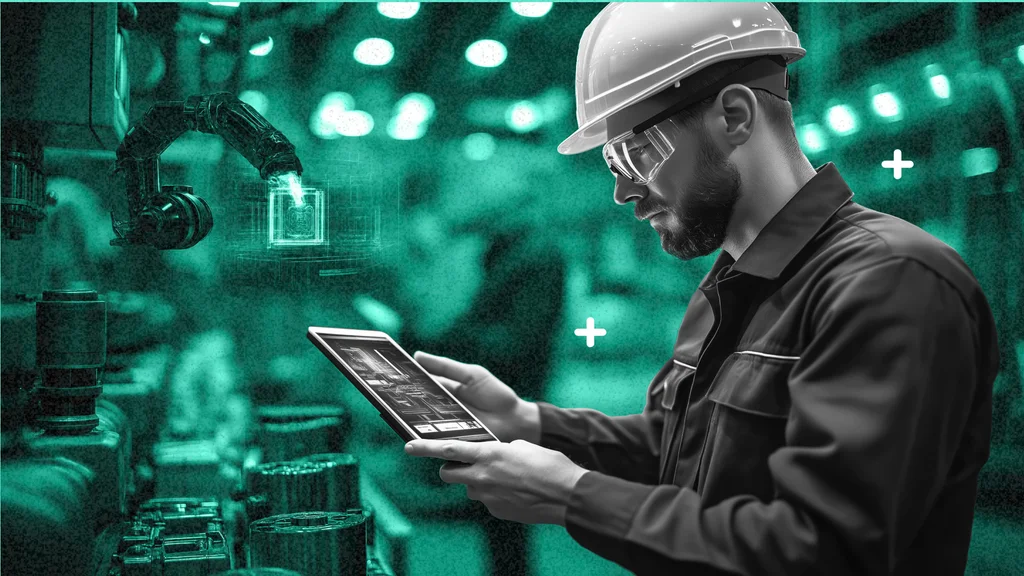
Along the same lines is the trend of robots designed to work alongside humans. Collaborative robotics—or cobots—are improving safety and efficiency in underground mining, cleaning pharmaceutical tanks, and even painting lines on sports fields.
Cobots mitigate the need for specialized, sometimes dangerous, time-consuming work by humans. By tackling complex tasks that were recently impossible for either humans or machines alone, cobots enable solutions that combine human judgment with robotic precision and consistency.
3. LIVING ON THE EDGE
Much of this AI-powered hardware is driven by edge computing. In cases like an intelligent concussion recovery device, or an AI-powered hearing assistant that interprets sounds for the user, edge computing enables AI-powered devices to process data in real time and perform smarter, more autonomous tasks. In reducing reliance on cloud connectivity, edge innovations help solve the problem of frustrated users waiting on their devices to perform tasks.
By processing data locally, edge solutions improve privacy, reliability, and responsiveness—critical advantages in environments where performance, decision speed, and security are paramount.
4. SMARTER HOMES
Remember package thefts? They’re so 2020 thanks to secure package delivery boxes. That’s just one example of how smart home standardization is addressing real-world needs with innovative connected solutions.
This standardization is made possible via the Matter connectivity protocol, which is an open standard for smart home technology. It transformed smart home ecosystems by enabling seamless device connections. No more frustration of multiple setups and disconnected interfaces for users. Smart home systems drive consumer satisfaction and expand market adoption, from child-monitoring devices to intelligent mattresses.
5. CONNECTING DOCTORS, PATIENTS, AND ENTREPRENEURS
Consider an at-home sleep apnea test that sends results directly to your doctor. A connected digital stethoscope. A minimally invasive eye pressure drainage instrument. To create connected medical devices like these, doctors are working directly with entrepreneurs to address specific clinical problems.
By combining health care expertise with product development, these partnerships will continue driving progress in personalized care and diagnostic innovation in 2025.
6. SOLVING “AGE-OLD” PROBLEMS
A related trend concerns products targeted to aging. Exciting products include smart braille keyboards for the visually impaired and ergonomic walkers with electric brakes. Accessibility tech is prioritizing dignity and usability while offering solutions to “age-old” problems.
Innovators in inclusive design are addressing the needs of aging populations and individuals with mobility challenges, creating new opportunities to bring underserved markets meaningful and practical advancements.
7. BETTER BATTERIES
Much of the innovation in physical products is made possible by better batteries. Advances in high-density battery technology, including solid-state systems, are enabling smaller, lighter devices with significantly longer runtimes. This unlocks new possibilities to put the power of an advanced medical or aerospace laboratory into a portable, wearable device—for a fraction of the price.
8. LEGACY UPGRADES
A physical device is now just one component of the expected user experience. This requires longstanding products to be upgraded to connected products.
Physical product companies want new connectivity features, upgraded components, and cost-saving manufacturing methods, whether it is modernizing an electric wood router or redesigning industrial pump equipment. Redesigns help legacy products stay competitive by adapting to market demands and delivering fresh value to evolving consumer requirements in a connected world.
9. IT’S EASY BEING GREEN
Sustainability is also now a baseline expectation, driving companies to adopt suitable eco-friendly processes and materials, along with renewable energy solutions like solar-powered devices, hydroponic technologies, and recycled packaging. Prioritizing sustainability helps businesses adapt to evolving government regulations, take advantage of new incentives, and connect with environmentally conscious customers on an emotional level.
10. THE GREAT RESHORING
A final trend nobody a decade ago saw was the return of North American manufacturing. But product companies are bringing their manufacturing operations home due to the hard lessons of troublesome COVID supply chains, bottlenecks on global canals, and concerns over potential tariffs on U.S. imports. Call it the “Great Reshoring.”
This new generation of industrialization looks different than the past. By adopting advanced digital factory technologies—such as automated production systems and real-time monitoring—businesses are improving efficiency, cutting lead times, and meeting the growing demands of local markets with faster delivery times.
CONCLUSION
In 2025, innovators will redefine how products are developed and delivered. Faster timelines, smarter technology, localization of manufacturing, and tighter cost controls will be the new standard.
Companies that adapt—by nearshoring manufacturing, redesigning legacy products into devices for users in a networked world, and leveraging advanced technologies like AI and edge computing—can gain a decisive edge.
Staying competitive means embracing change, rethinking possibilities, and acting with purpose. The future is here, and the time to innovate is now. Design 1st is excited to be part of bringing innovation to the market in 2025.