


In my previous article, I explored various tools and technologies that increase productivity while enabling more patient-focused care. I introduced a productivity quadrant chart to highlight where the greatest gains and improvements were occurring.
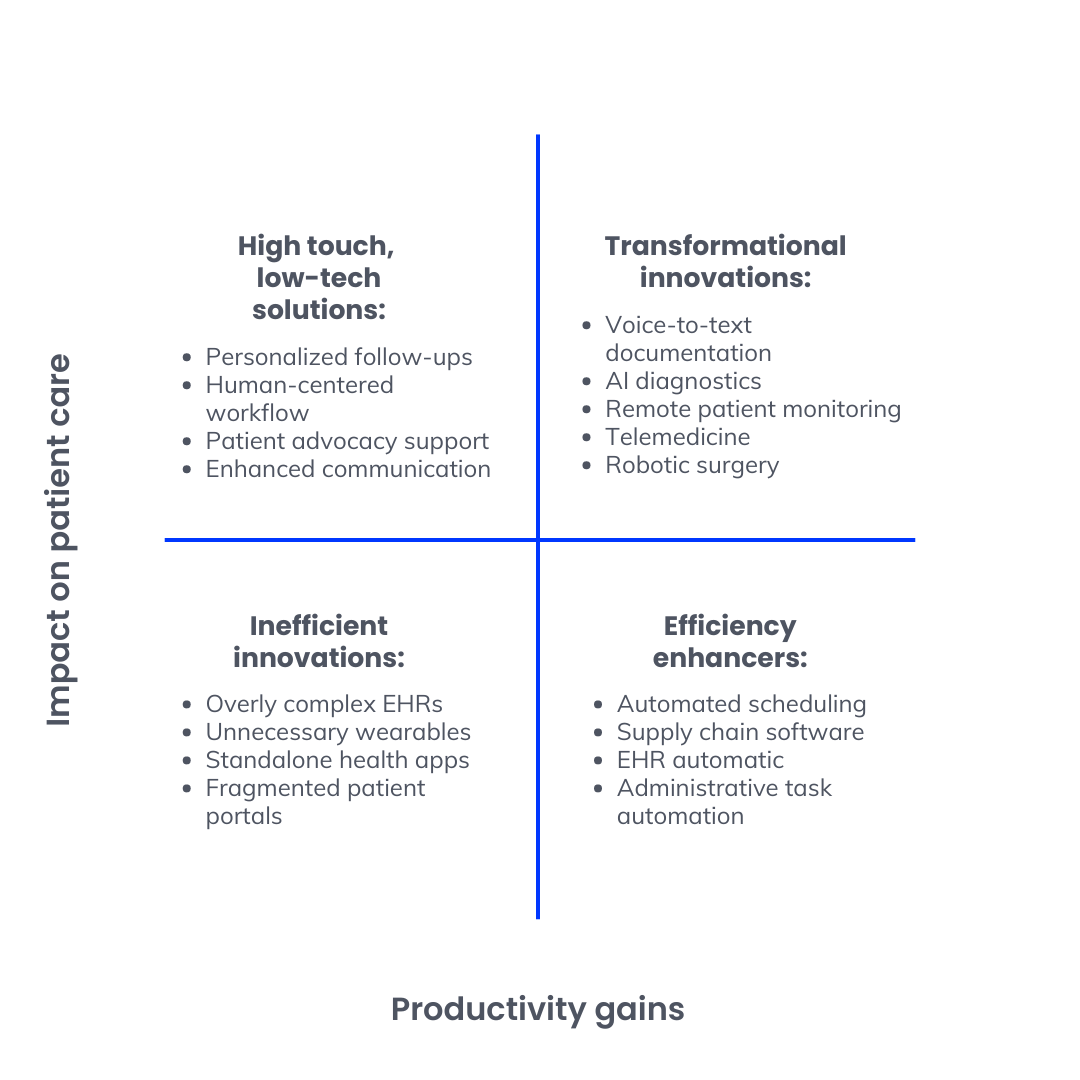
Now, I’d like to share fresh insights on the three key drivers behind these advances: leadership, predictive analytics, and personalized medicine.
Below, you’ll find why each of these areas is critical for the future of healthcare, along with practical advice for leaders who aim to drive meaningful change. I’ll share a few examples I’ve found to help you along the way.
1. COURAGEOUS TECHNICAL LEADERSHIP
Why It Matters
Effective leadership in healthcare is crucial for aligning technology with organizational goals and ensuring that innovations translate into better patient experiences. And it will need to be technical leaders. These leaders who can establish a clear vision and foster a supportive culture can create an environment where new tools and approaches are embraced rather than resisted.
But it will take more than just a clear vision. It is going to take courage to be able to say “no” to many really good ideas in order to say “yes” to the excellent ones.
How Will This Drive Productivity And Excellence In Patient Care?
- Alignment: Strong technical leaders set strategic priorities and communicate them clearly, guiding teams toward initiatives that streamline operations and enhance patient well-being.
- Innovation Culture: By encouraging experimentation and learning, leadership teams can swiftly adapt to evolving technologies, ultimately improving clinical outcomes. This means that some of the ideas will not work the first time, and this is often a barrier to entry in health care.
- Resource Management: Great leaders allocate resources wisely and ensure that time-saving tools (e.g., software-reducing administrative burdens) are implemented effectively and measured for success.
Practical Advice
- Start With A Pilot: A large health system in Michigan decided to roll out a new tool for improving AI written documentation, which would in turn save clinicians time and improve quality with patients. Upon adopting such a product, clinicians became able to spend time with patients while allowing the technology to write the notes.
- Prioritize Clinician Well-Being: Support clinicians and staff with training and manageable workloads, so they can devote more time and energy to patient interactions. In the case of the Michigan health system mentioned above, the new technology meant clinicians didn’t need to spend time at home catching up on notes when they could be spending that time with their families.
2. PREDICTIVE ANALYTICS
Why It Matters
Predictive analytics uses historical and real-time data to identify patterns, anticipate patient needs, and inform clinical decisions. This data-driven approach can be a game-changer for preventive care, resource allocation, and operational efficiency.
There is a tendency for health systems to just use off-the-shelf solutions, but those often lead to less than desired long-term outcomes. You really want to build up a functional team of experts to understand the data and help make project decisions to drive the most value for the system.
How Will This Drive Productivity And Excellence In Patient Care?
- Preventive Interventions: By analyzing risk factors, healthcare providers can proactively address potential health issues before they escalate. This approach often reduces treatment costs and improves patient outcomes.
- Optimized Workflows: Predictive models help organizations forecast patient volumes and staffing needs, minimizing wait times and alleviating clinician burnout. This data will allow you to know how many nurse team members to staff before a shift—knowledge that can reduce team burnout.
Practical Advice
- Don’t Just Go Off The Shelf: Prioritize solutions that integrate seamlessly with your electronic health record (EHR) systems, but might be outside of the typical off-the-shelf ecosystem.
- Upskill Your Team: Listen and train your teams in data literacy and analysis to ensure they can interpret and act on insights from predictive models. Keep in mind: This is often a process that takes 3-5 months to achieve user adoption.
- Iterate And Refine: Continuously refine analytics approaches, incorporating feedback from clinicians and patients to improve accuracy over time.
3. PERSONALIZED MEDICINE
Why It Matters
Personalized medicine tailors treatments to an individual’s genetic profile, medical history, and lifestyle factors. By focusing on precision care, healthcare providers can offer interventions that are often more effective and have fewer side effects than one-size-fits-all approaches.
How Will This Drive Productivity And Excellence In Patient Care?
- Targeted Treatments: Genetic testing can reveal drug sensitivities or predispositions, helping clinicians choose the most effective therapies right away. It is still early for this, but the long-term idea is to have tailored patient plans based on lifestyle, medical history, and other data points that can boost treatment success rates.
- Reduced Trial-And-Error: Personalized medicine can shorten the diagnostic and treatment pathway, lowering costs and minimizing adverse reactions.
- Improved Outcomes: In oncology, for example, personalized approaches have improved survival rates by up to 30% and reduced adverse drug reactions by up to 60%, according to the National Cancer Institute.
Practical Advice
- Stay Current: Keep abreast of emerging research in genomics and related fields to identify relevant opportunities for your organization. For example, I’ll be attending the Rise conference this year in Nashville.
- Focus On Patient Engagement: Listen first, then communicate clearly about the benefits and limitations of personalized treatments, ensuring patients are active partners in their care.
CONCLUSION
Innovation in healthcare is about more than just adopting the latest tools; it’s about the vision and leadership driving them. By prioritizing predictive analytics and personalized medicine, healthcare organizations can significantly boost productivity and deliver patient-centric care. Industry projections echo this momentum: The U.S. healthcare AI market alone is projected to grow from $19.27 billion in 2023 to $26.7 billion by 2030.
Disclaimer: I am not a healthcare expert; I continuously seek insights from industry leaders to deepen my understanding of healthcare technology trends. For any medical questions or concerns, please consult a qualified physician.