

It’s a topic of endless debate for business leaders and analysts: What is the most important element that determines a company’s success or failure?
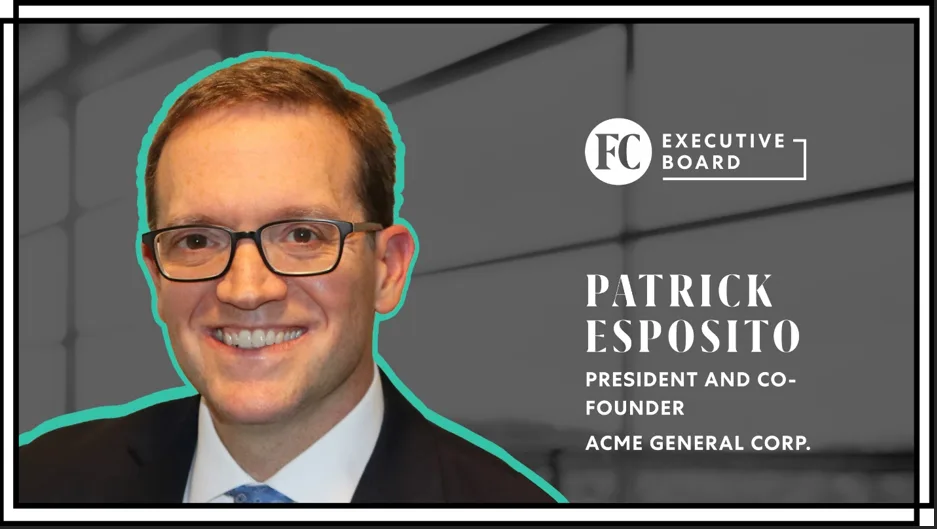
Patrick Esposito, president and co-founder of ACME General Corp.—a company that bridges the gap between public sector organizations and innovators building problem-solving technologies—even wrote a book about it. He combined survey research with his experience advising over 100 entrepreneurial business leaders to outline eight critical factors that influence the success of small to medium-sized businesses.
Through his conversations with other leaders, however, Esposito realized that people were looking for even simpler guidance. While one approach would be to narrow the focus to the traditional “three P’s” of organizational management—people, process, and product—he zoomed in on what he determined to be the most pivotal lesson of all. At the end of the day, it all comes down to people.
“Everybody always wants to know: Do I have to worry about eight things, or can I just worry about one thing?” says Esposito. “People are setting up processes. People are creating products. People are central to each of the eight factors I talk about, from growth and infrastructure development to business disputes and breakups.”
BUILDING TODAY’S AND TOMORROW’S TEAMS
Developing talent is an ongoing investment in your organization. It’s not enough to hire and train talented individuals. You also need to make sure that those people can actually play well as a team. Look at both talent and capability to build a cohesive, complementary team that can grow together over time.
“We’ve all seen scenarios where the sum of the parts isn’t greater than the whole,” says Esposito. “Unfortunately, a lot of organizational leaders make the mistake of thinking they can just pick a group of talented folks and everything will work out. That’s only true if those talented folks understand when they should be driving and when they should be supporting. You can’t have only Type A, hard chargers on your team. You also need people who are great at being the connectors and supporters, who can help the Type A people come up with better concepts together.”
EMBRACING SUCCESSION PLANNING AS AN INEVITABILITY
When you work with smart, talented people, you have to accept that a number of them may end up accepting new opportunities outside of your organization. Design your team to be dynamic and resilient. Focus on constantly building and rebuilding your team—as you grow employees’ capabilities and as people come and go.
“When I’ve looked at the top reasons why businesses fail, many times it’s because of weak management teams, disputes among partners, or failures to pivot,” says Esposito. “And those are really people problems—situations where people did not work well together or did not understand how to collaborate to make a change in a business. I tell people that the best thing they can do for their business, from a practical standpoint, is take a hard look at their management and governance team structures. You’re going to see gaps that emerge either because people leave or because the universe changes. How can you balance the different parts of your organization to make sure that your team functions well as a whole? How can you work with a formal board or advisors to support strong governance?”
CREATING HUMAN-CENTRIC PROCESSES
Revisit team management and governance structures regularly. If you run a smaller organization, you’ll likely have an easier time keeping tabs on both day-to-day and long-term operations. If you lead a larger organization, you’ll probably need to create more formal processes to evaluate succession planning and governance. Depending on your structure, schedule quarterly, semi-annual, or annual check-ins to gather data and make adjustments.
“Examine not just what your talent pool looks like today but also how you are compensating that talent,” says Esposito. “Do you have clear processes for developing your people? How can you document those models to grow the next generation of management talent from your operational talent? Put humans at the center of processes for assessing, planning, and implementing team decisions. Remember that humans have inherent emotional responses, perspectives, and beliefs that need to be factored in. When you’re talking about people and their livelihoods and career trajectories, and how you help them grow their talents and your business, you want to be more thoughtful and circumspect than you would be with just a process or product.”
IDENTIFYING STANDOUT MANAGEMENT QUALITIES
The best managers aren’t always the superstars in operational roles. Define the qualities that enable people to thrive as managers on your team, and look for the individuals who exhibit them. Seek out managers who aren’t afraid to have tough conversations or raise questions and concerns.
Before you promote an employee to a managerial role, give them the opportunity to test their abilities on a smaller scale. Let them lead a working group or existing team as the project manager or team lead. If they do thrive in the role, make additional investments into their development so they can manage at an organizational level, not just a project level.
“In response to the question, ‘Why are we doing it this way?’ too many leaders respond, ‘Because we’ve always done it that way,’” says Esposito. “When you start to see a people problem emerging on your team, don’t let it go. Don’t shy away from frank, difficult conversations. Address any issues head-on as early as you can to benefit the team and the business.”