
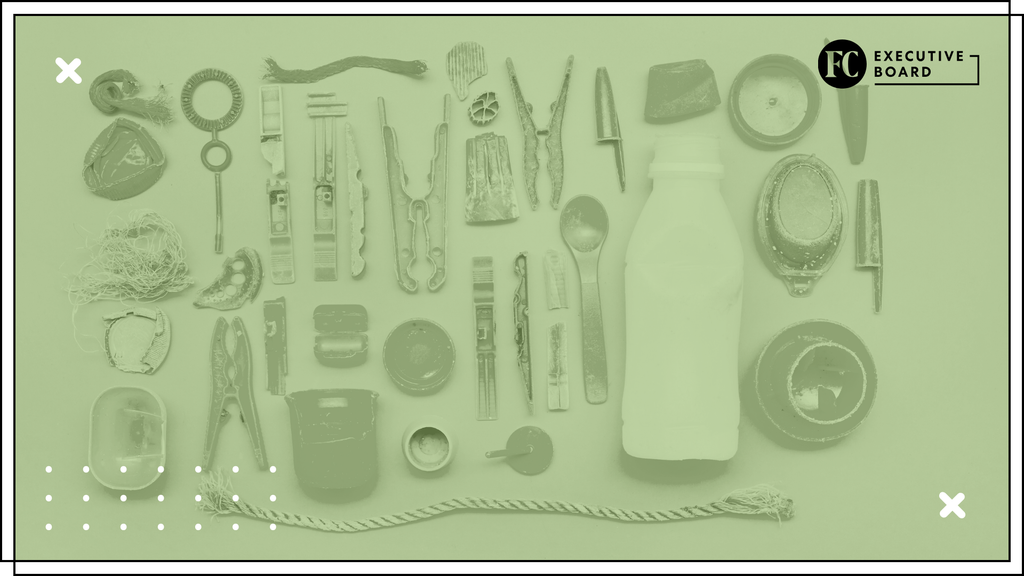

It’s hard to believe how far plastic travels, because most of its journey is hidden from view. It isn’t just littering beaches and filling oceans. It breaks down into fragments so small that they drift through the air, ride ocean currents, and circulate through our own bodies. Scientists have even detected microplastics embedded in human brain tissue and even inside placental cells, the most protective barrier of new life.
Each particle tells a story about progress without foresight. Plastic, once celebrated for its convenience and strength, has become a lasting symbol of pollution. What began as an industrial triumph now sits inside us, woven into our environment and our biology.
The same systems that accelerated plastic’s rise, such as industrial automation, machine learning, and global logistics networks, are now being enlisted to repair the damage. Artificial intelligence, which helped perfect the mass production of plastics, is being redirected to find and eliminate the fragments it helped create.
Plastic of the past
Plastic was once the emblem of modern progress. It connected continents, preserved food, and made goods accessible to billions. Its permanence was part of its promise. Now, the World Economic Forum calls plastic pollution one of the most urgent global threats to health and the economy.
Artificial intelligence and automation have amplified aspects of the challenge by further optimizing design, molding, and logistics processes in industries that rely on plastics. Smart factories and predictive models increased efficiency to the point that plastic became almost unavoidable. Convenience became dependence.
AI’s role in microplastic removal
Today, AI is working in the opposite direction. Researchers at the University of Dhaka in Bangladesh have trained machines to identify and trace microplastics with extraordinary precision.
Using spectroscopy and image analysis, computers can identify the type and source class of plastic, and in some experimental cases, infer its possible origin or pathway into the human body. Data reveals what human vision could not: The invisible trail of our own excess.
This new intelligence is transforming how industries across the globe respond. Startups such Notpla and Flexi-Hex are using data-driven design to create seaweed and fiber-based materials that decompose naturally. Xampla has developed coatings modeled on the structure of spider silk, providing strength without the environmental cost. Major companies like Unilever and Nestle with IBM use predictive modeling and materials science to test how new packaging options degrade over time without compromising product quality.
Engineers at CLEANR have integrated smart filters into washing machines that capture synthetic fibers before they reach waterways. Matter maps microplastic emissions from industrial plants in real time.
What this means for the bottom line
The economic implications are staggering. A study in Marine Pollution Bulletin estimates that the broader economic and environmental costs of plastic pollution may reach up to $2.5 trillion annually. The Minderoo–Monaco Commission estimated health-related costs from plastic at another $600 billion annually, as of 2015.
Investors have noticed. Many of the same venture funds that once financed the digital economy are now channeling capital into filtration, recycling, and sustainable material startups.
At the same time, global dependence on fossil-based polymers continues. The United States produced $550.7 billion in shipments in 2024, and more than $750 billion in total economic output across downstream industries. Even as governments promise to reduce plastic waste, they remain tied to the revenue that perpetuates it.
Change is coming, though slowly. In the U.S., Congress has introduced two bills that would fund federal research on microplastics. The Microplastics Safety Act would require the FDA to conduct the first-ever comprehensive federal study on the human impacts of microplastics in food and water. The Plastic Health Research Act would study the human health effects of exposure to plastic. Meanwhile, California is preparing to classify microplastics as a toxic substance, potentially requiring manufacturers to disclose and reduce their use.
Other governments have already acted to reduce microplastics. The European Union has adopted regulations reducing microplastics released into the environment by 30% by 2030. France now mandates microplastic filters in all new washing machines.
Consider the future
These measures will impose costs but also redefine pollution as a liability rather than an externality. Companies that adapt early will gain both credibility and capital. Those that resist will face a market that increasingly associates sustainability with survival.
Economic growth has long come at the expense of ecological stability. The balance is shifting. What once represented human genius now tests our collective humility. Artificial intelligence, the engine that fueled mass production, is being asked to help undo its consequences. It reflects both the causes and potential cures of our industrial era, a mirror held up to the choices that shaped our world.
We built a material that outlasts us. Now we’ve built a machine to understand it. Whether that becomes salvation or symmetry is up to us.
Allison Nottingham is a managing partner of Nottingham Unlimited Ventures.