
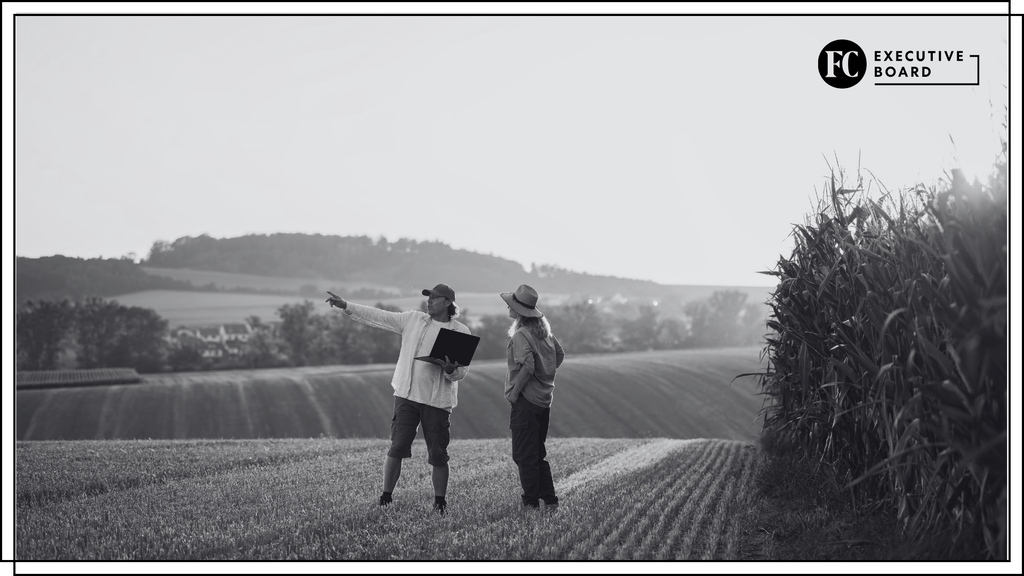
Growing up on my family’s sod farm, an early lesson shaped the way I think about business. To solve a problem, farmers look for better equipment, better processes, and better ways to produce more from the same land—they don’t simply work harder.
Years later, after building an agricultural technology company, I believe the same principle separates businesses that scale from those that stall.
After all, most companies begin the same way. In the early years, founders hire employees, solve problems, and stay involved in nearly every important decision. Customers expect direct access to the founder, decisions happen quickly, and the business grows because someone is willing to do whatever it takes.
Over time, though, those same habits become harder to sustain. Employees wait for approvals, important decisions pile up, and the founder gets pulled into work others could handle. The organization doesn’t always grow alongside the business.
The numbers tell a story
This pattern showed up clearly in a recent national Scaling.com study of 1,000 business owners, where many recognized that they had become part of the constraint, with 54% identifying themselves as a bottleneck in strategic focus and prioritization. Other causes of stalled growth include resource limitations (58%), economic conditions (54%), and internal operations (48%).
I’ve seen the same thing throughout agriculture, where most founders run out of capacity. No one expects to manage 5,000 acres the same way they managed their first 200. As operations expand, farmers invest in equipment, improve processes, standardize workflows, and trust experienced people to make decisions in the field.
If every decision still depended on one person, growth would eventually stop. I’ve seen this happen while building Nano-Yield. In the beginning, nearly every customer conversation, partnership discussion, hiring decision, and product question came across my desk. That worked because we were a small company.
As we expanded into new regions, served more growers, and built new partnerships, we had to expand decision-making to get bigger. This required us to document how we worked, develop leaders throughout the company, and trust people to own decisions instead of simply carrying out instructions.
Improve capacity and efficiency through trust
Many businesses struggle because growth is more complicated than the systems that support it.
Agriculture has dealt with that reality for generations. Farmers respond to challenge by looking for ways to remove constraints. One operator can accomplish more with better equipment, and precision agriculture can produce every acre more efficiently. Growers achieve stronger results with fewer inputs using advances in fertilizer technology. Progress comes from multiplying capacity rather than multiplying effort.
Business growth follows the same pattern. Hiring more employees, adding more meetings and working longer hours may increase activity, but activity isn’t the same as capacity. Companies continue scaling when good systems replace unnecessary bottlenecks, responsibilities move closer to the people doing the work, and leaders spend less time solving today’s problems and more time building organizations that can solve tomorrow’s.
We’ve experienced that evolution at Nano-Yield. Some of our most important investments have been in leadership, processes, communication, and creating an organization that can continue growing without depending on a few people to keep everything moving. Those investments often determine whether a company keeps growing five years from now.
Growing crops and growing companies have more in common than most people realize. Both eventually reach a point where success depends less on individual effort and more on building systems that allow good people to do their best work. Agriculture learned that lesson a long time ago. Every founder eventually has to learn it too.
Clark Bell is CEO and cofounder of Nano-Yield.