

As a 16-year-old I traveled from my home in Germany to the Middle East because I wanted to see and understand the world. Two years later, I volunteered in West Africa. These experiences were life-changing, informing my decision to work in the humanitarian and development sector. Today, foreign aid budgets are contracting, making that work tougher. But it’s never just been about the size of the funding. It has always been about the shape: What is needed is capital with longer horizons, fewer restrictions, and local ownership at its center.
I have spent decades working in Africa, Asia, Europe, and the Middle East. The economic, health and education solutions that lasted came from communities, local governments, and national colleagues who understood the problem best and knew how to make every resource count. Much has been said about doing more with less. My argument is about doing things differently.
The UNICEF Office of Innovation, which I lead, forges partnerships to develop frontier technologies in emerging markets into scalable solutions for children worldwide. These are the markets where the next billion users are, and where frontier technology faces its hardest challenges—patchy connectivity, many languages, and low-cost hardware. Too often the money for innovation comes with the shortest of horizons: earmarked to a specific project with a specific end date.
A DESIGN FLAW, NOT A FUNDING GAP
Projects funded this way can work beautifully for exactly as long as they are financed. And when the money stops, they stop too. This is a design flaw, not a funding gap: an approach that rewards the launch, not the longevity.
Innovation for lasting impact looks different. It is built close to the problem, owned locally, and backed by financing that is patient and flexible, durable even when not abundant.
In India, for example, a low-cost latrine, conceived and built by a community in West Bengal with UNICEF support, was eventually adopted nationwide because it was owned by the people it was for, not deployed by outsiders. Or look at mPower, a Bangladesh-based startup we invested in and mentored, which builds digital tools for public health that have now reached over 150 million people.
Today, our work with Arm, a global microprocessor company, is an example of partnership that bridges the divide between private capital and local impact. Together, we are supporting edge artificial intelligence solutions built by startups in emerging economies, equipping young people with AI literacy in 12 countries, and influencing the wider technology sector towards responsible AI. There is a lot of talk of the dangers of AI right now—and rightly so. That is why the AI startups and solutions we support are built with safety-by-design, with explicit guardrails, and with a clearly defined purpose.
Take community health workers, who in many countries and contexts are the first line of defense against maternal mortality, infant death, and disease. They often lack the funding, support, and training to respond quickly, diagnose accurately, and connect vulnerable patients to appropriate care. We are currently running pilots in Colombia, India, and Kenya that deploy multilingual AI assistants that work offline in places where mobile coverage is patchy or unreliable.
This is frontier tech built in the places where it is needed, by entrepreneurs who understand the challenges their communities face. It is also a testing ground and an untapped market for edge AI.
WHERE OPPORTUNITY MEETS OBLIGATION
Poverty-ending ambitions cannot be achieved through donor funding alone. They require collaborating with governments and local partners to build the innovative tools that address identified challenges in their countries and their communities.
It’s increasingly clear we will not hit the United Nations’ Sustainable Development Goals using the old methods. What is required are innovative partnerships with the private sector on one side and local actors on the other. These collaborations must be based on shared values and aimed at shared targets. Our shared role is to support communities as they build the solutions they need.
Local ownership informs everything we do at the UNICEF Office of Innovation—from sanitation to AI models. That requires patient, agile investment based on an understanding that emerging markets present a compelling opportunity to build on shared values and create something new. Innovation and partnership are force multipliers, for funding and for impact.
IMPACT THAT LASTS
I was in Bhutan some years ago, visiting a remote yak herding community high in the Himalayas. There was just one girl at the school who had access to a smartphone, which she used to help with her homework. Her teacher told me she was top of the class!
Earlier this year, in partnership with the government of Bhutan, our youth-focused entrepreneurship program, UPSHIFT, was integrated into that kingdom’s Google Classroom platform. Now, more youngsters will be equipped to navigate the path from school to skills-based employment, leaving poverty and uncertainty behind.
For business leaders seeking growth alongside lasting social impact, the pathway is clear: founded on innovation, nourished by patient capital, sustained by local ownership.
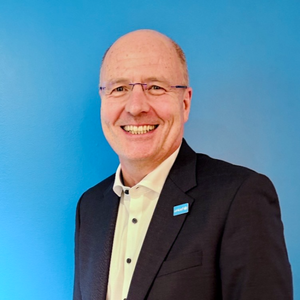
Rudolf Schwenk is director of the UNICEF Office of Innovation.