

Today’s workers are inundated with headlines warning of the dangers of AI to our economic future. The biggest fear those headlines often point to is that AI will eventually come for everyone’s job. And most American workers share that fear, as nearly three-quarters (71%) say AI could cause permanent job loss, according to a recent Reuters/Ipsos poll.
I see another path that gets far less attention, where widespread economic prosperity depends on humans and agents working in harmony.
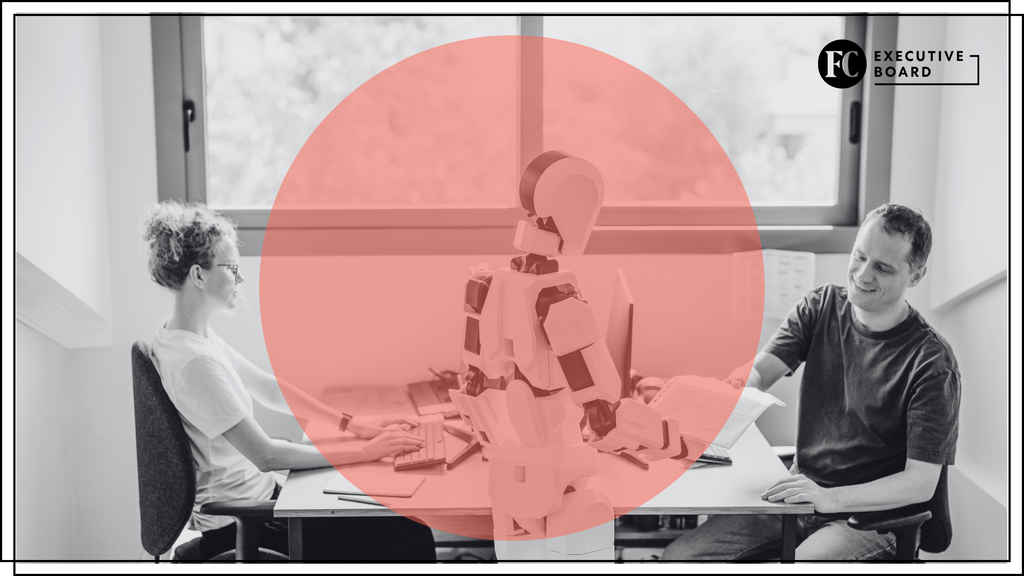
In this scenario, AI agents serve as a tool to boost human productivity, working in concert with people to complete tasks while expanding the value of human expertise across the workforce. In a harmonious state, humans provide real-time instruction and judgment, while agents undertake the work on their behalf. In effect, AI agents empower humans to create more than ever before.
But this outcome isn’t inevitable. Organizations must intentionally design for it. The question is: How?
From automation to augmentation
For decades, technology primarily automated routine, rule-based work. The Autor-Levy-Murnane (ALM) Task Matrix documented this shift, showing how computerization reduced demand for routine tasks while increasing the value of complex, non-routine work.
The agentic era is disrupting this pattern, as large language models (LLMs) now perform non-routine tasks—such as writing or programming—without needing humans to write explicit instructions for every use case.
Some believe this shift points to a zero-sum future, because if AI can handle non-routine cognitive execution, human workers become obsolete. But this view mistakes task automation for the replacement of human thinking and judgment.
Instead, AI can create an opportunity for human workers to spend less time on task execution and more time on strategic steering. IKEA offers an example, according to reporting from CX Today. As its AI chatbot took on routine customer queries, the company retrained thousands of human agents for more complex support tasks and moved them into remote interior design advisory roles, shifting human expertise from routine support to higher-value work.
So how can organizations put this model of human-agent harmony into practice? It starts by redesigning the relationship between humans and the agents working on their behalf.
Agent accountability as the bedrock of trust
Organizations already know how to establish accountability among human workers. They can apply that same process to governing AI agents. Every AI agent should have a clear identity, role, and level of authority, along with oversight and recourse mechanisms.
It’s imperative that every AI agent has a named human responsible for its actions. For enterprises to confidently trust AI agents with high-stakes, non-routine work, a specific human must ultimately own the outcome. When a human is ultimately responsible for an agent’s outputs, oversight becomes an active part of how the AI agent operates.
But naming an accountable human is only half of the answer to achieving human-agent harmony. If a human sponsor is going to make good on that responsibility, they need the tools to actually steer the agent in real time.
Why human-in-the-lead is the next model
The existing human-in-the-loop models fall short, often giving people oversight at a single decision point. Namely, the AI agent proposes an action and the human approves or rejects it. Meaningful human oversight must come earlier in the process, also known as human-in-the-lead.
The human worker sets the strategic intent, defines policy boundaries, and actively provides real-time steering during the AI agent’s execution. The AI agent can carry out much of the underlying work, but the human remains responsible for direction and outcomes.
Guardian AI agents can help make this model possible by monitoring every interaction and identifying when situations require human intervention. Rather than requiring people to approve every routine action, humans are brought into the loop only when their unique judgment, context, and ethics are required.
This is what human-agent harmony looks like in practice. Allowing agents to handle execution while bringing humans in when judgment is needed gives AI greater autonomy without sacrificing oversight or accountability.
Designing work for the agentic era
The biggest mistake leaders can make in the agentic era is assuming that automating cognitive tasks means eliminating the humans who perform them today. We’ve already seen several companies walk back AI-driven workforce reductions.
Instead, AI agents enable human workers to move from executing tasks to setting direction, applying judgment, managing exceptions, and taking responsibility for outcomes. But we must intentionally design that future, as the outcome depends on strong agent accountability alongside a human-in-the-lead approach.
Every leader faces the same choice: We can let AI replace human labor and let the technology’s economic benefits concentrate in the hands of a few, or we can build guardrails that let humans and agents co-create prosperity together. The future of work will depend on which path we choose.
Rory Blundell is the CEO of Gravitee.io.