

Look at a classroom almost anywhere in the world, and you will find a handful of very curious students, the kind whose curiosity exceeds a typical classmate’s. Their brains are wired for learning. The classroom syllabus is not enough to satisfy them, so they follow teachers around asking for more.
In that very classroom, another larger group of students work consistently and diligently, hoping to reach the top of their class.
Alongside them is a different set of students who do just enough to pass and move up. And at the far end of the spectrum are the kids who experience school as punishment, counting the hours every day until the bell rings and the day is over.
Principals do not design this bell-curve distribution, yet, in my experience, it appears in schools across generations. I have long believed that statistics demonstrate truth in numbers, and people spread themselves across a bell curve without planning it.
The same curve appears when I look at a leadership team. Companies depend on the everyday excellence of the teams who keep the machine going, and they need those teams doing exactly what they do. The curve I consistently see takes shape on the leadership bench, typically consisting of a few hundred people in a company our size.
Most people on the leadership bench show up on the curve as career builders. Half of this group are leaders with positive intentions, who work hard and get things done, and whose negativity (if and when it surfaces) stems from a genuine desire to make something better.
The second half of the middle group achieves the defined metrics, doing just enough to look good in the manager’s eyes. These leaders tend to need more external validation and recognition to feel their work matters.
On the far-left tail are the people whose days deliver very little output. They may ignore goals and go through the motions of checking boxes without achieving the desired outcomes. Worse, they may get consumed by gossip or blame. They complain about the boss, their colleagues, the company, and the environment. At times, it seems as if complaining is their job.
Top leadership qualities
At the opposite end of the spectrum are the people on the far-right tail. I call them “character builders.”They are outcome-oriented, willing to take risks, and they think like owners without needing to prove ownership.
They read, seek out mentors, and mentor others without being asked. Their drive is intrinsic, a need to see their own potential realized. They are not trying to impress others. I would put them at roughly 1 in 1,000, the top 0.1%. From my perspective, the health of a company depends on whether these 1-in-1,000 leaders occupy the bench.
A well-known leadership framework measures leaders on 4 Es and a P. It looks for energy, the ability to energize others, the edge to make a call on incomplete data, and execution. Energizing others is a different thing from having energy yourself. The 4 Es are fueled by passion. In my experience, you cannot measure it or fake it.
The CEO behind this framework also built a version of his thinking into his company’s appraisal process, the forced ranking system that removed the bottom 10% every year. Other large companies adopted it and later dropped it.
In my view, they were right to step away. A quota system ends up manufacturing the distribution it claims to observe. If you force each team of 10 to produce a failure, whether one exists or not, you will certainly introduce politics and sabotage. Managers would start gaming the system to protect their people.
What deserved to be buried was the forced cut; I still believe the observations about people are valid. The normal distribution forms irrespective of whether you rank the people or not, just as it does in school. So, I keep the curve as a map, the 4 Es as a lens, and I discard the quota.
How we shift on the curve
A position on the curve is not permanent. Organizations and people grow and change. Staying on the right side demands continuous learning and limitless passion. Priorities accumulate, and energy gets divided. The business environment forgives neither.
Leaders slide left without deciding to, sometimes only because of the circumstances of life at the moment. The far-left tail is visible and small. It is not where companies have the most to lose. Companies face the highest risk when leaders get by on just enough effort to satisfy the person they report to while protecting their title and positional power.
You cannot build a great company with leaders who defend a seat instead of earning it. The subtler version of sliding left happens to good people in the career-builder group. This is the group that concerns me the most.
These are leaders who dedicate years to building a company and develop an emotional bond with it. Somewhere along the way, that bond turns into an expectation and entitlement. The thinking goes: I built this, so the company will take care of me. I will continue to own a leadership chair.
Companies should be kind when a leader’s standing changes. But tenure does not guarantee a leadership seat, and leaders are not measured by timelines. Durability in a role or company is not a virtue; impact is.
Lead for the future
If you can make a mark in the role you hold, you are doing great and deserve to be in the leadership seat. If you cannot continue to deliver impact, the right move is to step aside and elevate a highly capable person. Stay close in a supportive role and keep mentoring. A leader who steps aside without being asked is doing what character builders do. They choose impact over the seat.
Achieving a title does not mean you are entitled to it, or that the work of staying on the right side of the curve is done. If you want to remain on that side, you have to keep working at it. There is no holiday on the far-right tail.
The question I put to our leadership team is the one I keep in front of myself. Do we have character builders on our bench?
When the answer is yes, great things happen without monitoring or quotas. The test applies to each seat. It applies to mine first.
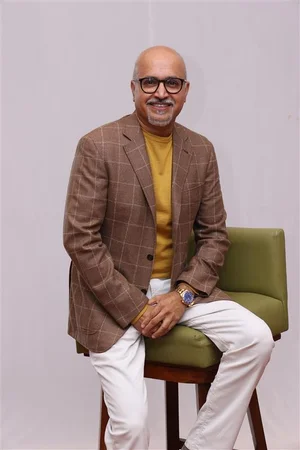
Ajit Prabhu is the cofounder and CEO of Quest Global.