
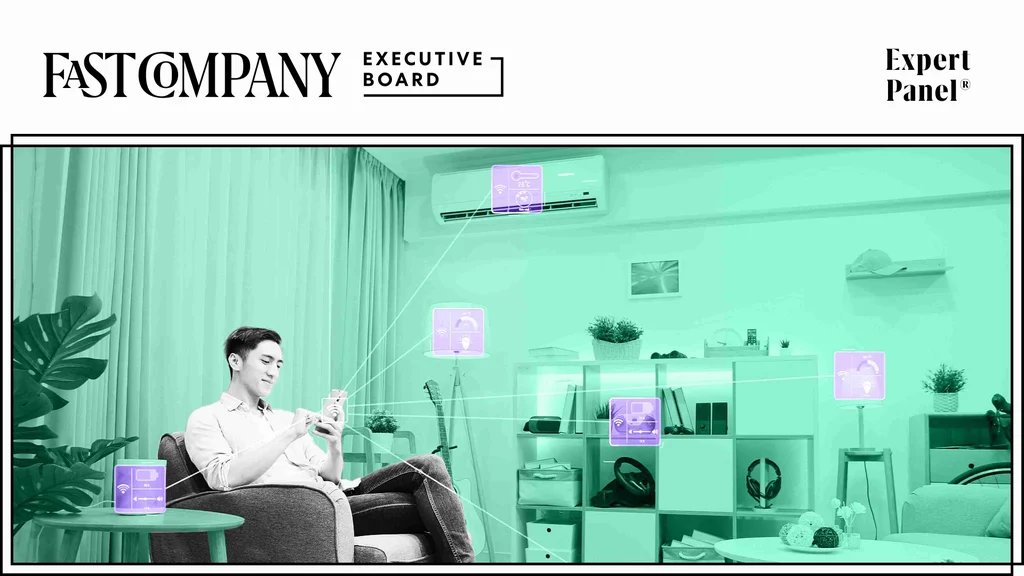

Technology continues to be the solution to helping brands and their customers elevate their business and personal experiences. One key to assessing a client’s satisfaction with a particular device is to gain access to their existing daily habits and how the product impacts their life. Once that information is determined and measured through a combination of data analytics and real-time user feedback, the brand can work on modernizing its product to make it better.
Below, 12 experts from Fast Company Executive Board each offer one suggestion to help other brand leaders and creative UX designers adapt their product designs for new and evolving wearables, smart home devices, and other Internet of Things devices.
1. CONNECT WITH USERS ON AN EMOTIONAL LEVEL USING AI AND ML ACROSS DEVICES.
Develop a “cross-device emotional continuity” strategy using AI and ML to create emotionally consistent experiences across IoT devices. By adapting interfaces, content and interaction styles based on the user’s emotional state and context across different devices, brands can deliver seamless, empathetic interactions that enhance user satisfaction and strengthen emotional connections with the brand. – Cliff Jurkiewicz, Phenom
2. PROVIDE CLEAR INSTRUCTIONS THAT USERS CAN COMPREHEND.
Knowledge is key. For example, giving the end user essential information about the wearable is powerful and goes a long way. Attrition rates increase when users cannot understand how to use their products. – Tarek El Ali, Smart Insurance Agents
3. STREAMLINE USER NAVIGATION THROUGH AUTOMATION.
The most important predictor of satisfaction and long-term stickiness for devices such as wearables is how well they fit into existing lifestyles and habits. Careful assessment of users’ existing habits is essential. A device must not rely on the formation of new habits for success. Rather, it should make existing habits easier or automate as many steps as possible. – Ronald M. Razmi, Zoi Capital
4. DEVELOP A SEAMLESS AND SECURE INTEGRATION.
Aim for intuitive interfaces and device-agnostic seamless integration without sacrificing security. For instance, if a status is updated on one device, it should be updated on other devices as well. This is not a problem now, especially with cloud-based apps. The next step is to adapt these apps to Web3 or blockchain. – Zain Jaffer, Zain Ventures
5. TAKE A HOLISTIC, USER-CENTERED BRAND APPROACH.
Focus on creating a holistic, user-centered approach to the brand. This will ensure the products remain intuitive and effective across the growing landscape of connected devices. – Britton Bloch, Navy Federal
6. OFFER FLEXIBILITY AND RESPONSIVENESS.
Design with flexibility in mind. Focus on responsive, modular elements that adapt seamlessly to different devices, from wearables to smart home products. At tickadoo, we ensure our designs are intuitive and scalable across evolving technologies, maintaining a consistent user experience. – Francis Hellyer, tickadoo
7. GAIN USER FEEDBACK THROUGH REAL-WORLD TESTING.
One suggestion for brand leaders and creative UX teams is to prioritize a seamless, cross-device user experience by focusing on responsive design and intuitive interfaces that adapt to various screen sizes and interaction methods. Incorporate user feedback and real-world testing to ensure functionality and aesthetics align with the specific context of each device. – Maria Alonso, Fortune 206
8. MAKE SMALL BUT SIGNIFICANT CHANGES TO MODERNIZE EXISTING PRODUCTS.
Product designs that now include IoT products have a two-fold mission: They need to keep the traditional look people are familiar with but modernize it to evolve for these other products. The secret is to take a small step where people are still familiar with the brand but the changes are enough for the press to talk about them and for those using these devices to find them. – Baruch Labunski, Rank Secure
9. DEVELOP A CONCIERGE MINDSET AND STRATEGY.
Think like a connected concierge: Prioritize experiences that are useful and intuitive, and anticipate customer needs. Embrace adaptive design principles to keep your product relevant and engaging across all emerging platforms. Stay agile and people-centric, continuously evaluating data as well as direct customer feedback to thrive in the evolving IoT landscape. – Val Vacante, dentsu
10. BE A PROBLEM SOLVER FIRST.
Great design has never been about beauty, color, or style. It’s always been about solving problems. So focus on the problem you’re trying to solve and how a wearable or a smart home device is uniquely able to solve that problem. Translating your design ideas onto one of these new platforms is easy when you center every design decision squarely on that purpose. – Barry Fiske, Merkle
11. CONSIDER THE DEVICE LOCATION.
It’s important to embrace a “context-aware” design philosophy. This means ensuring that your product design adapts to the environment in which it’s being used, whether the wearable is used in a busy city or on a smart home device in a quiet living room. Your designs can deliver a more intuitive and personalized experience considering the unique contexts and user scenarios. – Dan Sorensen, Air National Guard
12. BE WILLING TO COLLABORATE AND BREAK DOWN ANY CONFLICTS.
Embrace constraints. I led writers on design teams across emerging technologies where ambiguity and misinformation are high and the need for education and onboarding is higher. Adaptive designs happen on collaborative teams that cut through siloes, debate through disagreements, and dismantle dysfunction to conceive responsive, inclusive, and cohesive experiences. – Pooja Vijay Kumar, Autodesk