
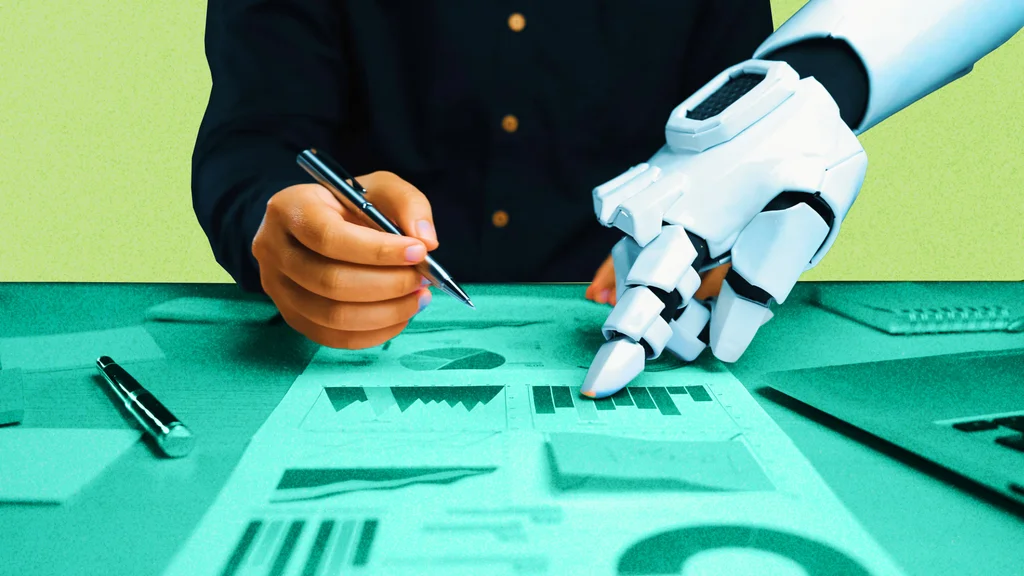

AI stubbornly persists at the extremes: One extreme is limiting, treating AI as a fast-commoditizing tool that boosts performance by 5%-10%. The other is expansive, portraying AI as a disruptive force that is reshaping jobs, the nature of work, and what’s fundamentally possible.
Both are critical, but compelling outcomes live between those extremes. Ironically, AI, which promises disruption, may also enable transformation without massive organizational change.
We often treat AI like a moonshot—a high-risk, high-reward bet requiring bold, expensive, and dramatic changes. But moonshots can have higher failure rates and cause disruption; they should be used strategically. Like an investment portfolio, diversity and balance yield the right gains at the appropriate risk levels. A smart investment strategy should include roof shots (measured upside, steady growth with scalable change) and chip shots (incremental and reliable, but limited structural change at scale).
If a business chases extremes, it misses the value found between them. One middle-ground benefit is what I call low-friction transformation. The goal isn’t for teams to overhaul how they work to accommodate AI; it’s for AI to absorb as much change as possible. AI agents can flex around new or non-standard processes, so humans adapt only where it’s required. Agents handle complex data and variability in processes, and give humans the outputs they need.
AI works as an extension of humans by navigating complex systems and processes, and driving performance benefits and productivity gains without massive disruptions.
This is where AI’s precision matters most. Its strength isn’t just what it can do, but how intentionally it’s applied. AI can enhance the operating model in targeted ways that use agents to manage the differences where practical. It becomes part of the system and a lever for innovation—quietly powerful, deeply effective, and built for long-term impact.
THE “GOOD ENOUGH” AI REVOLUTION
For years, executives have sought standardized processes, as standardization drives consistency and optimization. Variability was the enemy of quality.
AI evolves that thinking. A marketing team once followed a content production process; AI now generates tailored drafts in seconds. A support team escalated tickets through multiple layers, but AI can interpret and triage instantaneously. Rigid processes become less valuable when AI can consistently produce high-quality results.
The goal is no longer blanket standardization. Instead, standardize where it creates value and let agents manage process variability or non-standard data. Standards still matter, but AI can bridge gaps where standards don’t exist.
AI’s promise lies not just in its upside, but in raising the baseline. “Good enough” becomes “better.” With quality outcomes from AI, executives can loosen their grip on standardization.
AI doesn’t need to be perfect to be powerful. The right framework makes outputs consistently valuable.
CHANGE LESS, TRANSFORM MORE
Transformation once meant sweeping change: reorgs, retraining, and disruption. But today’s AI strategy changes that—change less, transform more.
That’s why 66% of executives reported increased productivity and 57% reported cost savings from adopting AI agents, according to PwC’s AI Agent Survey. Value is being captured early and often from these agents.
Transformational outcomes come from minimizing human behavior change. Machines can now work like humans. We should rethink an employee’s daily habits to leverage AI agents, or reshape customer value with greater intelligence and personalization. Deeper change may still be needed for business model shifts, and the value will justify a greater degree of change. But change only where it counts.
Think of a busy hospital. Doctors have limited time with patients and deal with a wide range of complex symptoms. AI can help analyze these symptoms and give the doctor a more accurate diagnosis to work with. The result: faster, more personalized, and precise medical care. The only change is using the input from an AI agent instead of consulting a physician.
With any new technology, the less people need to change, the less organizational friction you’ll see. That’s the essence of low-friction transformation.
TOMORROW’S BUSINESS MOATS
Why does it matter? Traditional strategies are shifting, new threats are emerging, and we need to accelerate innovation to be ready.
AI may still be emerging in enterprises, but upstarts are already using it to disrupt. We have seen startups with small teams—using AI to write their code—take market share from industry heavyweights. AI-native competitors are designed for change and are therefore fast, nimble, and threatening.
Competitive advantage often comes from brand power, capital, high barriers of entry, economies of scale, and so on. These traditional moats are blunted by AI if scale and specialization can be achieved with AI agents via low-cost models. The question becomes: How do companies stay great when “good enough” is cheap and instant? There will be tremendous pressure on big companies to maintain their growth and defend their positioning.
Not enough companies are thinking about AI’s business impact. Only 44% are developing new agentic products and services, and just 42% are redesigning processes around AI agents, according to our AI Agent Survey.
That’s a problem. Tomorrow’s advantages won’t come from size and staying power. They’ll come from speed, creativity, and human-led innovation, amplified by AI agents. Enterprises need small, independent teams—innovation labs—tasked with reimagining their business with AI. These teams need to be well-resourced and free to experiment.
This work can feel ambiguous to executives. It can take up budget or pull your star players from other resources. The payoff isn’t always immediate, but if you don’t do it, someone else will.
THE PRAGMATIC PATH AHEAD
AI has changed the game, but too many executives still treat it like past technology implementations. They assume it will disrupt teams and require major changes.
The power of AI lies in its adaptability. It integrates into existing workflows, supports human output, and creates profound impact without huge change management. When deployed thoughtfully, AI strengthens teams and reduces friction.
Tomorrow’s leaders won’t chase perfection. They’ll pursue pragmatic, low-friction transformation on the path to reinvention.