

Technological advances for brick-and-mortar retailers have come a long way in improving both the customer experience and retail operations—and as we saw over the past two years, retailers who don’t embrace and implement new technology aren’t likely to last.
The COVID-19 pandemic probably advanced technology and innovation for brick-and-mortar retailers by about five years. As retailers needed to adapt to shutdowns and social distancing, they turned to technology to help keep their businesses open, like buy online and pick up in-store, touchless checkout, and virtual shopping options. Those who didn’t turn to technology found themselves in an adapt or die situation throughout the pandemic. Many don’t have their doors open today.
But the technological innovations born out of necessity weren’t the first retailers have seen, as technological innovation has always been a part of the brick-and-mortar experience. Here are some of the inventions of the past, and some of the present and future.
TECHNOLOGY OF THE PAST
While the fundamentals of the customer shopping experience haven’t changed—a customer goes to a store to shop for a product—retailers have looked for ways to make the customer experience more streamlined and convenient, and retailer operations more airtight and organized.
Today, we probably can’t imagine a retail experience without some kind of cash register at purchase, but until 1879, storeowners kept sales ledgers by hand. That is until James Ritty realized that he could stop losing money from unrecorded sales and keep better track of money in the drawer by inviting a machine to track sales and inventory. The cash register allowed store owners to keep better records of revenue and inventory sold, and today, the cash register, or a point-of-sale system, is one of the cornerstones of the brick-and-mortar experience.
Credit cards were another evolution in brick-and-mortar technology that gave customers new ways of paying for their goods and services. In the early 20th century, retailers began issuing charge cards or credit cards, which allowed customers to purchase a product and pay later. Initially, a credit card could only be used at the store that issued it, but in 1950, the Diners Club card became the first card customers could use at a variety of places. Today, customers use a credit card for nearly one-third of their purchases.
As department stores and big box stores got bigger in the mid-20th century, retailers found themselves with a customer service problem. With so many products on the shelves, it was taking cashiers a long time to type in each item manually to the register, thus causing long lines and bottlenecks. So in 1976, taking his inspiration from Morse code, Joe Woodland designed the first UPC code, which could be scanned easily at the register for faster checkout.
Other technologies have made the experience of cashing out faster and more convenient, including the first contactless payment with Mobile’s Speedpass, launched in 1997. This keychain fob could be waved in front of a scanner at the pump, and the amount charged to a card attached to the account. It was based on Radio Frequency Identification (RFID) technology, which allows us to make contactless payments today.
TECHNOLOGIES OF TODAY AND TOMORROW
Today’s retailers are also embracing technology to make the customer experience more exciting and streamlined, and to offer something that online shopping just can’t provide.
When looking at technologies of today and tomorrow, it’s worth starting with contactless payment, which has gone from the aforementioned Speedpass to simply tapping a card or waving a phone or smartwatch at a register terminal. Not only is it fast and convenient, but with COVID-19 health precautions in place, it’s a safer option for checkout as well.
We’ve seen the cash register evolve into state-of-the-art POS systems and today, more brick-and-mortar retailers are installing self-checkout kiosks in their locations, at which customers can scan their products and pay without needing to interact with an employee. It’s a popular option; in our “2021 State of Self-Checkout Experiences” report, we found that nearly half of respondents (49%) said they use self-checkout all the time.
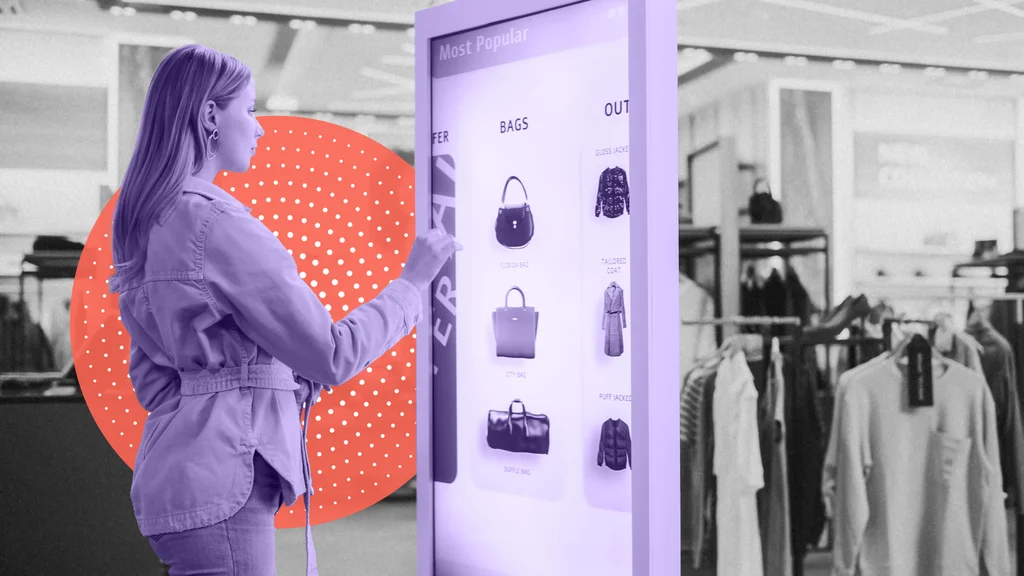
Self-service kiosks allow customers to find items in the store, learn more about products or the company, and even order and cash out themselves. Not only can self-service kiosks be an engaging way to put the store experience in the hands of the customer, but retailers can also serve up targeted offers based on audience insights as the customers are using it.
Augmented and virtual reality has now made it into brick-and-mortar to enhance the shopping experience. Customers can try out products through virtual reality before they make a purchase, and augmented reality features let customers learn more about products, play a game in-store, or see a product label come to life.
Finally, robots and artificial intelligence aren’t just for sci-fi movies and are now being incorporated into the brick-and-mortar experience. Robots provide customer service while artificial intelligence is being used in apps, smart mirrors, and other technology to guide customers to recommended products based on their appearance and preferences.
EMBRACING TECHNOLOGY FOR YOUR BRICK-AND-MORTAR
If brick-and-mortar retailers want to continue to thrive and differentiate themselves from online retailers, embracing technology is the way to go. Today, we couldn’t imagine a retail experience without a cash register or the ability to pay with a credit card. In 50 years, what technologies from today will we wonder how we ever lived without?
Bobby Marhamat is the CEO of Raydiant, a digital signage and in-store experience solutions provider.