
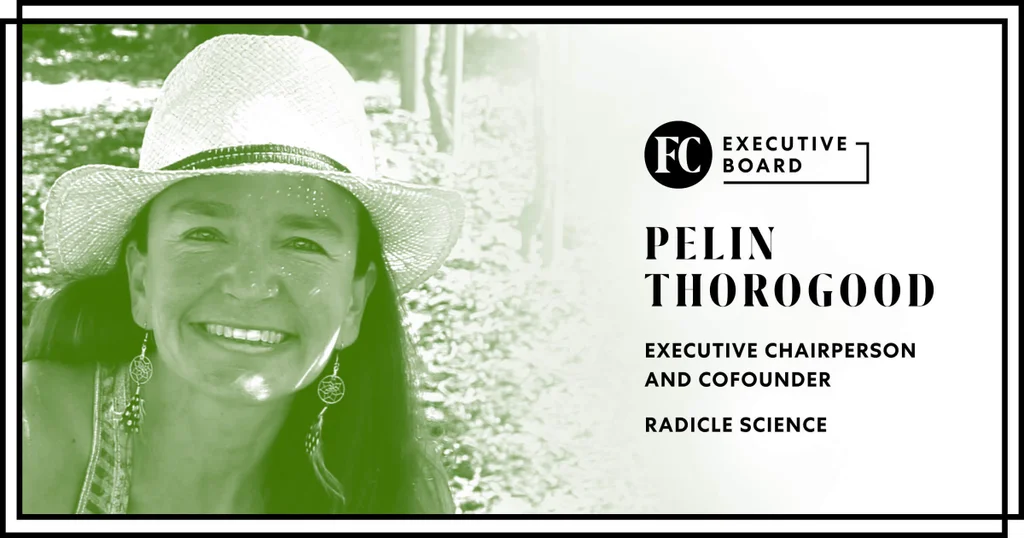

It all started with the keen observations of an impact-minded entrepreneur with the audacity to call out what wasn’t working, examine why, and seek a better way forward.
From 2017 to 2020, Pelin Thorogood, now cofounder and executive chairwoman of healthtech B-corp Radicle Science, was a philanthropist funding clinical trials at universities across the nation. Through this work, she gained insight into how traditional research studies operated—and at the same time, noticed many facets ripe for innovation.
For Thorogood, the most glaring problem was one of diversity and inclusion. A data expert by training, she quickly recognized that traditional clinical trials left out vast swaths of the population: Most participants in traditional trials are Caucasian men living in metropolitan areas, even though demographically White males represent only 30% of the U.S. population. Women, minorities, and rural populations are still traditionally under-represented. A major consequence of the current inequity is that 80% of prescription drug recalls stem from women experiencing unanticipated side effects. “I saw that the data we were getting from these very expensive clinical trials was not actually meaningful to the population at large,” Thorogood says. “So to me, that was a massive problem that had to be tackled if we are to achieve much needed health equity.”
Then there was the tremendous cost and slow speed of pharmaceutical clinical trials: As of 2016, the estimated median cost of a clinical drug trial was $19 million. The average drug takes more than 10 years to get through FDA approval and to market, and clinical costs rise with each added phase, with the total cost of development estimated at $2-3 billion. “The exorbitant price tag of clinical trials may work for patentable products developed by companies that have the potential to recoup those costs, but it’s simply not affordable for the natural product industry,” Thorogood says. Because natural products (such as ashwagandha, turmeric, ginseng, St. John’s wort, etc.) are not patentable, brands selling vitamins, minerals and dietary supplements simply don’t have the same resources as pharmaceutical giants, whose work yields patentable, proprietary formulas that can then be sold at greater profit margins. “Lack of easy access to clinical trials has led to a massive proof gap between pharmaceuticals and non-pharmaceuticals,” Thorogood admonishes, leading to “a very real problem affecting the 75% of Americans who regularly use supplements.”
A BIG AND AUDACIOUS MISSION
These problems and more led Pelin Thorogood and her cofounder Dr. Jeff Chen, a physician scientist, to launch Radicle Science and pioneer the proof-as-a-service category. Their mission is to elevate the non-pharmaceutical industry by offering a fast and affordable way to clinically prove product effectiveness beyond placebo with gold-standard, AI-driven, direct-to-consumer clinical trials. Makers of supplements, for example, can now access large-scale, randomized, placebo-controlled clinical trials (RCTs) at a fraction of the time and monetary costs.
Moreover, due to the transformative nature of Radicle Science’s research process, these manufacturers can now study the effectiveness of their products on a wider, more diverse pool of participants that includes more women, minorities, and rural populations. Direct-to-consumer trials are conducted from the comfort of participants’ homes; quality tested research products are mailed directly to consumers and consumers report regular check-ins from their smartphones. And unlike in traditional trials, at the end of each study, Radicle Science unblinds study participants, providing them with personalized health reports detailing their product usage and outcomes. Each of these practices not only mitigate common obstacles to broader participation in traditional pharmaceutical trials, which typically require time-consuming in-person visits to clinics in metropolitan areas, but also deliver added incentives for participants.
ENGAGING CONSUMERS NATIONWIDE
But going after such “a big, audacious goal” (as Thorogood puts it) to revamp the traditional drug research process requires a balancing act. The brands researched in Radicle’s first clinical trial were very interested in generating clinical data and establishing benchmarks for the industry, but there was also some hesitation due to uncertainty over how the public would react to such a novel approach. Radicle Science was not only pioneering a brand new model to research with its AI-driven, virtual, crowdsourced, direct-to-consumer trials, but also focusing on large-scale studies with thousands of participants to deliver relevant data for the broader population (whereas the average traditional clinical trial has just dozens of participants). Could they actually execute on their bold promise?
Thankfully, consumers responded resoundingly, with Radicle Science’s first study, in 2021, enrolling 3,000 participants within a record seven days for the 13-brand RCT. Since then, Radicle Science has studied over 20,000 Americans, across diverse populations and conditions, on dozens of dietary supplements. “It’s clear that American consumers want clinical proof on the effectiveness of the supplements and health products they regularly use,” Thorogood shares.
BUILDING A UNIFIED VISION
Fostering trust between Radicle Science and their participating brands was also paramount. Thorogood and her team were open about the fact that their approach to clinical trials was brand new and untested at the time. In addition to fostering trust and transparency, they were also deeply committed to clearly defining shared goals between Radicle Science and the brands participating in their first trial, helping these brands to view themselves as “trailblazers” that had the vision to prove the effectiveness of products and formulations that (despite being used by millions of customers) had not previously been clinically studied. “They trusted us and believed in the common mission—that this was going to be a win-win,” she says. “As self-proclaimed ‘rebels with a cause,’ we knew this endeavor was bigger than us. What we were collectively embarking on was something that was going to fundamentally change the industry for the better.”
THE IMPORTANCE OF MISSION ALIGNMENT
According to Thorogood, that was exactly what happened. “The results, which were shared within a record six months as we’d promised, generated tremendous interest from the entire industry as well as national and trade media,” she says. Since then, all the companies that participated in the launch have gone public with the findings. Consumers, the media, and the broader ecosystem indeed saw the brands for the trailblazers they are, which led to a jump in sales, new contracts, and increased customer trust. All of this, Thorogood says, is “because these companies believed in our mission and took a chance to invest in a novel evidence-generation approach to show proof of product effectiveness.”
Thorogood touts the benefits of “mission alignment” between Radicle Science and its participating brand partners—a shared commitment to democratizing clinical trials, making them accessible to a wide array of diverse participants, and driving consumer trust through clinical evidence. She notes that almost all of the companies that were part of their launch study have since participated in more Radicle Science studies. “The relationships have blossomed into long-term partnerships instead of one-time transactions,” she says.
“We all are here for business,” she acknowledges. “But, when there’s a purpose that’s bigger than us, it elevates relationships to a more strategic level, amplifying their potential for meaningful impact. And I believe that’s absolutely essential to driving fundamental, industry-wide transformation.”