
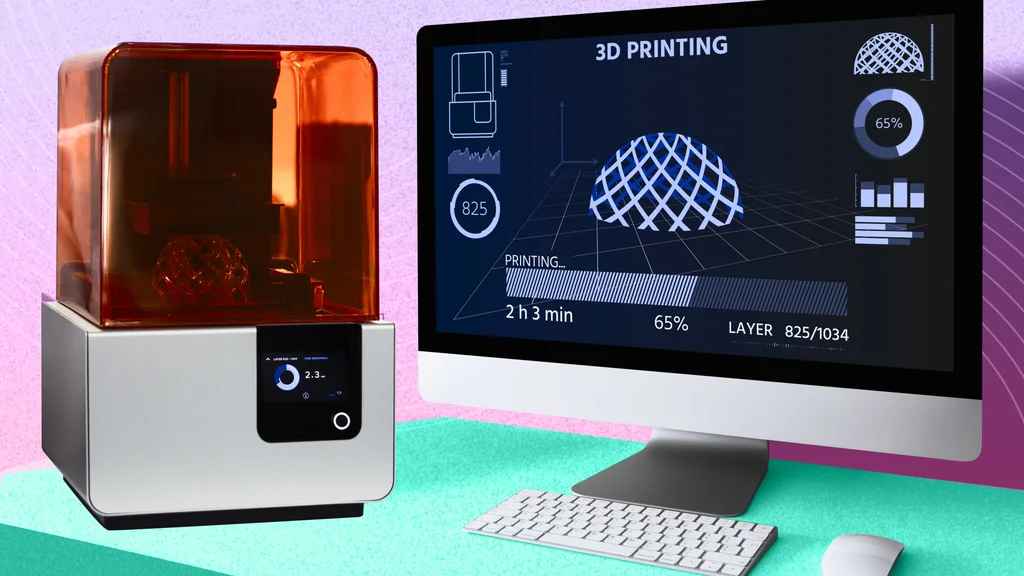

About 10 years ago, many of you probably read an article or watched a news program that made bold predictions about the 3D printing revolution: Our children would soon be manufacturing their own toys (and preparing for STEM careers in the process!), we’d all be printing our own toothbrushes, and on the business side, a revolution was coming to manufacturing.
Hobbyists’ fascination with 3D printers aside, this mainstream do-it-yourself consumer 3D printing concept hasn’t really happened. And that’s led some to claim—inaccurately—that 3D printing is one of those technologies that never really “crossed the chasm.”
The chasm refers to the difficult transition between early adoption and mainstream use that every new technology eventually needs to overcome. It was a concept first described by marketing guru Geoffrey Moore in his book Crossing the Chasm.
In fact, Moore references 3D printing in the book’s 2014 edition: “At the time of this writing, 3D printing is getting a lot of press, but the actual market is still much like the original home computing market in the days of Heathkits before the Apple II—a DIY technology enthusiasts paradise.”
Now, unless you’ve been printing toothbrushes at home, you have probably realized that consumer adoption of 3D printing didn’t cross the chasm. But what you may not be aware of is that the 3D printing industry has, in fact, grown steadily over the last decade. It has done so as a behind-the-scenes B2B technology, increasingly referred to as additive manufacturing (AM). According to Wohlers Associates, the global additive manufacturing industry grew from $5.1 billion in 2015 to about $18 billion in 2022.
3D printing’s growth in manufacturing is based on scale, not on printing 100% of anything. It’s printing the parts where AM has an advantage in flexibility—complex geometries, reduction in cost, low-volume and high-volume printing, and mass customization. The evolution, or crossing of the chasm, of additive manufacturing comes from shifts in just doing prototyping to the production of real parts, which ultimately play a role in the entirety of a product.
In more than a few industries, additive manufacturing has already become the only sensible solution for the fabrication of some products—dental aligners, manufacturing aids, interior aircraft ductwork, and product prototyping of all kinds. For these specific use cases, AM has clearly already crossed the chasm. A roadmap for broader adoption is in place.
As an industry, we’ve gotten to this point by developing bigger, faster, more accurate 3D printers and inviting early-adopter customers to explore disruptive new ways to use them in their operations. That’s not how the additive manufacturing industry will grow in its next phase—reaching mainstream manufacturers who seek a clear strategic advantage before taking a risk on a new technology.
Fortunately, we are now ready to meet the needs of these “pragmatists in pain,” as Moore calls them, who are rethinking global supply chains. They are seeking to make healthcare delivery more personal. They want to give customers the customized cars, eyeglasses, shoes, and other goods they demand. They urgently want to improve the sustainability of manufacturing by cutting emissions, reducing waste, and using more renewable materials. And, of course, they want to make everything more affordable. We call these people, “pragmatic innovators.”
What does this pragmatism look like for 3D printing? I’d argue it’s even more compelling than a 3D printer in every home.
- NASA spent two years making sure strong but lightweight 3D-printed parts would stand up to space travel by strapping them to the International Space Station. Those rigorous tests have paid off, and the next stop is the moon.
- Surgeons look at medical scans on a screen to try to figure out complicated surgical plans, and sometimes it’s not clear it’s even possible. But now they can easily 3D print a model of the patient’s anatomy and even practice removing the tumor, inserting the catheter, or suturing the tissue. They are turning inoperable procedures into operable ones.
- The FDA recently cleared 3D-printed full-color, single-piece dentures (gums and teeth) for the U.S. In 2021, it was a market in which more than 4.2 million dentures were created. It’s a labor-intensive craft that makes the process more expensive and less repeatable. Now, more people can simply sport an incredibly realistic 3D-printed set, which is also easily replaceable if worn out.
- The U.S. Navy needs to keep planes approaching 100 years old flying. One of the solutions to this old technology is new technology. Not only is the Navy ramping up its investments in 3D printing to maximize readiness, but it is also placing these printers around the world to make parts faster and get that equipment back in action.
Despite impressive growth, there is lots of room for more growth ahead. The vast minority of manufactured products today are created with 3D printers, yet there is enormous growth potential. Yes, our ability to anticipate how new technology will emerge into the mainstream is often initially limited by numerous challenges, yet they burst into the mainstream, nevertheless. This is what’s happening today as 3D printing finds its place and makes its journey into our manufacturing industries around the world. You’ll be using it, driving with it, and wearing it even if you don’t print it. That chasm doesn’t look so far-reaching after all.
Chief Executive Officer, Stratasys