
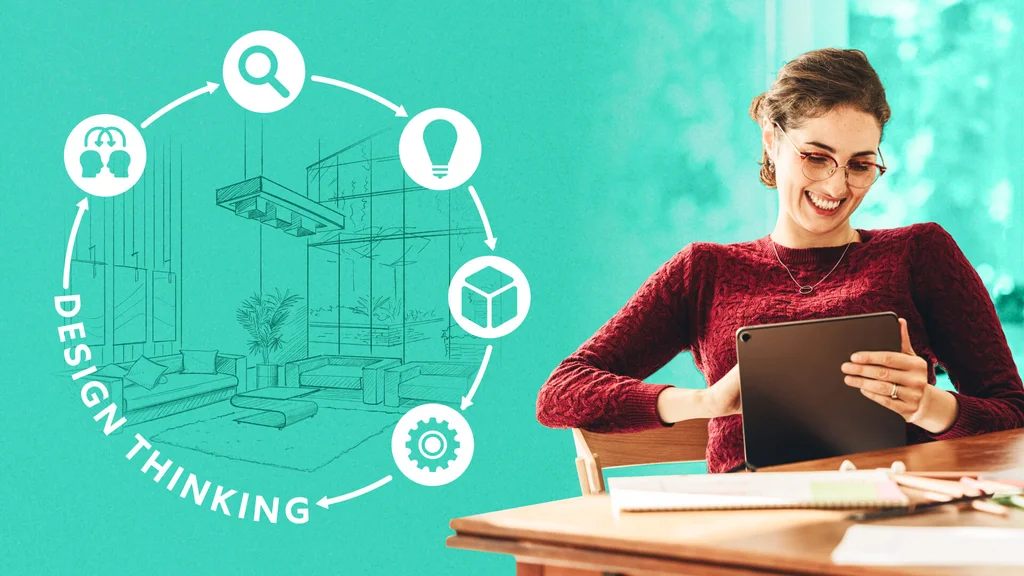

Design thinking is not all about building creative solutions for your customers or users, nor is it only an iterative process to continuously improve your business processes and other optimized products. Design thinking is for our lives, too.
Many of us have naturally incorporated design thinking into our daily working lives, businesses, products, and growth, but it can be easy to forget to implement this magical technique into life itself.
When incorporated into our personal lives, design thinking can turn life’s processes to work with us, not against us.
WHAT IS DESIGN THINKING?
Design thinking is a process for creative problem-solving. It begins with a focus on understanding the user and proceeds through creativity and experimentation to find innovative solutions.
Design thinking has been shown to be effective in addressing complex problems, and it is increasingly used in businesses, schools, and other organizations.
There are five key elements to design thinking:
- Curiosity: Clear and precise questions about a problem
- Openness/Unbiasedness: Understanding the user’s needs and perspectives
- Brainstorming: Breeds creative ideas to solve the problem
- Implementation: Testing those ideas to see what works best
- Measurement: Did the ideas work?
Further, design thinking is an iterative process, which means that it can be used over and over again to solve different problems. It is also a collaborative process, which means that it involves working with others to come up with the best solution.
THE FIVE CORE STEPS OF DESIGN THINKING
These are pretty similar to the core elements of design thinking. The only difference is they are implemented in a pragmatic way.
These are the five main steps of design thinking:
- Empathize with the user
- Define the problem
- Ideate solutions
- Build the prototype
- Test the prototype
In business, these steps can be started with research such as interviews or surveys. Once you understand the user, you can define the problem and start brainstorming possible solutions. Once you have some ideas, you can begin prototyping them to see which ones work best. Finally, you will test your prototypes with users to get feedback and improve upon them.
When it comes to solving your own life’s problems, you can implement this same technique to churn out solutions from your life’s processes. This requires looking at yourself from the point of view of your users.
APPLYING DESIGN THINKING TO YOUR LIFE
Design thinking can be applied to any life process to make it more efficient and effective. By breaking down the steps of a process into smaller, more manageable pieces, you can better understand how each step works and how it fits into the larger picture. This understanding can help you identify areas where improvements can be made.
In addition to improving efficiency, design thinking can also help you achieve your goals by providing a framework for thinking about problems and potential solutions. By taking the time to consider all aspects of a problem, you are more likely to come up with an innovative and effective solution.
Finally, implementing design thinking into your life can help you achieve a better work-life balance. By taking the time to understand your needs and identify potential solutions, you can find ways to improve your life balance and live a happier, healthier life.
So, if you’re looking for a way to streamline your life and achieve your goals, consider applying design thinking to your process. It just might be the answer you’ve been looking for.
CONCLUSION
Remember, design thinking doesn’t change the problems. Instead, it changes the way you look at those problems. And, when you do that, you follow a different—likely more innovative—path to solve them.
Design thinking is a process and a mindset. It’s iterative and non-linear. And it’s simply a fresh way to look at the problems you may face in your life. As I have implemented design thinking into my own life, I have improved it and everything I care about. Life is all about perspective, and design thinking is not void of that.
Candice Georgiadis is an active mother of three as well as a designer, founder, social media expert, & philanthropist | Digital Agency, Inc