
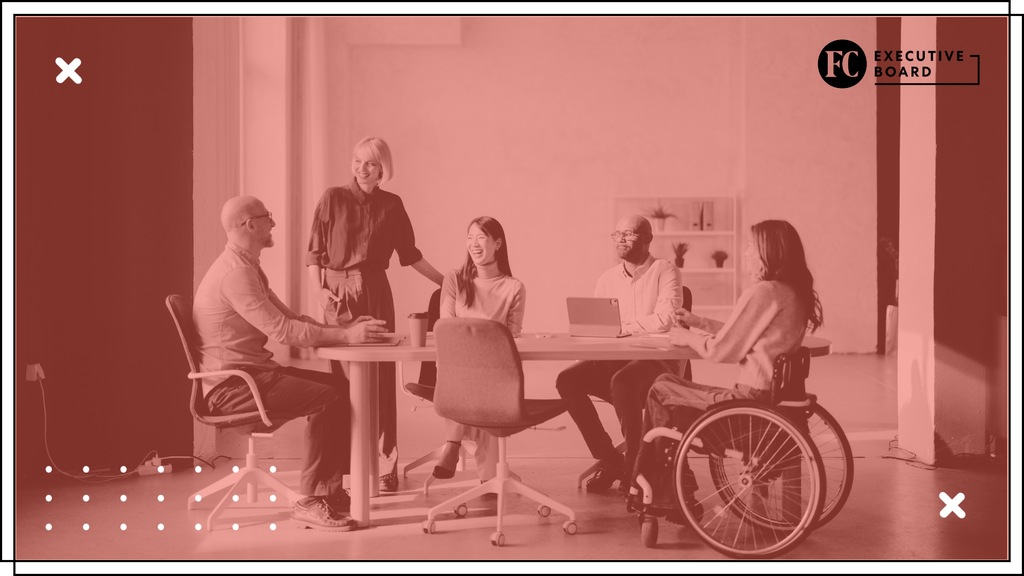

According to the CDC, one in four American adults has a disability.
In my opinion, people with disabilities are limited by the workplaces, hiring processes, and organizational cultures that were built without people with disabilities in mind.
The employment gap between disabled and non-disabled working-age adults is larger than any racial, ethnic, or educational employment gap tracked by the Federal Reserve. That points to a major design problem.
I lead Relay Resources, a disability social enterprise nonprofit that transforms workplaces and communities by championing disability inclusion. Our vision is straightforward: “All Disabled People Belong. Everywhere.”
That is a practical blueprint, as the evidence is clear: When companies build workplaces with disabled employees in mind from the start, they become more inclusive and more competitive.
Disability drives innovation
Disabled people have always re-engineered the world to everyone else’s benefit. Ralph Teetor was the blind engineer who invented cruise control simply because he was sick of his friend’s choppy acceleration. The precursor to today’s text messaging was the teletypewriter, built by and for the Deaf community. Disabled veterans fought for curb cuts on city sidewalks, which cyclists, delivery workers, and parents with strollers use today.
The office is no different. When you rebuild a process, a physical space, or a job role to actually work for disabled employees, you end up making the whole company run more efficiently, in my opinion.
One example is using asynchronous meeting tools like Loom to give employees time to digest information, ask clarifying questions, and contribute to discussions and decisions. I’ve seen how asynchronous meetings work well for many neurodivergent people, and also benefit introverts and people who may find it difficult to get their ideas across verbally. It makes our discussions more equitable and, if everyone uses it, allows each perspective to be expressed so we can make better decisions.
The business case is stronger than most executives realize
Disabled consumers and their families control $13 trillion in annual spending globally and make up 15% to 20% of the world’s population. When companies lock disabled talent out of their workforce, they predictably end up building products and services that lock out a massive chunk of their customer base too.
A 2023 Accenture report found that companies leading on disability inclusion made more money, pulling in higher revenue, net income and economic profit than their competitors. Plus, 92% of managers surveyed by the American College of Healthcare Executives said their disabled team members performed just as well as or better than those without disabilities. Inclusion gives businesses a competitive edge.
Yet, the employment gap remains staggering. A 2024 Department of Labor survey noted that only 38% of working-age disabled Americans have a job, compared to 75% of their non-disabled peers. Let’s be clear: This employment gap is primarily structural, in my opinion. The DOL survey noted that people with disabilities may face discrimination and employment barriers such as a lack of workplace accommodations, which are all barriers employers can control.
3 things disability-inclusive employers do differently
Organizations we’ve worked with that do disability inclusion well treat it as a proactive design challenge. In practice, that looks like the following.
1. Share interview questions in advance
Sometimes considered an accommodation for neurodivergent candidates and others who process information differently, advance questions tend to produce better interviews for everyone. Candidates come prepared to answer substantively rather than manage the stress of the unexpected.
2. Build sensory spaces into office design
In our experience, quiet, low-stimulation work areas benefit employees with sensory processing differences and anyone who needs focused time away from an open floor plan.
This includes things like:
- Natural light or dimmable LED lighting turned down to about 60%
- Walls painted with soothing colors
- Seating options that include large bean bags and ergonomic chairs for different seating positions
- Acoustic wall panels and ceiling tiles to absorb sound
- White noise machines
- Availability of sound-canceling headphones
- Partitions to limit visual distractions
In my experience, I’ve seen broader benefits from these offerings, and how most employees use them once they’re available.
3. Promote accommodations
Companies can also broadly communicate their workplace’s physical accessibility features and personal accessibility options, like screen readers and remote ASL interpreters, to help disabled employees feel included at work.
Other accommodations include remote work and flexible hours. Both expanded dramatically during COVID-19 without productivity suffering, and disabled workers benefited most. One UK study of 1,200 disabled professionals found that 67% felt more productive working from home.
Stanford economist Nicholas Bloom’s studies found that hybrid work (of two days at home per week) significantly increases retention and has no negative impact on productivity. In short, well-designed remote and hybrid work options are great for neurodivergent and disabled employees, and have no negative impact on neurotypical or nondisabled employees.
Where leaders can start
For executives thinking seriously about this: The first question to ask is whether your organization knows what its disabled employees actually need and has built a feedback loop.
This includes efforts like anonymous surveys asking employees what accessibility features they would like to see, and tools like Disclo (a service provider of Relay Resources) to streamline the accommodations process and ensure Americans with Disabilities Act compliance.
From my working experience, disabled employees who feel safe disclosing their disability at work are more engaged, more productive, and less likely to leave.
Making disability inclusion a genuine priority gives companies access to a larger talent pool, a more engaged workforce, and a stronger connection to one of the country’s largest consumer markets. Treating it as a legal checkbox is leaving all of that on the table.
Disabled workers built some of the most widely used technology and infrastructure of the past century, and are doing the same in workplaces right now, in organizations that have figured out how to get out of the way. That is the version of disability inclusion worth building.
Jennifer Camota Luebke is president and CEO at Relay Resources.