
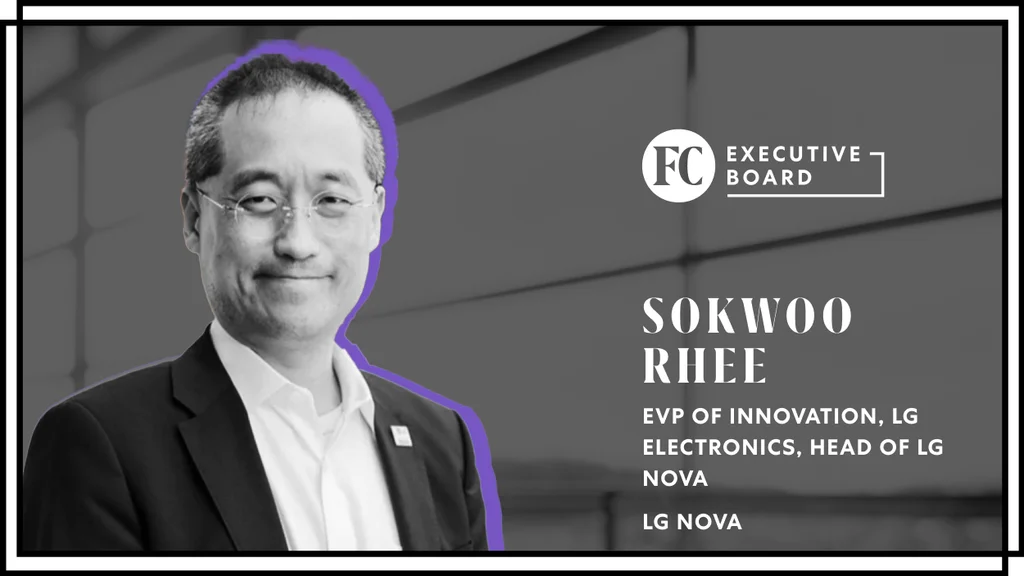

In a world where technology moves fast, working together has become essential. LG NOVA, the North American Innovation Center for LG Electronics, focuses on partnerships to solve problems and create new ideas. Sokwoo Rhee, who leads LG NOVA, sees these collaborations as a way to bridge the gap between the agility of startups and the structure of larger corporations.
“Corporations are not used to this kind of speed,” Rhee explains. “Startups are more nimble, fast, and agile.” LG NOVA’s goal is to create an environment where startups and corporations can combine their strengths to move ideas forward and make them real.
AI’S ROLE IN HEALTHCARE AND CLEANTECH
AI is central to much of what LG NOVA is doing, especially in healthcare and cleantech. These industries face challenges that need more than gradual improvements. AI isn’t just a tool for efficiency—it’s about creating solutions that make a meaningful difference.
In healthcare, mental health services stand out as a sector with serious delays. In some states, it can take months for patients to receive proper care.
“Why does it take three months to see a psychiatrist? There must be something,” Rhee says. AI could help by streamlining back-office processes, thus reducing the time it takes to connect patients with care.
Dropout rates are another issue. Many patients stop treatment, and those who continue often go through multiple psychiatrists before finding the right fit. AI has the potential to improve these systems, making care more accessible and helping patients stick with their treatment.
Radiology is another area where AI is already having an impact. Rhee explains that radiologists are used to working with data, which tends to make them more open to AI solutions. These tools are helping speed up diagnoses and improve accuracy, which leads to better patient outcomes.
In cleantech, AI is being used to improve grid maintenance and repair. “When you have a blackout, it takes about three hours for somebody to come in and fix it,” Rhee says. AI can reduce that time by analyzing data faster and helping crews get to the source of the problem more efficiently.
The opportunity for AI is also expanding, as new AI models, such as DeepSeek, are cheaper and more efficient and could potentially accelerate innovation and AI adoption across these and other sectors. By lowering the barrier to entry and enabling smaller companies and even individual developers with less capital to run large AI models, it will spur faster development.
CLOSING THE GAP BETWEEN INNOVATION AND ADOPTION
Even with its potential, AI adoption can be slow. Businesses often resist change, even when it’s clear that new tools could save time and money. Rhee points out that a lot of AI investment today is focused on infrastructure rather than practical solutions that businesses can use right away. “A large portion of the corporate investment is still coming into infrastructure like chips, data centers, and LLMs,” he explains.
For AI to gain traction, it must go beyond ground-level improvements. Companies need to see clear and immediate results. If the benefits aren’t obvious, many decision-makers will stick with what they already know.
FOCUSING ON IMPACT
LG NOVA looks for opportunities where AI can make a big difference quickly. Areas such as radiology and mental healthcare back-office systems are good examples. They have clear problems that can be fixed with the right technology. By focusing on solutions that fit into existing systems, LG NOVA ensures the benefits are seen right away.
The team evaluates thousands of startups every year, reviewing each one to determine if it can solve a real problem and fit with the way industries currently work. “We look at 150 to 200 startups every month,” Rhee says. This “always on” approach ensures LG NOVA constantly focuses on ideas that will have the greatest impact.
LOOKING AHEAD
For LG NOVA, the future is about turning ideas into results that matter. The challenges are big, but so are the opportunities. Rhee believes the key is to focus on what works, not just what’s possible. “We know there are tons of opportunities. The question is, what are you going to do with them?”
By bringing together corporations, startups, and communities, LG NOVA is redefining how innovation happens. The work they’re doing is creating not just solutions but real, lasting change.