

In the corporate world, there’s still much progress to be made when it comes to getting women into leadership positions. Analysis by the Pew Research Center, for example, revealed that the “share of women CEOs of Fortune 500 companies reached an all-time high of 10.6% in 2023, with 53 women heading major firms.” However, despite that percentage being a record, women don’t even account for a quarter of leadership at Fortune 500 companies. Additionally, according to McKinsey’s 2023 “Women in the Workplace” report that year, “for every 100 men promoted from entry level to manager, 87 women were promoted.”
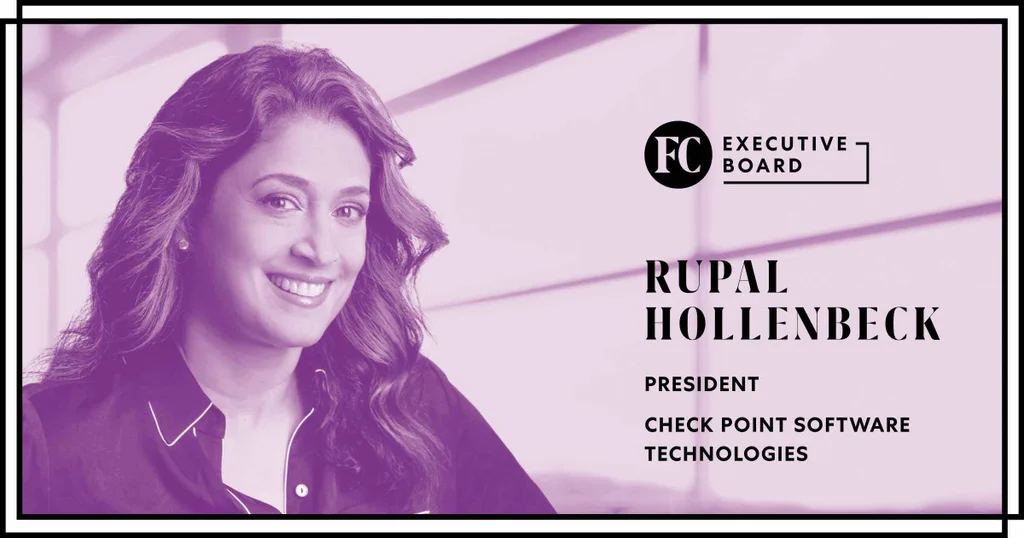
But at Check Point, it’s a different story, according to Rupal Hollenbeck, the company’s president.
“More than 40% of our executive leadership team consists of women,” Hollenbeck explains. “We’ve made a lot of progress getting women into leadership roles on our management team and board of directors. I’m particularly proud of the fact that the key roles of chief technology officer and chief product/R&D officer (CPO) are held by women. We also have women in senior roles across our finance, legal, R&D, sales, and marketing departments.”
THE BENEFITS OF HAVING WOMEN IN LEADERSHIP POSITIONS
Hollenbeck explains that there are benefits to having women in leadership positions. For one, they can become role models to other women.
“I believe in the notion, ‘If you can see it, you can be it,’” Hollenbeck says. “The women in leadership positions at Check Point serve as important examples of possibilities for women and can serve as valuable mentors to women who are earlier in their careers, lifting them up.”
Then there’s the impact women in leadership positions have on customers. Hollenbeck emphasizes that diversity inside a company supports the diversity outside a company, helping form strong business relationships.
“I meet more and more women in the ranks of our customers and partners when I travel around the world,” she says. “We serve a diverse base of clients, and a diverse company best serves a diverse customer base.”
Hollenbeck stresses that diversity, equity, and inclusion are important ethically, but they also open business opportunities.
“Doing good is absolutely good for business,” she says.
HOW CHECK POINT HAS CULTIVATED AND ELEVATED WOMEN IN LEADERSHIP POSITIONS
Check Point is intentional about helping women advance into leadership positions.
Hollenbeck points to the company’s early career program.
“The Global Associates program brings recent college grads into Check Point and rotates them through different roles as they begin their careers,” she explains. “When recruiting these cohorts, we take a thoughtful and inclusive approach so that we hire people today—many of them women—who will be our leaders of tomorrow. In 2023, in the United States, the majority of our Global Associates were women. Worldwide, over 35% were women.”
The company also takes an inclusive approach to recruiting. Hollenbeck notes that Check Point tends to recruit candidates from its employees’ professional networks, and she’s intentional about “combatting ‘like hiring like.’”
Once hired, employees have pathways for progressing their careers at Check Point. Hollenbeck explains that the company has affinity groups for employees at its different locations around the world, as well as mentorship and networking opportunities.
WHAT NEEDS TO CHANGE ABOUT THE CYBERSECURITY INDUSTRY’S APPROACH TO WOMEN IN LEADERSHIP
There’s a shortage of women in the cybersecurity industry. A 2022 Cybersecurity Ventures report found that women accounted for 25% of cybersecurity jobs worldwide. The organization predicted that women “will represent 30 percent of the global cybersecurity workforce by 2025, and that will reach 35 percent by 2031.”
Hollenbeck emphasizes that if women aren’t even in entry-level cybersecurity roles, the industry can’t expect a substantial increase in the number of women in leadership roles.
“It’s important to acknowledge the progress the industry has been making, but at the same time, we cannot lose sight of the road ahead or be satisfied with standing still,” she says. “Like in technology innovation, and business in general, we need to build systems that promote constant growth and progress in this area.”
She says that hiring alone doesn’t build diverse organizations.
“Hiring is important, but it’s only a first step,” Hollenbeck says. “It’s important that company leaders address the full career cycle.”
Moreover, she stresses that company leaders need to weave diversity, equity, and inclusion into the fabric of their organizations if they want to influence real change.
“Surface-level initiatives will garner short-term results,” Hollenbeck says. “Lasting impact requires making systemic cultural changes.”
LOOKING AHEAD
Given the skills gap in cybersecurity, Hollenbeck says, increased diversity in the industry presents a “great opportunity to access a broader talent pool.”
“Addressing the cyber skills gap requires a multi-threaded approach,” she says. “We will need a combination of skilling, reskilling, and cross-training to build the industry’s talent base. Practically speaking, the wider and broader we cast a net for possible talent, the better off businesses will be.”
She calls the White House’s National Cyber Workforce and Education Strategy a “good step in the right direction” and encourages companies to implement their own strategies for developing cyber talent and increasing diversity.
“At Check Point, for instance, we’ve committed to training a million people over the next four years through our MIND Cyber Security Training Program, a commitment we made in partnership with the NCSWES,” she says. “We’ll need the private sector to work closely with the public sector and regulators to achieve our ambitious targets and address the cyber skills gap.”
She explains that as companies develop their strategies for developing cyber talent and increasing diversity, leaders should pay attention to technological advancements, especially artificial intelligence.
“AI should factor into our strategic planning for the workforce, and I don’t mean in the sense that it’ll be a replacement for the workforce,” Hollenbeck says. “The security professionals with AI skills and know-how will be the most in demand, and we, as an industry, should cultivate these skills in the workforce. The more we do so, the better off we’ll all be.”