
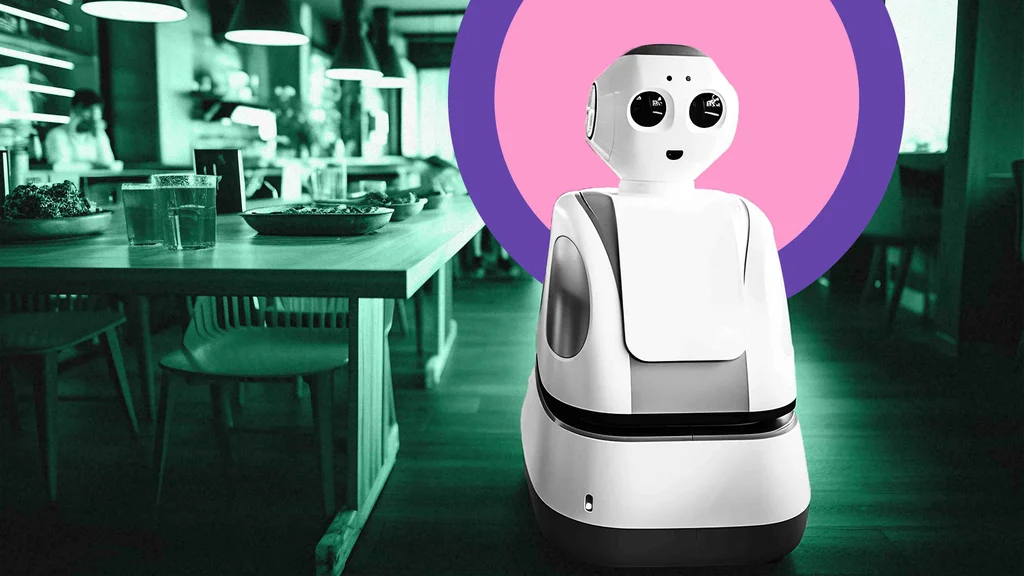

When you visit your favorite restaurant, you probably pay attention to the food, service, and decor, but restaurant owners and operators know that most of the work happens behind the scenes.
From running an operationally efficient business to sourcing food during inflation to hiring staff during a labor shortage, there are hundreds of daily tasks involved in running a successful restaurant these days. With that type of workload, it’s no wonder that hospitality is excited about the possibilities of artificial intelligence (AI) to transform the industry.
Today, some of the most exciting AI implementations are in the quick-service sector, which still suffers from a labor shortage. Wendy’s and CKE Restaurants, among others, have recently integrated conversational AI tech into their drive-thru ordering systems. Customers already order from AI-powered systems at chains like McDonald’s.
Even delivery providers, who are meeting resistance from customers due to their high fees, are getting into the act. DoorDash is testing an AI chatbot and Grubhub has rolled out delivery robots.
Other AI solutions actually prepare the food, like the Chippy robot at Chipotle and the Flippy robot at White Castle. These are specialized robots that perform routine tasks, which help alleviate the labor shortage as well as keep workers safe from hazards like hot oil.
For quick-service restaurants, AI can sometimes be synonymous with automation, but the needs of high-end, full-service restaurants are different. Automation is still important, especially for menu forecasting and ingredient management, but the standards are higher. Boutique restaurants can use generative AI powered by Large Language Models (LLMs) to stand out from the competition.
For example, our internal data indicates that restaurants experience a significant boost in conversion rates when they enhance their online ordering platforms with vivid images, enticing descriptions, and compelling writing.
However, the challenge for restaurateurs lies in bandwidth. Restaurant operators often operate under time constraints, making it daunting to curate content for every menu item. Think about it: Curating content for a menu with 100 items could mean investing seven to eight hours. But, with the prowess of LLMs and by integrating data directly from their point of sale, AI can now swiftly craft high-quality writing tailored to their unique menu, in multiple languages, all in mere seconds.
The benefits that generative AI brings to hospitality operators are multifaceted. It’s a massive time-saver, it amplifies their revenue potential, and it’s remarkably user-friendly.
Furthermore, it’s a perfect application of AI technology. Why? Because it fills a gap. Without such platforms, this content might never exist—restaurants have enough challenges to worry about day to day. As for why LLMs excel in content generation and translation, these models are trained on vast amounts of text, enabling them to understand context, nuance, and language intricacies. This ensures that the generated content is not only accurate but also resonates with the target audience, making LLMs indispensable tools in today’s software landscape.
Especially in regions like Europe, restaurants have customers that speak a wide variety of languages. An operator might only have one or two languages that they speak personally, which poses a challenge when they create their menus. With LLMs, machine translation has suddenly become very fast and very accurate. There is a huge opportunity to make it easier and more accessible for all diners to see menus in their preferred language, without any additional effort from the restaurant. And when the ordering and payment are done by the diners themselves, the entire experience can happen in their preferred language. All of this was possible five years ago, even ten years ago. The transformative aspect is that AI unlocks the ability to do it at the click of a button—and do it well.
In order for small and medium-sized businesses to succeed in the real world, they need to be able to focus on what makes them unique: their culinary craft and customer experience. Everything else—the mundane work, or perhaps the work that they do not have experience doing—is work that can be simplified by leveraging AI.
There are many manual and data-oriented tasks that still exist in hospitality, like handling invoices and managing menus. AI can eliminate all of these, over time, so that restaurateurs can spend more time on hospitality, not content and data generation.
These are sophisticated tools for sophisticated restaurants. Beyond being powerful automation tools, generative AI can be used to generate new ideas. A Miami chef recently used Dall-E, the image generator from OpenAI, to design the concept of a new restaurant and new menu items like a chocolate mousse inspired by Picasso. It makes sense that creative culinary professionals are inspired by AI-generated content. Ideas are layered on top of ideas to make something new: that’s true in food and in art. AI can accelerate that art.
Whether restaurants are using AI to serve food, forecast performance, or generate their menus, it’s an exciting time to work in hospitality. AI will never replace human interaction at high-end restaurants, but it can enable the people who run those restaurants to spend more time with guests. In the future, everybody wins.
JP Chauvet is the CEO of Lightspeed Commerce.