

There is a bellhop I will never forget.
I had just finished delivering a keynote and was leaving the hotel looking for a restaurant. I stopped at the front lobby and asked the bellhop for directions. He looked at me, genuinely apologetic, and said, “I’m sorry. I don’t have my phone with me. I can’t tell you.”
Giving directions was once a fundamental part of a bellhop’s job. And yet, without his cellphone, this bellhop was lost. He did not lack intelligence. The capability that once lived inside him had been handed over to a machine.
That moment is a cautionary tale and a mirror. Most of us, if we are honest, would see ourselves in it.
HOW ARTIFICIAL INTELLIGENCE SHAPES US
Generative AI is one of the most important innovations of our lifetime. It can compress years of research into minutes, unlock creativity in people who never believed they had any, and democratize expertise that was held by the privileged. But these extraordinary tools demand extraordinary introspection.
The question isn’t whether to use AI. That ship has sailed. The wave is coming whether you face it or turn your back to it. The real question is: Who are you in relationship to this technology?
There are three kinds of people emerging in this AI era. Only one of them will truly thrive.
The first type is the AI-afraid person.
You know them. You may one of them. These are the professionals, leaders, and creators who feel the rumble of the AI wave and have a John Connor, “Terminator”-like response. They avoid the tools, dismiss the conversation, and tell themselves that authenticity means doing everything without assistance.
Fear can leave you in a cage of confusion and abdication. Research from McKinsey & Company found that fear of uncertainty and loss of control is the single most consistent barrier to innovation inside organizations. Companies whose employees were encouraged to experiment—to fail without career consequence—were 11 times more likely to produce breakthrough results than those operating under cultures of risk aversion.
The second type is the AI-obsessed person.
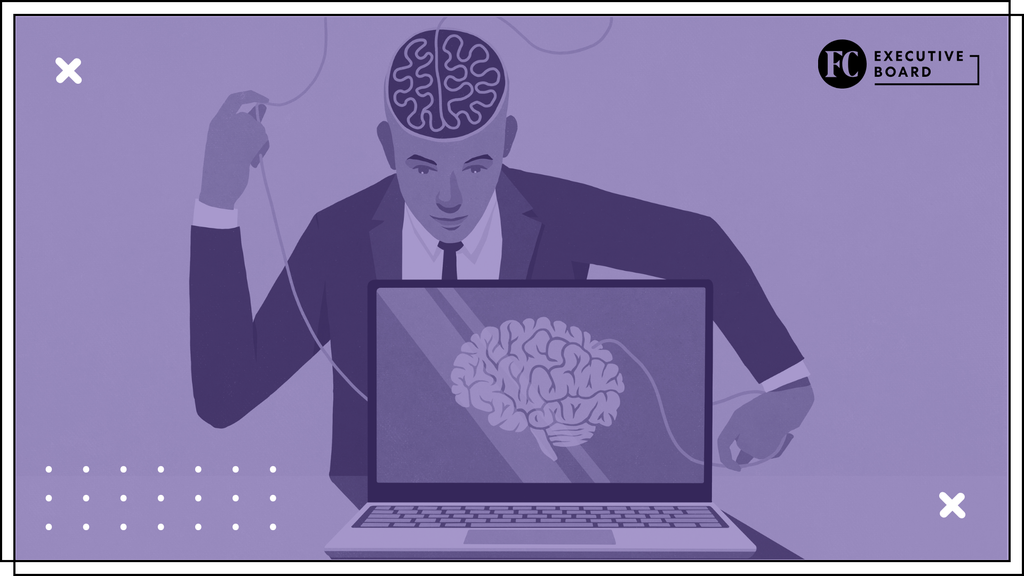
The AI-obsessed professional has discovered that AI makes them faster, more articulate, and more prolific. They prompt before they think. They generate before they question. They have, in a real neurological sense, begun outsourcing the most precious resource they own—their original cognitive voice. I know people who use AI chatbots to respond to text messages on blind dates, or to plan their days, choose their clothing, and navigate their emotional decisions. This is not productivity. This is dependency wearing productivity’s clothes.
The third type is the AI-enabled person.
A landmark study from the Swiss Business School’s Center for Strategic Corporate Foresight and Sustainability examined the relationship between Gen AI usage and critical thinking. The findings were sobering: Higher Gen AI usage directly correlated with reduced critical thinking ability. The younger and less educated the participant, the more cognitive off-loading occurred—and the steeper the decline in independent reasoning. We are renting our brains to machines.
Where is our cognitive sovereignty going? Do we have any cognitive awareness of what we are compiling in our own original thinking when we offload to AI-machines? These are the questions I asked when I researched what it means to be AI-enabled.
THREE STEPS TO RECLAIM COGNITIVE SOVEREIGNTY
The AI-enabled human treats generative AI the way a master chef treats the ingredient list or cooking instructions using powerful kitchen appliance. The machine can chop, blend, and reduce with speed and precision that no human hand can match. But the chef decides the technique behind the recipe. The chef brings the intuition shaped by 10,000 meals cooked, failed, and reimagined. The appliance serves the chef. Not the other way around. The appliance can teach a cook to create a meal, but never enough to create a great chef.
To reclaim cognitive sovereignty, follow these three steps:
1. Experiment relentlessly on your own. Before you ask the machine to solve a problem, struggle with the question yourself. Sit in the discomfort of exploring. Try, fail, iterate. This is not inefficiency. This is the gymnasium of insight.
Every time you wrestle with a problem before outsourcing it, you are building the cognitive muscles that makes you irreplaceable. Neuroscience confirms that the brain grows its connectivity through the productive struggle of original thought. Research also shows that searching for an answer is not the same as solving a question.
2. Give yourself your own opinion. Before you open a chat window, write down what you think. What does your experience and your accumulated knowledge suggest? Use it as a sparring partner, not a ghostwriter. The research of Adrian Ward found that when people were required to articulate their own knowledge before searching, they developed far more accurate understanding of their own cognitive limits. They became smarter about what they knew and what they didn’t.
3. Reclaim insight as your core competitive asset. Foster the “aha” moment that has driven every genuine innovation in human history. From Newton beneath his apple tree to the jazz musician who bends a note into something that has never existed before, insight is not the product of information retrieval. It is the product of a prepared, wandering, deeply human mind bumping into an unexpected connection.
AI is trained on what already exists. It is, by its nature, a sophisticated mirror of the past—brilliantly organized and astonishingly fast, but anchored to what has already been thought, written, and created. It can recombine. It can optimize. It can generate impressive approximations from past data but not originality. Generative AI cannot see forward the way a human prepared by curiosity, experience, and disciplined struggle can.
With the three steps above you can learn to dominate the AI-machine and not lose your mind in the AI-obsessed era.
Mohan Nair is CEO of Emerge Inc.