

You’re not listening to me.
You’re looking at me and smiling, but inside your head, a little voice is wondering whether I like you, whether I think you’re good-looking, whether that email went through, or what’s for lunch.
If some of my words happen to get through, your brain is focused not upon what I’m saying—but upon what you want to say next.
Now you may be thinking, angrily: “Wait a minute. I’m listening. I’ve always been a good listener. I’m hearing everything. And I don’t have a little voice in my head!”
And… that’s the voice.
Listening—really listening—is hard. Our minds typically race ahead. We’re distracted, we’re insecure, and we’re biased, and all of these get in the way of truly focusing on someone else’s words and meaning.
This all-too-human tendency can cost a busy executive dearly. Failing to listen to our mentors, customers, partners, or employees can deprive us of startling perspectives and breakthrough ideas.
Consider that quiet engineer with brilliant ideas, that customer whose perceptions rock your world, or that friend whose common sense is unerring. But only if someone is listening.
Authentic listening can give us a competitive advantage in today’s AI-saturated workplace by mitigating misalignment, churn, and poor strategy.
So where can we learn to listen? Let’s expand and explore from my previous piece on how business can improv like jazz.
The chorus
“The most important thing I look for in a musician is whether he knows how to listen,” said jazz musician Duke Ellington.
For musicians, listening is a livelihood. While beginners and amateurs focus on playing, pros focus on listening. Only through intense and constant listening will a player be able to achieve the precise matching of pitch that makes music in tune, or the shared microseconds of rhythm that makes music swing.
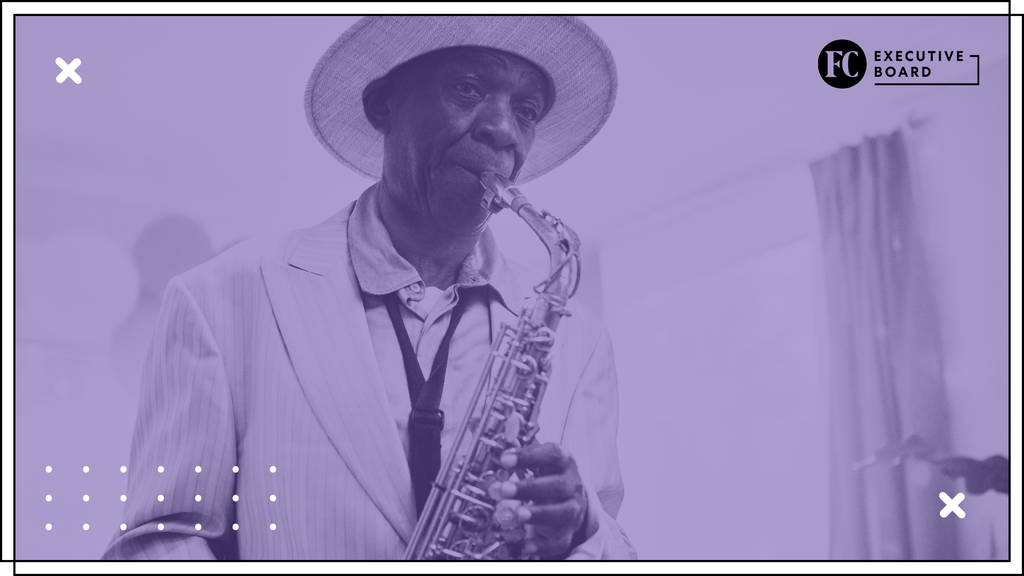
Listening is particularly important for the jazz improviser. Jazz soloists may appear to be lost in a world of their own. In reality, they’re listening—fiercely—to the other members of the ensemble.
The best improvisers are deeply attuned to the harmonic structure, rhythmic accents, and melodic ideas exchanged with their sidemen. Note that in each of these cases, the listening is not casual or automatic. Listening is effort. It is intentional. It can be trained, and it must be practiced.
In music, of course, listening takes in much more than sound. Musicians exchange information and ideas with nods, winks, gestures, and expressions.
Build the skill
“When you talk, you are only repeating what you already know. But if you listen, you may learn something new,” said the Dalai Lama, the spiritual leader of Tibetan Buddhism.
If this talk about listening in jazz inspires you to dust off your Sarah Vaughn and Dave Brubeck records, great—but more importantly, what will you do differently on Monday morning?
My suggestion: Commit to listening as an innovation practice. Great listening should be instilled in your company’s culture, with you as the model listener. Remember, the best leader may not be the smartest person in the room, but rather the most attentive.
To improve your listening skills, experiment with the exercises below. In music, these are called études (French for “studies”), and are used to practice a particular technical skill.
5 ways to improve listening
These exercises are designed to reduce distractions and help you return to the listening moment.
Etude No. 1: Try dramatic listening
Imagine the way you would hang on every word if you had the chance to interview your all-time hero. Apply the same degree of attention to the next person you speak with.
Etude No. 2: Take notes
For your next video call, plan to write down everything you heard after you log off. Don’t take notes (or use AI!). You will listen differently if you know you have to remember it all later.
Etude No. 3: Pause
See how long you can go in a conversation without responding with your own opinion or ideas. Inquire instead: “Tell me more about…” “Can you explain what you mean by…” “I liked what you said about…” This exercise forces you to listen intently for the key points someone else is making.
Etude No. 4: Yes, and
Try improv disciplines such as the famous “Yes, and” accept whatever your scene partner says and build upon it. No debate, no negative comments.
Etude No. 5: Build on turns
In a group setting, try a sequential conversation. Each member goes in turn and starts with “The thing I liked the most about what [previous speaker] said is…”
Coda
One of my college professors spoke very softly in a thick French accent. His class was held in a new room with a loud hiss from the ventilation system. I had to sit in the front row and lean forward to catch even part of what the professor said.
To this day, I believe I learned more in that class than in any other in my college career.
You don’t have to be a Miles Davis or Bird Parker to be a good listener. But in today’s distributed, fragmented, AI-accelerated business world, listening can be your secret weapon. Why not give leading by listening a try?
Bob Sprague is the founder of Yes&.