
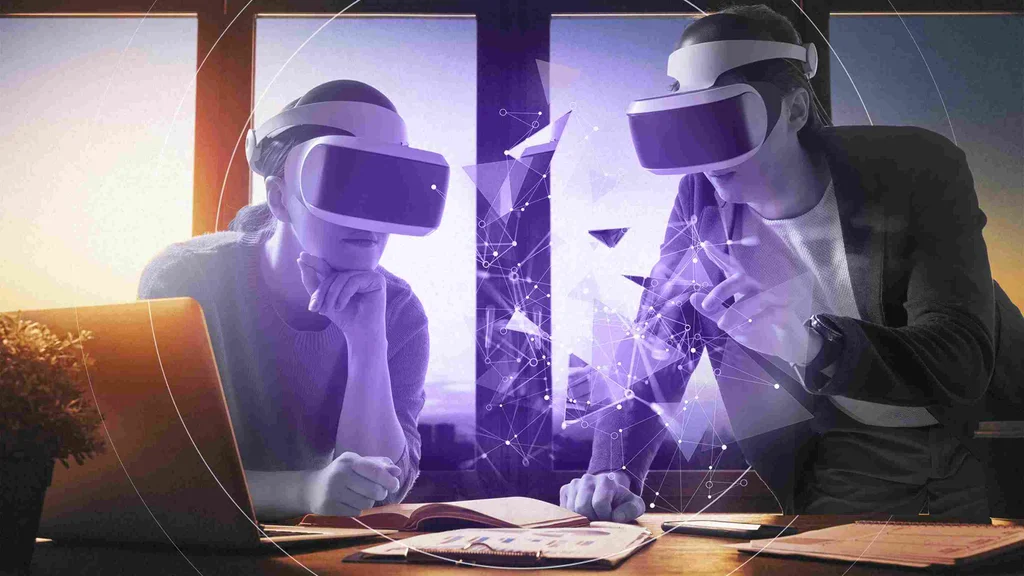

AI and the metaverse are two of the biggest innovations of this decade (and beyond). They hold the combined potential to transform businesses and even whole industries, unlocking new eras of growth and innovation in ways that are not even imaginable today. Together they can build smarter, more immersive, engaging, and secure virtual worlds that feel almost as real as the physical one.
The synergies of AI and immersive spaces are striking—they bring ideas to life and invigorate the senses, transcending geographical and physical limitations. In the workplace, Josh Bersin defines AI as creating the era of the “super-worker,” where everyone has “superhuman” powers.
How do we best harness this potential? How will it play out? And what are the psychological impacts of AI in the metaverse on the individual worker?
HOW AI CAN ENHANCE VIRTUAL ENVIRONMENTS
According to Tuong Nguyen, Gartner director analyst, “There is this intersection between AI as a technique, and the metaverse as an evolutionary state or era of the internet.” AI in the metaverse is speeding up the progress of more dynamic and rich virtual environments through data analytics, machine learning, automation, and faster, more effective decision-making.
Through AI, we have access to more accurate and integrated information, insights, education, and perspectives. With AI, we can improve the rate of development of a collaborative metaverse and make better data-driven decisions based on user needs and wants.
Specific scenarios include:
- Facial recognition data for more realistic avatars
- AI algorithms analyze user behavior, patterns, and preferences to create custom avatars or tailored recommendations for virtual experiences
- Multilingual translation services and natural language processing, speech recognition, and computer vision connect globally dispersed teams
- Voice-enabled navigation negates the use of controllers
- Digital humans/automated assistants (think 3D versions of chatbots) assist users in the metaverse by providing them with instructions and information at relevant moments
- NVIDIA is even training AI machines to create entire virtual worlds
AI is also rapidly growing in interest in the education sector, where educators now have access to AI tools to seamlessly create training vignettes in virtual scenarios. For example, ChatGPT can capture a script and put it into video form. AI can also be utilized to provide real-time feedback to students based on their individual virtual world behaviors.
Generative AI has great promise to create personalized opportunities, respond to users’ actions to solve problems, and create engaging experiences in the metaverse. It enables the instantaneous creation of 3D models, images, art, and environments using intuitive voice commands that push the boundaries of what’s possible.
Generative AI probably holds the biggest potential today in democratizing the development of the metaverse, rapidly creating unique experiences that can be achieved by anyone, not just experienced virtual developers.
IMPACT AT A PSYCHOLOGICAL LEVEL
The benefits of AI at a team and company level, both in the physical working world and the enterprise metaverse, are clear. But what about the impact on the individual worker’s emotional well-being?
Our company is focused on technology innovation with humanity at its heart. Everything we do comes back to how it enhances human connection, not takes us away from it.
Our parent company, eXp, is a prime example here. A “Luna” AI bot lives inside the Virbela campus, available 24/7 for any employee or customer across the business to ask a question or solve any issue. The AI bot is programmed with personal knowledge on each individual, such as their recent performance and transaction history, in order to offer relevant and helpful advice. It’s proving to boost morale, confidence, and efficacy across the business.
Some may assume AI chatbots will further take us away from the connective tissue that makes us the social beings we are. But there is plenty to highlight the positive impact on our well-being, including helping to alleviate stress and increase happiness at a time when mental health is categorized as a top workplace priority.
A 2023 study found AI in the workplace significantly aided in staff training and upskilling, reducing managerial resources, and increasing employee retention. AI can streamline operations, erase repetitive tasks, and increase safety to help reduce anxiety at work.
IBM and Intel use sentiment analysis to better understand how their employees think and feel, looking at areas such as work-life balance, and designing policies that reflect the results. Google uses AI to identify and manage stressors, looking for signs of depression to help structure personalized wellness plans.
Natural language processing can be used to design structures that best match personalities for positive group dynamics and team happiness (and in turn, output). It can be used to listen to real-time collaboration, measure psychological safety, and find signs of depression or anxiety. One of the limitations of AI for sentiment or facial analysis today is that you can’t assume a one-size-fits-all approach—the same words or reaction can mean different things to different people.
WHAT TECH LEADERS CAN DO
As AI use increases, there will be a need for leaders to improve their “technological intelligence”—a need to focus as much on human psychology and unconscious biases toward AI as on the design of the technology itself.
Involve your employees from the start, build awareness of staff preferences, and address any fears or nervousness around AI before beginning any company-level rollout. Transparency and education are key, with clear steps to the end goal and openness on how it will positively impact them at an individual level.
That’s not to say companies will generate support across the board. In this case, a more gradual rollout at a team level may be required in order to showcase impacts and successes as you go.
IN SUMMARY
AI will eventually act as an interface in the metaverse, and the potential reward for a collaborative, more engaging, authentic, and scalable future is massive. I believe brands that embrace this new frontier for innovation and growth will shape the future of business.
As with any new technology and process, it should be carefully thought through, considering employees at the forefront. Leaders and disruptors should be clear on human impact and ethical considerations to help navigate any risks.
Alex Howland, Ph.D., is President and Co-Founder of Virbela, an immersive virtual world platform for work, events, and education.