
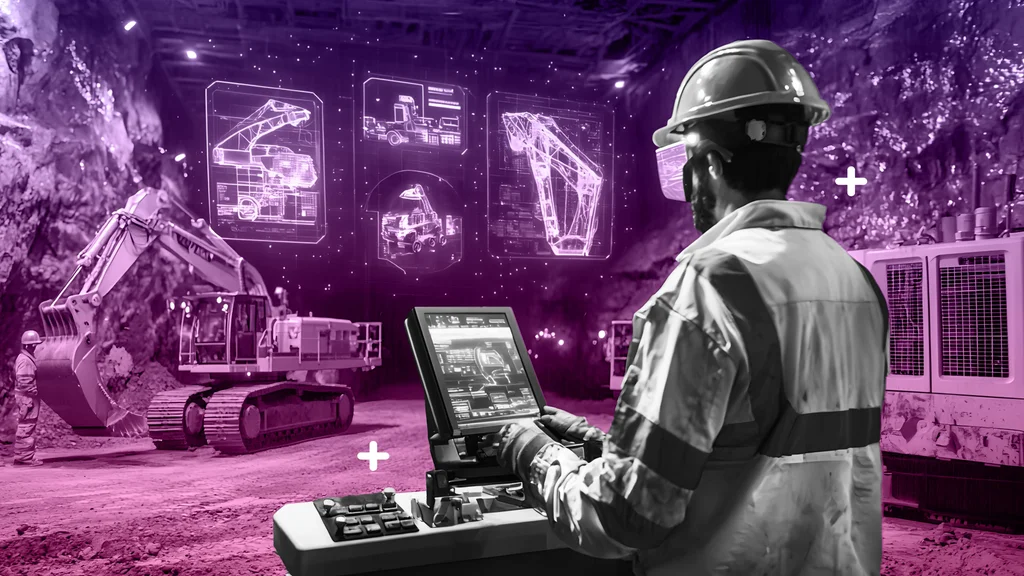

Smart solutions are already making the industry more efficient, sustainable, and competitive.
Artificial intelligence in mining is a game-changer that is already redefining how the industry addresses its most pressing challenges. From predictive maintenance and ore-quality assessment to autonomous vehicles and environmental monitoring, AI-driven innovations are making mining smarter, safer, and more sustainable. Moreover, this technological shift is expected to create new job opportunities, further contributing to the industry’s growth and prosperity.
Through real-world applications from industry leaders, let’s look at how the mining industry is embracing AI across four critical areas that demonstrate its evolution toward a more sustainable future.
1. OPERATIONAL EFFICIENCY IN MINING OPERATIONS
The use of AI starts at the beginning of the production cycle. Mining companies now process and interpret complex datasets, identifying patterns and anomalies that human geologists might miss. This capability accelerates the discovery of new mineral deposits and reduces the uncertainty and costs associated with exploration. This in turn makes mining projects more attractive to investors and supports both the industry’s growth and its sustainability in a virtuous cycle.
One major company demonstrates this shift, using intelligent systems to monitor the health of its haul trucks. These predictive maintenance capabilities detect potential failures before they occur, reducing downtime, preventing costly repairs, and extending the lifespan of equipment. The technology guides autonomous vehicles and drilling systems by optimizing routes, managing loads, and ensuring precise drilling, enabling them to operate with greater precision and efficiency.
Smart technologies also facilitate a safer working environment by handling the kinds of hazardous tasks that expose workers to potential accidents and health risks. Intelligent monitoring detects anomalies in equipment operation that might indicate safety hazards and enables proactive measures to prevent accidents—underscoring the industry’s commitment to the well-being of its workforce.
CASE STUDY: AUTONOMOUS EQUIPMENT
This mining company employs autonomous trucks, drills, and trains that work around the clock without fatigue, significantly boosting productivity. Their AI systems optimize both the scheduling of mining activities and the mining process from exploration to extraction, reducing both costs and environmental impact. This initiative demonstrates the potential of AI to revolutionize the mining industry by making it more efficient, sustainable, and competitive.
2. SUSTAINABLE PRACTICES
Another company is pursuing modern, responsible mining practices through its innovative approach to operations. Their proprietary initiative integrates AI, big data, and advanced analytics to transform mining operations. The program deploys predictive maintenance systems to monitor real-time equipment health and intelligent water management systems to optimize water usage across their operations.
It also utilizes digital twins—virtual replicas of physical assets powered by AI—to simulate and optimize mining operations and decision-making. The company’s autonomous haulage systems and remote operations centers enhance safety and productivity by reducing the need for on-site personnel in hazardous environments.
CASE STUDIES: PREDICTIVE MAINTENANCE AND SAFETY
For one project, this company is implementing its approach for predictive maintenance, water management, and optimization of energy use. Similarly, at an iron ore mine, advanced systems enhance productivity and safety through autonomous trucks and advanced data analytics.
3. WATER AND ENERGY MANAGEMENT
One other big mining company is also changing its approach to resource management. At a mine in Chile, the company has significantly reduced groundwater usage by switching to desalinated water for operational needs, with AI systems optimizing the desalination process and water recycling. AI-driven water monitoring systems track water usage in real time, detect leaks, and optimize water distribution to ensure compliance with environmental regulations.
CASE STUDY: RENEWABLE ENERGY INTEGRATION
The miner employs sophisticated monitoring to optimize energy consumption across its operations. The system identifies inefficiencies by analyzing data from various sensors and machinery and recommends adjustments to reduce energy use and greenhouse gas emissions. Its intelligent grid management balances renewable energy inputs and conventional power sources to maintain a stable and reliable energy supply while minimizing its carbon footprint.
4. REDUCING ENVIRONMENTAL IMPACT
Mining companies are minimizing their environmental impact through better resource use and waste management. Intelligent systems optimize the chemical composition in ore processing, reducing the use of harmful chemicals and minimizing environmental contamination. This is a significant step towards making mining more sustainable and aligning with the interests of environmentalists and policymakers.
Advanced monitoring platforms track emissions, water quality, and soil health in real time. This capability is critical in regions with stringent environmental regulations, where non-compliance can result in significant fines and operational disruptions.
CASE STUDY: IBM WATSON AND NATURAL RESOURCE OPTIMIZATION
IBM’s Watson AI platform is already transforming natural resource extraction and processing. The system can analyze data from multiple sources to enhance operational efficiency, predict equipment failures, and reduce environmental impact. Its advanced analytics also contribute to improved decision-making to meet its operational performance, sustainability, and efficiency goals.
ACCOMPANYING CHALLENGES
As much as there might be understandable enthusiasm for these solutions, legacy systems still need time to catch up with the new wave of developments. Integrating data across siloed systems and scaling solutions across unique mine sites are challenges that require substantial investment in infrastructure. Add to that the skills shortage in the industry to actually implement AI innovations, and we can expect some time lag before efficiency gains become standardized.
These caveats were echoed by Fernanda Martins, Industry Marketing Director at industrial software company Aveva. She says AI implementation requires robust data infrastructure and alignment of IT and operational systems. While leading mining companies have advanced their digital capabilities, many operators still need to strengthen their foundational systems before fully leveraging AI’s sustainability benefits.
It’s also worth noting that in a market saturated with AI solutions, not all AI is equally suited to mining’s needs. While large generative AI models have limited utility, smaller predictive systems using real-time operational data show more promise for sustainability gains. In short, a methodical and patient approach is needed to choose wisely and run small-scale pilots before making major investments.
FINAL THOUGHTS
By integrating AI into mining practices, we can take the lead and ensure that the mining industry remains a cornerstone of technological and economic progress. A sustainable future is not a luxury but a necessity, so the time for miners to embrace AI is now.