
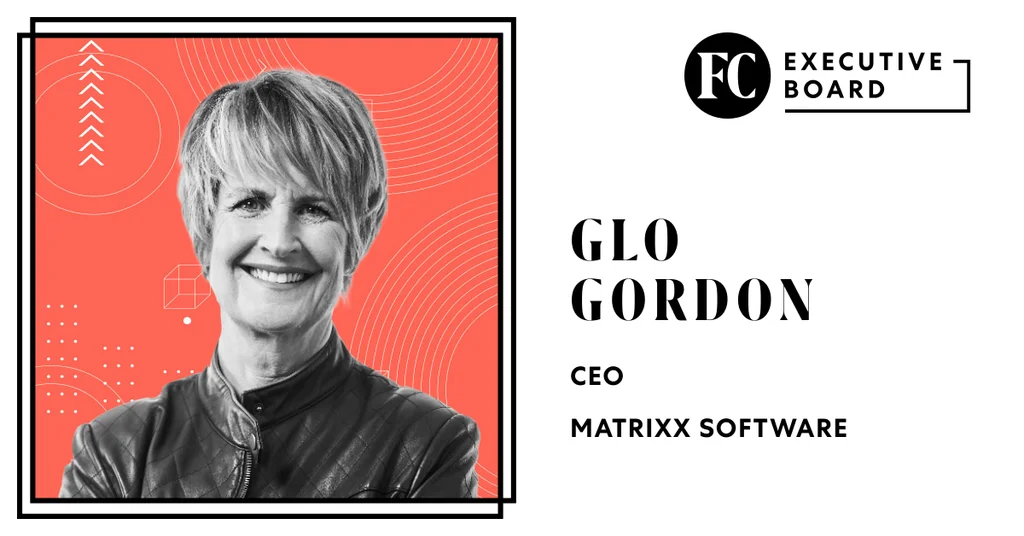

Over the years, Fast Company Executive Board member Glo Gordon has learned that cultivating a diverse and equitable workplace requires a careful combination of vulnerability and authenticity.
Back when Glo Gordon was head of sales at software company PeopleSoft, she realized she needed to better understand the company’s products. PeopleSoft had taken a chance on Gordon and hired her for her leadership experience—she had no software background to speak of. Once she was on board, she wanted to take a deep dive into the technical aspects of the products. So she turned to her team.
“They would whiteboard it for me. And I’d say, ‘I don’t understand this. Help me understand why, why, why, why?’” says Gordon. “Before we went into a sales call, I really wanted to understand what exactly we were selling, and why that was the right solution for that customer.”
Gordon reflects with gratitude on the PeopleSoft team, whose members eagerly and cheerfully supported her in this pursuit. “My team had the grace to teach me,” she says. “I called one of them my professor, because he would come in for an hour or two, every couple of days, and just teach me. I was a sponge. It was fun. I think it was fun for them, too.”
This type of humble, vulnerable leadership—a willingness to acknowledge what you don’t know, to learn from your subordinates, and to thoughtfully consider and value the needs and talents of those around you—is what has characterized Gordon’s managerial style across a veritable who’s who of software and telecommunications companies in Silicon Valley. That list includes Oracle, Jasper, Cisco, and now MATRIXX Software, on whose board of directors Gordon first began serving in 2018 before taking the helm as CEO in 2020.
Culture is always at the forefront of Gordon’s mind. She is deliberate in advancing initiatives whose purpose is to keep employees motivated and engaged by showing that their experiences matter—and that higher-ups are, contrary to popular belief, eager to hear their voices. Under her leadership, MATRIXX leverages data from employee surveys, including Net Promoter Scores and statistics on attrition, to figure out what they are doing right and where they could improve in keeping their people happy. Gordon mentions that based on what the data showed, the company “refined a couple of departments,” bringing in new people to promote a cultural shift toward increased engagement. In addition, realizing that “some people are shy, and want a vehicle to ask questions [or give feedback] without naming themselves,” she launched an anonymous line for employees who may be uncomfortable speaking openly on the public chat.
Through this research, Gordon has seen that one key component of strong company culture is communication, leading her to model a form of leadership that prioritizes relationship-building, shared goals, and openness. An advocate for “treating it as our business versus my business,” Gordon emphasizes the importance of making sure that everyone is incredibly clear on the company’s vision and their role in making it come to fruition. “I think you get a lot more out of people when they want to, versus when they have to,” she explains. “And when they understand where you’re going, and why what they’re doing is so important, I feel like people really want to be involved more—because then they’re connected to the larger picture.”
Gordon also recognizes that instilling a sense of belonging in employees is contingent upon more than just obtaining buy-in to organizational initiatives. It also requires elevating and empowering marginalized or under-represented groups. At the start of Gordon’s career, she was one of the few women leaders in tech—she emphasizes that now there are many more women in these leadership roles—and she found it imperative to “find men who support women and help them go to the next level.”
Gordon reports that gender parity in leadership has improved since she was coming up in the industry. “I’m finding more and more, I’m not the only woman in the room, and the decision-makers are female,” she says. Still, she maintains the work isn’t done. Her focus now is on helping members of other minority groups find that support: “How do you navigate the playing field and find the people who are going to support you, regardless of your minority status, through critical parts of your journey and your career?”
In her capacity as both CEO of MATRIXX and board member of Megaport, an Australian software-based elastic connectivity provider that deals in cloud-based services, Gordon ensures she and her peers in both organizations leverage data to deliver pay equity and hiring diversity. Still, she admits that even with data and increased focus on DEI across all industries, obtaining a diverse range of candidates can still be challenging—particularly for tech companies.
The work of creating a diverse workplace that is also equitable and inclusive—beyond merely reiterating tired industry platitudes—can sometimes seem like a moving target, but Gordon works assiduously to hit that mark, with the combination of vulnerability and authenticity that has come to define her unique leadership style. “I value diversity,” she says. “I value humility, in being able to have a healthy debate, and being humble enough to just listen to other people’s opinions, even though they might be totally different than your own.” The result—a track record of successfully leading team after team of engaged, motivated, high-performing individuals, whose collective work has indelibly shaped the telecom industry—speaks for itself.