
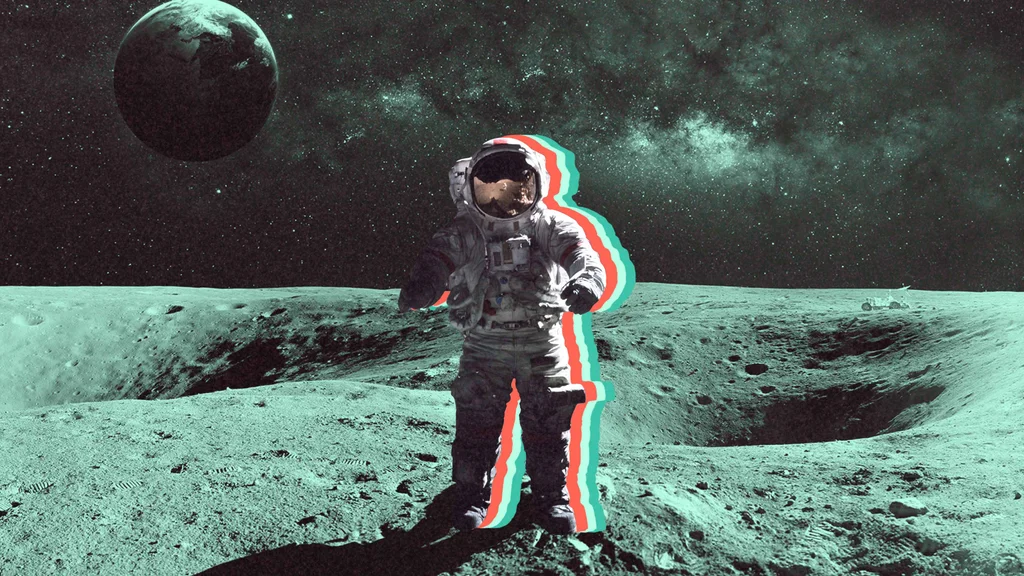

In 1962, President John F. Kennedy gave a brief but memorable speech at Rice Stadium in Houston. The late Commander in Chief spoke of the galvanizing power of doing hard things—of the Rice Owls squaring off every year against the football juggernaut Texas Longhorns. He almost casually dropped the news that America would send a crew to the moon within the decade. Not because it was easy, but because it was hard, he said. The nation needed an innovation catalyst, and the moon provided the perfect opportunity.
We all know the rest. In July 1969, the Apollo 11 crew, headlined by Neil Armstrong, planted boots and an American flag on the lunar surface. The event captured imaginations and gave the U.S. an invaluable public relations win in a technological arms race against the Soviets, who’d previously beaten the rest of the world to manned spaceflight.
There hasn’t been much action on the moon in recent years, but that’s about to change. The U.S. is engaged in a second moon race against China and Russia, and this time the stakes are even higher. The winner will enjoy major political, military, and economic advantages for decades, or even centuries, to come.
PLANNING FOR A PERMANENT LUNAR PRESENCE
The last moon mission was in 1972—a half-century ago and a decade before I was born. In the interim, we’ve had the rise (and sometimes fall) of NASA’s shuttle program, the International Space Station, Hubble and James Webb space telescopes, and the creation of a soon-to-be trillion-dollar private space economy.
As the moon took a backseat to the development of small satellite constellations and aspirations to colonize Mars, wealthy and industrialized nations improved the technology stacks that made space travel and lunar exploration possible. Still, until recently, there wasn’t much urgency to get a human presence back on the moon. It was still seen as too expensive relative to the modest scientific and political benefits moon missions provided in the ’60s and ’70s.
That calculus has totally changed. In the last few years, China and Russia signed an agreement to build a joint base either on the surface or in orbit around the moon. Along with some friendly international partners, the U.S. has more elaborate plans to build both a permanent human presence on the lunar surface and a floating orbital base via the Artemis and Lunar Gateway programs.
MINING THE MOON FOR CHEDDAR CHEESE
Newfound energy to revisit the moon isn’t only about science and geopolitics. The economic incentives to put permanent roots on the earth’s rocky satellite are becoming more obvious.
For starters, the moon is a trove of natural resources that promise trillions in value for the lunar and Earth economies. What might we mine on the moon? Here’s a short list:
- Silicon: There’s plenty on Earth, but it would be expensive to ship into space for off-planet manufacturing. Plus, the semiconductor supply chain crunch revealed that overdependence on Southeast Asia for semiconductor manufacturing is a risky bet.
- Rare earth elements: These materials are, obviously, in short supply on Earth, so the moon’s stores could be a huge boon to industries that need them, like makers of smartphones and electric car batteries.
- Titanium: This strong, lightweight metal is found in abundance in lunar dirt and is used in all kinds of earthly industries, including aerospace, medical devices, sporting goods, consumer electronics, and even paint.
- Helium-3: Found in abundance in lunar soil, Helium-3 is a lightweight and stable isotope that might be used to fuel highly safe nuclear fusion.
These are just a few of the substances and materials that make the moon a literal gold mine (yes, there are also precious metals on the moon). It’s easy to see the economic and political urgency behind the new lunar land grab. Flags planted and bases built in this decade could swing the fortunes of companies and nations for a century or more.
A STEPPING STONE TO MARS, AND BEYOND
The appeal of lunar mining goes beyond extracting moon minerals for shipment to Earth. Eventually, there will be a whole new lunar economy, with companies and industries popping up to sustain future human colonies on the moon.
The startup company Ethos is a perfect microcosm of this potential. The company bills itself as a kind of infrastructure-as-a-service company for the future lunar economy. Ethos wants to mine moon materials, manufacture solar cells to power the expanding human footprint, and use the byproduct oxygen to keep human habitations fully stocked.
This might seem like a lot of work to enable people to live on a rock far less hospitable than Earth, but it’s only part of the vision. SpaceX founder Elon Musk has famously promised to make humans an interplanetary species. Musk’s sights are set on Mars, which is 126 million miles from earth. The moon will be a crucial pit stop once Martian missions are mainstream.
Of course, Mars isn’t exactly a utopia either, but interplanetary colonization is vital to pushing the boundaries of space exploration. If we can colonize the moon, we can colonize Mars. If we can colonize Mars, maybe we can find ways to extend the human race to other parts of space, including permanent residential space stations and far-off exoplanets with Earth-like potential.
The future of humanity is interplanetary, and permanent lunar colonies are the catalyst to get us there. The first moon missions more than a half-century ago really were just the first step in our eventual giant leap forward.
Brian McCann is CEO of Intergalactic, a thermal management systems integrator serving the space and aerospace sectors.