
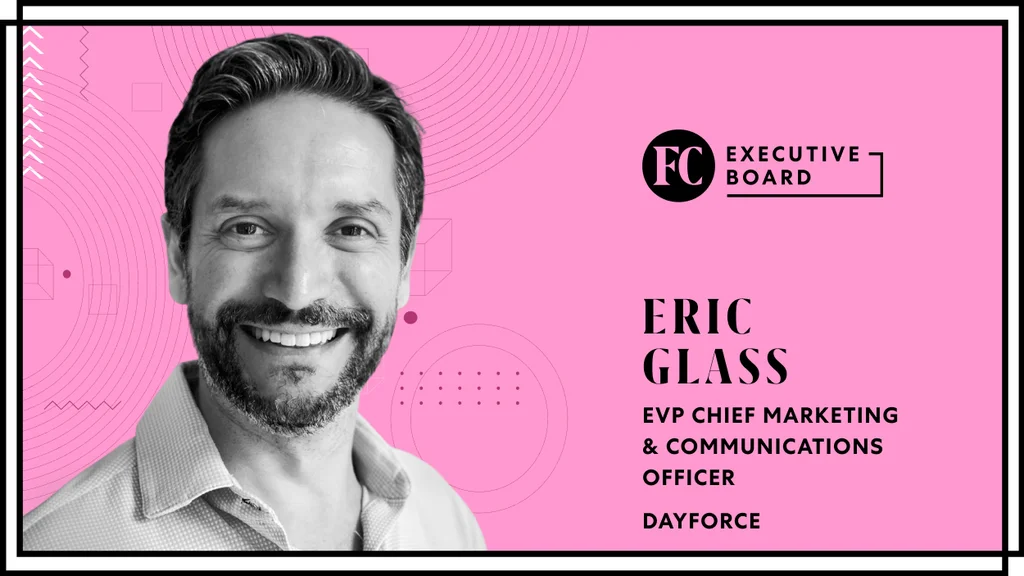

For Eric Glass, EVP and chief marketing and communications officer at Dayforce, leadership has always been an evolving story: one of curiosity, vulnerability, and learning to trust his own voice.
The idea of using storytelling as a tool for meaning and connection has shaped Glass’s approach to business and leadership for decades. “I’ve always been anchored in storytelling,” Glass says. “Writing and narrative have always been how I make sense of things and how I connect with others.”
His career has taken him from agency-side consulting to senior in-house roles at major brands like Yahoo!, HP, LinkedIn, and Workday. Now, at Dayforce, he’s helping shape how leaders show up for their people—and vice versa. Here he offers some of the wisdom he’s gathered along the way.
KNOW YOUR BUSINESS, NOT JUST YOUR STORY
Early on, Glass learned that narrative alone isn’t enough, especially in technology, where credibility depends on knowing your stuff inside and out. “There were times when I had a good kernel of an idea and I’d come in full of energy, but I didn’t have enough context,” he says. “And if you’re sitting across from a CEO or a founder, it only takes one or two pointed questions for that to become obvious.”
It’s a mistake he doesn’t make anymore. Today, he knows how important it is to understand the business as deeply as you understand the story you want to tell. That means knowing both the product and the market and being able to communicate them in a way that builds trust with audiences both internally and externally.
VULNERABILITY IS A SUPERPOWER
Of course, no one has all the answers, not even the EVP of a high-growth, global tech brand. Glass is a big believer in showing what he calls “the strength of vulnerability,” especially for emerging leaders.
“When you’re early in your career, you feel like you have to know everything,” he says. “I spent too much energy trying to be all things in all situations, and the truth is, it didn’t have the impact I wanted. It’s okay not to know. What matters is how you figure it out.”
That kind of humility boosts your credibility in the long run, he says. “I appreciate team members at all levels who say, ‘I don’t know, but here’s how I’m going to find out.’ That’s the kind of person I want to work with.”
BAD NEWS DOESN’T AGE WELL
If there’s one leadership mistake Glass wishes he could undo, it’s waiting too long to raise a red flag. Early in his consulting career, he let a client issue fester while trying to solve it behind the scenes.
“I was working on the problem, but I held back from communicating it because I wanted to show up with a solution,” he says. “By the time I brought it forward, it was too late. I was ultimately kicked off that account, and that had never happened to me before.”
The experience left a mark, but it turned out to be a great learning experience. “Get in front of bad news,” Glass says emphatically. “Even if you don’t have the solution yet, name the problem and bring people into the process. It’s better to be transparent early than perfect too late.” Whether it’s an underperforming campaign or a team challenge, the sooner an issue is out in the open, the sooner everyone can work toward a solution together.
EVERYONE HAS A STORY
Glass doesn’t believe in leading every team the same way. “Everyone shows up with their own stuff,” he says. “The more, as a leader, you can understand what drives each person—what their challenges are, what their magic powers are—the better the relationship will be. And ultimately, the better the outcome.”
That means tuning your leadership frequency to match the individuals around you. “You can coach anybody on the mechanics of marketing and communications. But what you can’t coach is that ‘fire in the belly.’” That deep drive is what separates employees who just check the boxes from those who inspire innovation, motivate teams or ignite a campaign.
As a leader, Glass says, one of the most profound things you can do is help your team find the crucial spark. “If someone’s going through the motions and not feeling the charge, it might be time to shift direction,” Glass says. “But when they tap into what energizes them? That’s when acceleration becomes exponential.”