
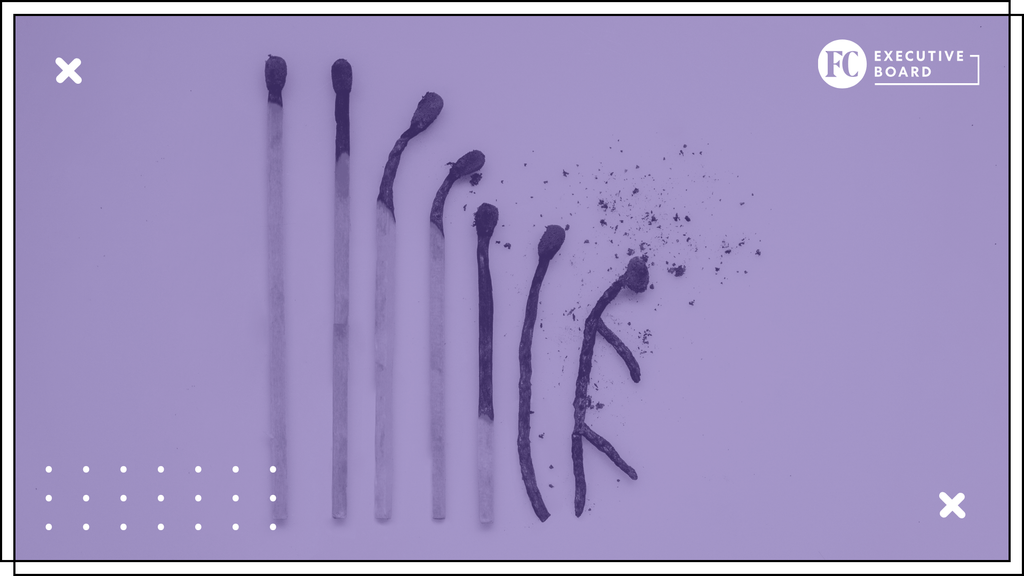

Among startup founders, more than half reported a risk of burnout directly, per a Sifted survey of 156 founders. Burnout makes people tired, but more than that, it changes how leaders think and how quickly teams can solve problems.
Leaders often assume burnout looks like absenteeism. More often, it looks like presenteeism. People are at their desks. They are in the meetings. But they are operating at a fraction of their capacity. Roadmaps slip, releases stall, and nobody connects it back to how the work was designed.
I know this firsthand.
My introduction to burnout
In late 2021, I had just helped take Hippo Insurance public on the New York Stock Exchange. Signing my name on that wall on the walk to ring the bell should have felt like the culmination of years of work. It was. And I was completely spent.
I had not built the right system around myself. I just absorbed more instead of designing for capacity. The combination of personal and professional commitments kept me in a chronic stress state—what psychologists call hyperarousal, where the nervous system remains in a sustained fight-or-flight activation.
Primed for threat, I suffered from elevated cortisol, poor sleep, diminished capacity for complex thinking, and a narrowed focus on immediate survival tasks at the expense of recovery, relationships, and perspective. I operated on fumes and made decisions from a place of depletion rather than clarity. It took nearly eight months to restore my nervous system and reclaim my full capacity.
Leaving Hippo altogether was the cut I had to make. I accepted that I couldn’t heal while still carrying that load, and needed a clean break to show up fully for my kids and for my own future.
I went to Sedona, Arizona and built a four-day reset practice of rest, meditation, hiking, and journaling. No email, no strategy, just restoration.
That experience became the template—an annual non-negotiable reset that I protect to this day. What those eight months taught me is that recovery sometimes requires you to remove what’s breaking you. That period changed how I think about organizational design and continues to inform everything I advise on today.
The design problem
I’ve found that most startups resist the idea that slowing down could make them faster, particularly because velocity is one of the most important drivers of startup valuation.
Yet when founders default to extreme work models, they burn out their people and undermine their own ability to deliver. The instinct is to call that a people problem, but it is a design problem. The question is whether the work itself is structured for sustained output or short bursts followed by collapse.
In hindsight, what I would have done differently at Hippo is design my own role with the same rigor I applied to organizational structure. I would have capped my hours, built in recovery windows before they became crises, and protected thinking time. I would have said no to stretch assignments that looked like growth but were actually just load.
Most critically, I would have modeled sustainable capacity instead of infinite absorption. Founders set the organization’s nervous system. When you’re in hyperarousal, your whole team lives there too.
Two examples of where capacity design starts
I recommend that organizations define what work is actually needed over the next 12 months. Not what people are currently doing. What needs to get done, why it matters, and how it should happen.
For example, a Series B company thought it needed to hire 2–3 more people on the sales team because the sales vice president said the team was drowning.
The problem was that the CEO needed approval for every sales compensation decision, every deal exception, and every contract variance. The sales vice president was bottlenecked waiting for sign-off, but the sales team was actually doing the work.
So we built a compensation framework and an exception approval matrix. The CEO defined some approval thresholds, while the vice president could decide on others. That single design change freed up eight hours a week for the sales vice president, allowing the sales team to actually do their work. No new hire needed. Better design won.
This approach means looking honestly at where the bottlenecks are, where automation should be introduced, and what behaviors persist simply because nobody has questioned them. Then, stepping back and designing the workforce needed over the next 12 to 18 months with a small group of trusted advisors without a political stake in the outcome.
Another growing Series A company assumed they needed another human resources hire because onboarding was a disaster. New hires were lost, took weeks to ramp up, and nobody knew where to find anything.
It turns out that onboarding was broken because there was no process. The real work needed was in documenting what actually happens in weeks one, two, and three, and assigning ownership. Not creating a new role, just clarifying who does what.
So, we spent two weeks mapping what each department actually does with a new hire, documented it in a shared checklist, and assigned an “onboarding buddy” role (rotating among peers, not a new hire). Onboarding went from chaotic to consistent, without adding a new person. The real work achieved was in process design.
What strong leaders do differently
Many startups, flush with new funding or navigating leadership transitions, believe they must move faster to catch up. But moving faster without structural design only accelerates breakdowns. Culture erodes. Leadership teams fragment. Silos form.
Strong leaders deliberately slow down and redesign work to reflect how humans and technology actually operate together. And when something breaks, they go back to the system rather than blaming the person closest to the failure.
If a founder wants to reach an eventual IPO or acquisition, the shift has to move from reactive hiring to intentional workforce design. Build the company around what people can sustain, and learn how to keep going forward sustainably.
Anna Lenhardt is the founder and CEO of Lenhardt Partners.