

Disruptive innovation comes from recognizing what’s “missing”—the root causes of persistent friction or deficiency in any given industry—and offering a unique solution, often leveraging new technologies. When the solution is indeed different and not just incrementally better than what was previously available, the innovator has the rare opportunity to define, name, and lead the new category they are pioneering. This is the story of one such journey.
One of the fastest-growing sectors in the health and wellness industry is dietary supplements. About 75% of Americans use natural products such as nutraceuticals and dietary supplements. These products are mostly considered safe (based on low side effect reporting despite broad-based usage), are usually not as expensive as pharmaceuticals, and can be bought directly by consumers without any gatekeepers. However, there is no clear guidance on which brand, dose, or ingredient would be most effective—if at all. Most supplement companies are missing clinical proof of their products’ effectiveness due to a lack of easy and affordable access to clinical trials. This proof gap leads to a trust gap by consumers and healthcare providers alike. Understanding the root cause of that distrust is the key to disruption.
DEFINING THE PROBLEM
The coveted gold standard research framework—double-blind, randomized, placebo-controlled clinical trials—was originally created and reserved to prove the effects of patentable pharmaceuticals. The traditional clinical trial approach, costing millions of dollars and taking years to complete, has long been largely inaccessible to natural product manufacturers. Put simply, this process is too expensive and slow for unpatentable nutraceuticals, creating a huge gap between health benefits supplement companies’ promises and the scientific evidence to support it.
But what if it were easy and affordable for manufacturers to formulate nutraceuticals that worked, and demonstrate clinical proof to support their products’ effectiveness claims for consumers and healthcare professionals alike? What if the datasets were large and diverse enough to eventually recommend the right natural product, at the right dose, for the right condition and person? Then, non-pharmaceuticals could finally be trusted by consumers, recommended by healthcare providers, and used widely.
DISRUPTING THE STATUS QUO
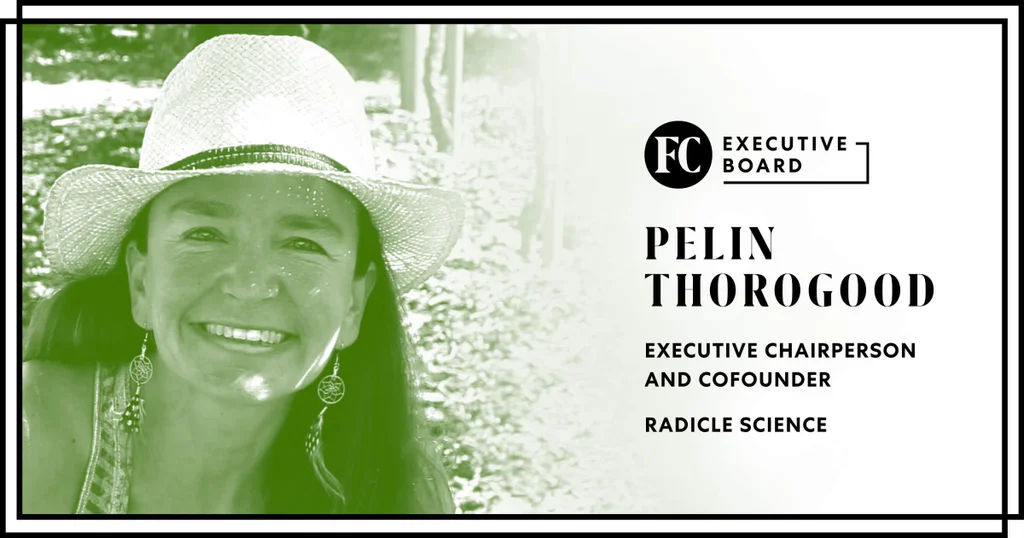
The disruption to the status quo had to come from outside the industry echo chamber, according to Pelin Thorogood, co-founder and executive chair of Radicle Science. (Thorogood is a tech executive and analytics industry expert who also has experience as a philanthropist, funding natural product trials at American universities. Her co-founder and Radicle Science CEO, Dr. Jeff Chen, is a physician/scientist who founded a natural medicines research program at UCLA.) Together, Thorogood and Chen realized that adoption of AI, virtualization, and widespread use of smartphones and digital health devices had the power to fundamentally transform the future of clinical trials for health and wellness products. And to use a car industry analogy, the solution to this black hole of proof wasn’t going to be “faster horses.” Rather, it had to be an entirely new category.
Category design is the discipline of creating and developing a new market category, which can then be monetized before competitors can enter the space. Establishing a new niche that is virtually free of competition maximizes the chance of dominating it. Category design starts by recognizing a persistent, ongoing problem that people didn’t know they have or haven’t yet realized can be solved in a new way. “It is not about being better than what’s currently on the market, so much as being completely and radically different,” Thorogood says. “It’s not about focusing on what’s already there, but on what’s missing.”
For Thorogood and the team at Radicle Science, the “proof gap” in the natural medicine industry required the creation of a completely novel category: proof as a service. Radicle Science enables nutraceutical companies to run AI-driven, virtual, direct-to-consumer (D2C) clinical trials, yielding large-scale predictive and objective health data that are representative of the population at large—all at a fraction of the time and monetary cost of typical pharma trials.
The availability of proof as a service is transformative for manufacturers and healthcare providers, as well as for consumers, who have not only endured a lack of health data about these products but also a lack of data generalizability to their broader population. Large-scale, virtual, D2C trials offer the opportunity to help mitigate the over-prevalence of white, urban, male participants in most traditional trials. The result, says Thorogood, is a giant step towards true democratization and personalization of medicine.
PIONEERING A NEW CATEGORY
The advent of software as a service (SaaS), a famous example of category creation, offers a paradigm around which proof as a service will be modeled, Thorogood says. She recalls “the birth of SaaS,” which she witnessed firsthand as a young tech executive serving as CMO of WebSideStory, the third SaaS IPO ever. “Until SaaS, IT served as the ultimate gatekeeper to all departmental technology needs,” she explains. When SaaS became prevalent, “it changed the game,” Thorogood recalls. “All of a sudden, every department—finance, marketing, sales, HR—was able to subscribe to whatever they wanted with their own budget, use it as long as they wanted, and switch at the turn of a dime. It wasn’t like you were going through the IT process faster, or more smoothly—everything was completely different.”
This reference point led Thorogood and her team to a realization that Radicle Science should not think of itself as a better, faster, cheaper clinical trials company; rather, it is a health tech company, with a transformative approach to elevating dietary supplement R&D, customer acquisition, and retention processes with a novel, lifecycle engagement approach. The new proof as a service category was born.
A “RADICLE” PARADIGM SHIFT
Several elements of the Radicle Science approach led to the paradigm shift: Automation and standardization support the company’s ability to deliver rigorous health outcome data at unprecedented affordability and speed. Leveraging AI to manage its large and growing dataset enables Radicle Science to continually optimize its entire process, from participant recruitment and engagement to study design. Virtualization and the D2C model make study participation easy and valuable for diverse groups of volunteers across the nation. Finally, the large scale of the studies and the diversity of the populations make the findings personalized and relevant for the population at large.
Each of these facets is a vital component of the proof as a service approach. When it came to category creation, it “wasn’t just about being better but also different ” than traditional clinical trials, says Thorogood. “What’s even more revolutionary is our ability to aggregate standardized data to create industry benchmarks and even predict personalized health outcomes leveraging AI models. Manufacturers and brands will finally have the opportunity to approach product innovation, customer targeting and engagement in a completely different way—and achieve outcomes simply not possible with custom-designed one-off studies.”
For Radicle Science, whose B-corp mission is all related to the questions of accessibility—of traditional clinical trials, of reliable data, of supplements, of health and wellness—the imperative of category creation represents not only a valuable business proposition but also a chance to meaningfully reimagine solutions to pressing issues impeding personalized medicine. “Anytime you create a category, you need to start by focusing on what’s missing in the status quo and why,” Thorogood reiterates. “Incremental change only yields incrementally better results. Want to shake things up? You need a game-changing approach.”