
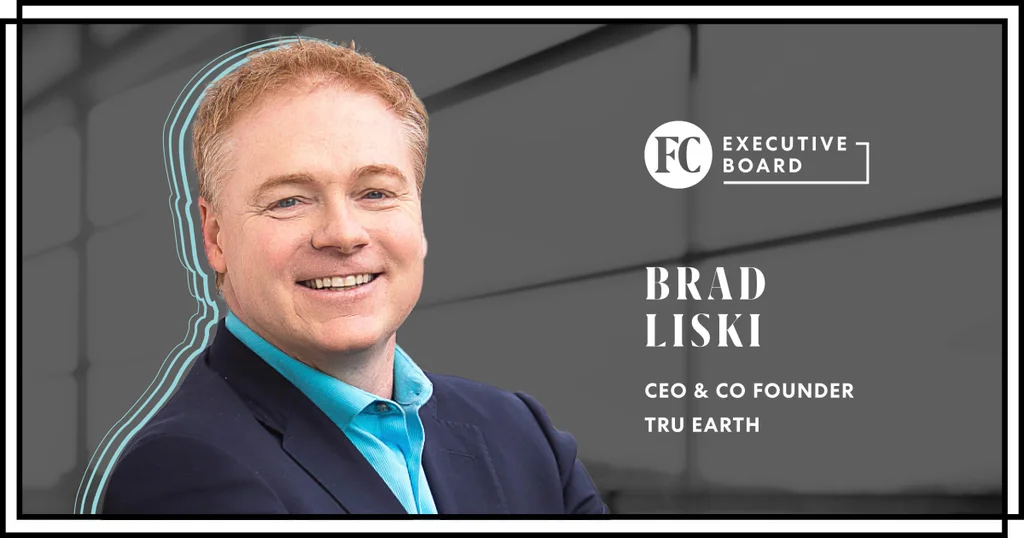

When asked about the severity of the global plastic waste crisis, Brad Liski, co-founder and CEO of Tru Earth, likes to share a particularly visual statistic: Every three minutes, humans dump the equivalent of one humpback whale’s weight in plastic waste into the oceans. Most of this is single-use and short-lived, non-recyclable plastic. When these plastic items are discarded, the incineration process further releases toxins into the atmosphere and subsequently into the water system.
Meanwhile, plastic production in the United States alone contributes to over 232 million metric tons of greenhouse gasses annually, which means plastics will surpass coal emissions as our biggest air pollutant by 2030. This isn’t because coal production is slowing down, Liski stresses. Rather, plastic production is speeding up and is expected to triple its current rate by 2060, even as it leaves a trail of environmental devastation in its wake.
The impact of plastic waste on human health is direct, Liski says, citing that plastics contain some 13,000 different chemicals, which humans ingest at a rate of five grams per week—mostly without even realizing it, while breathing or drinking from local water supplies. Plastic waste infiltrates all aspects of our food chain, making its way through water and soil into the food and beverages that we consume, resulting in a variety of health problems. “I’m not a doctor, nurse or medical professional,” Liski cautions, “however, data show that serious health issues—including cancer, lung diseases and birth defects—may result from the plastics we ingest every day.” And as greenhouse emissions and ocean waste further degrade the climate, Liski bluntly assesses that the increase in extreme weather events “will put everyone in peril.”
Liski believes that national and international agendas are necessary steps toward mitigating the crisis. “I’m a big believer that these agendas are steps in the right direction. They need to happen,” he says. “We pay close attention to the UN Global Plastics Treaty and the discussions that are underway about targeting the full life cycle of plastics are an unprecedented step forward.” Nevertheless, he says, the onus to implement systems that halt further environmental degradation must be on companies, ideally without the need for governmental pressure or injunction.
So what can companies do to reduce their plastic dependency and take steps to mitigate this crisis? Liski offers a three-fold plan:
1. Reduce plastic production. This step is simple in theory, but complex in reality. “You need to reevaluate your products,” Liski asserts. “Explore alternative materials and models within production, shipping, and storage, among other areas. Overall, the goal is to stop creating plastic in the first place.” Liski recalls that even Tru Earth’s marquee product, a laundry detergent eco-strip packaged in a cardboard envelope, had to undergo an in-depth process. “The person who initially invented our product thought it needed to be packaged in plastic, but we refused to accept that” Liski acknowledges. “They didn’t think it could be housed in just paper and cardboard. But, we continued to push everybody’s thinking and we’ve proven that it can.”
2. Educate your customers. Liski realizes that some companies believe plastic packaging is the only solution to meet demand. Yet, he says, organizations must think beyond offering what producers or marketers think customers want and rather, focus on “changing behavior through education.” Tru Earth has been successful, Liski says, because it focuses on teaching people to change long-held habits. Giving customers clear and digestible information about the consequences of plastic overuse and waste, and explaining easy-to-implement alternatives, is an effective strategy to obtain their buy-in.
3. Secure stakeholder buy-in. ESG scoring and reporting have improved in recent years, Liski says, but greenwashing remains a problem in many industries. Companies must make intentional commitments to environmentalism and accurately demonstrate the successes and limitations of their initiatives. “Truthfulness and transparency are going to be absolutely critical for stakeholders and investors to trust that the information companies provide is true and not greenwashed,” Liski says. “The goal is to ensure that consumers and other stakeholders clearly understand a company’s social good agenda and how these initiatives are being accomplished.” Tru Earth, for instance, produces regular impact reports on CO2 reduction as a result of their changes in shipping, which are then conveyed to customers, employees and investors. “There is a direct line between companies being fully transparent about the value of their social impact initiatives and winning customer loyalty,” Liski says.
Ultimately, the challenge to today’s entrepreneurs must be, Liski commented, to push common sense a little bit further, and ask “How can we live more sustainably? It won’t be easy to help save the planet—and you can’t do it without breaking some molds and creating new business models,” he says.
Liski believes that solutions must involve balancing capitalism, environmentalism, and social good. “Without that trifecta, we are in for more severe climate impacts on top of the myriad events we’re already experiencing,” he warns. “That’s why we’re trying to disrupt the entire market—and in doing so, create true, lasting change.”