
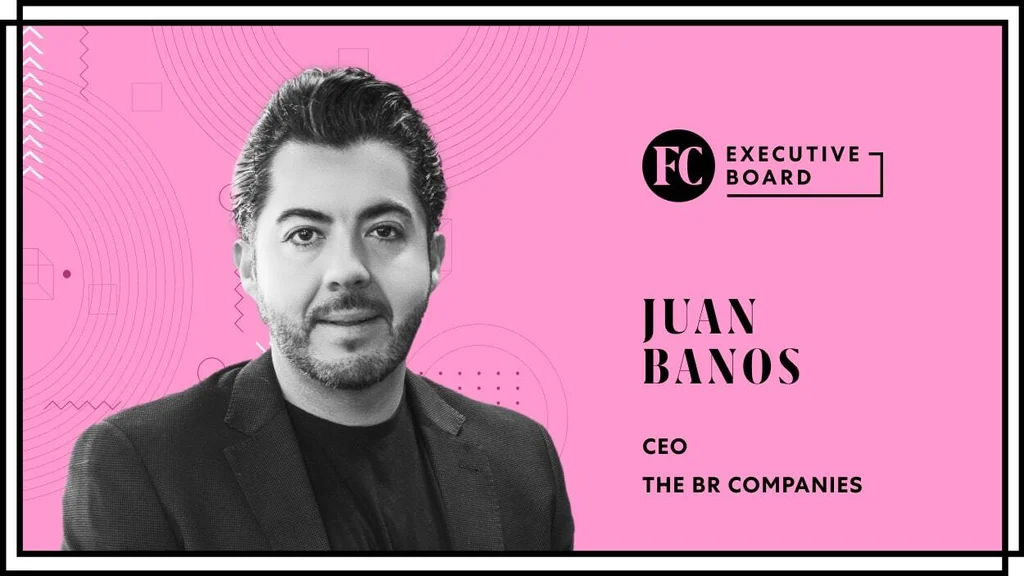

In 2009, Juan Banos, just 19 at the time, was working at a law firm and ready to begin college. His goal? To become a trial lawyer.
But then his father, the founder of The BR Companies, a construction and building firm, got diagnosed with lung cancer. Banos’ father, an immigrant from Spain, had been a builder in his home country in the 1970s. Due to political and economic instability in Spain around that time, he fled to Mexico, where he met Banos’ mother.
Eventually, Banos says, the couple moved to Southern California “in pursuit of the American dream.” Banos’ father started The BR Companies in 1985 and incorporated in the 1990s.
“He built a successful company,” Banos says.
However, by 2009, Banos explains, the business was “already starting to take a hit” due to the economy, and his father’s cancer diagnosis made matters worse.
“He did everything himself; he managed all the relationships and projects,” Banos says. “With the diagnosis, we started to lose everything. On top of that, we had no systems in place and no succession plan.”
Growing up, Banos worked for his father’s company, digging trenches and doing demo work during the summers—which made him “want nothing to do with construction.” But when his father only had several months left to live, Banos’ mentor, a friend of his father’s, told him something that would change the trajectory of his life.
“He told me that I would be a terrible lawyer, that he thought I was an entrepreneur, and that I needed to go help my family with the business,” Banos says.
When his family gathered together for a meeting to figure out how to proceed with the business, Banos offered some ways he thought he’d be able to help.
“I said, ‘I don’t know, maybe I could help sell some projects and build some relationships?’” Banos explains.
TACKLING THE CHALLENGE OF REBUILDING A FAMILY BUSINESS
In December 2009, Banos’ father passed away.
Banos, grieving, was deep into the process of trying to rebuild the family business with his siblings.
“We were working really hard,” Banos says. “We had no money in the bank. We’d actually bankrupted our father’s business because we didn’t know how to run a business.”
Banos realized that there was more to running a business than selling and establishing strong relationships.
“I could sell anything, but when you don’t know how to operate or take the necessary financial requirements into account, there’s no value to just knowing sales,” Banos says. “If you’re good at selling, you need to have money to support that.”
Banos points to an example—when he and his siblings secured their first big project, a $100,000 concrete job, for the company.
“We celebrated that night,” Banos says. “We were happy; we thought that things were going to start being OK for us again. But the next day, everybody was basically in tears because we couldn’t afford to do the job. That’s when we quickly learned that it takes money to make money. You can get a $100,000 order, but that doesn’t mean you’ve won the lottery. In fact, it could be the opposite.”
Banos and his siblings worked through the challenge and completed the job.
“From there, we slowly started rebuilding the business,” Banos says. “A lot of jobs were coming in. We got the company to a point where we were able to get into new verticals, like healthcare, and we realized that if we can build, we can build virtually anything for anyone. And then we realized that if we can build virtually anything for anyone, we should build an ecosystem around the foundation of building to better serve our clients and internal team.”
FINDING PURPOSE IN CONSTRUCTION
Banos knew that if The BR Companies was going to be an authority in the industry, then the team needed to understand the various elements of the industry, such as land acquisition, real estate, and energy efficiency. So he set out to grow those capabilities on his team.
“That’s why today, our core business functions are construction, development, energy, real estate, and finance,” Banos explains.
Banos also embarked on creating the company’s mission and culture. While doing so, he figured out why he had “hated construction so much” when he was growing up.
“It was because it hadn’t felt valuable, purposeful, or significant to me,” he says. “I saw it as getting a shovel, sweating, going home tired, and getting paid. But I knew that at our company, we needed to create a culture that emphasized the significance of construction and what it is to be a builder.”
Banos wanted people to see the valuable role construction has played, and still plays, in human advancement.
“It represents such an important foundation to who we are as humans,” Banos says. “You’re sitting in your office or in your house, and you have shelter. Somebody you don’t know was in there putting up that drywall and installing those doors for you.”
Banos began to prioritize supporting everyone involved throughout the building process. He didn’t put a formal mission statement into words until 2018, when he, his siblings, and the rest of the executive team sat down to evolve the company’s branding. The company’s mission statement became “Championing the people who build.”
“For me, that statement represents the person who’s pushing a broom to the person who’s in the boardroom raising $100 million for a project, the person who’s hanging drywall to the person who is selling the property,” Banos says. “Millions of people work in the world of building, be it in the field or behind the scenes. They’re all builders, whether they’re building a project or building a process in the business.”
TAKING A SACRIFICIAL APPROACH TO LEADERSHIP
While updating the company’s branding, the team agreed to keep the original logo. The logo, a shield, represents Banos’ sacrificial approach to leadership.
“The shield represents a big part of being a leader—the willingness to become a shield for those who follow you and the willingness to take hits even when you don’t know what they’ll be or when they’ll occur,” Banos says.
Banos believes that there’s been a paradigm shift in how businesses are run.
“Before, it was all about the emperor, also known as the employer,” he says. “But you really grow a business through the people. As leaders, we need to feel grateful for people being there alongside us and fighting each day to bring the vision to life.”
Banos says a key part of that gratefulness involves being ready to make sacrifices.
“Leadership is a sacrifice, and I think the word leader is misleading,” Banos says. “Everyone wants to be one, but most aren’t willing to make sacrifices, and the hard reality is that not everyone should. On a battlefield, the true leader isn’t a general in the back. It’s the one who’s on the first horse, gun in hand, running ahead of everyone. That’s who leaders need to be.”