
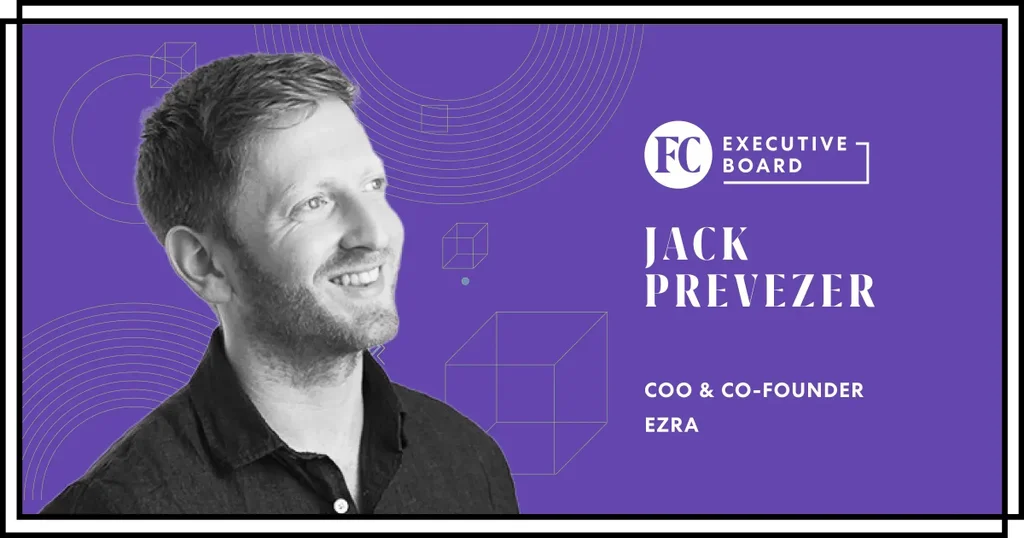

When the digital coaching and learning platform EZRA launched in 2019, its founders had a clear mission and vision: to revolutionize professional coaching and bring it to as many people and organizations as possible.
“At the time, coaching was very much a preserve of the executive community, those at the top of the organizational pyramid, and we felt like this was a superpower that those lower down were missing out on,” says Jack Prevezer, COO and co-founder of EZRA. “We believed the data was telling us that dollar for dollar, one-to-one coaching and professional development are probably the best investments an organization can make in developing their talent. And so we set out to democratize an inherently exclusive, elitist offering in an organization.”
This objective became EZRA’s North Star, the touchstone that all of its leaders and employees turn to before making decisions or taking action. But the company’s mission has also evolved over the years, as its focus expanded to encompass both individual and organizational change.
“What we realized over time, as we coached more and more people, in the hundreds or thousands at large organizations, was that we weren’t just transforming the lives of individuals,” says Prevezer. “We were transforming organizations as well. By transforming individuals at scale, we were making companies more productive, more inclusive, happier places to work. So our mission has evolved.”
While other organizations prioritize revenue growth or cost savings, Prevezer says that EZRA is “solely, relentlessly focused on driving impact.” According to March 2024 data assessing approximately 38,000 participants across 1,331 EZRA coaching programs in 442 organizations, 81% of employees saw an improvement in their behavior across all competencies—a conclusion supported by 71% of managers. After coaching, employees reported experiencing high job performance (52%) and satisfaction (40%), and managers noted a reduction in employees perceived to be disengaged (35%) and an increase in employees rated as ready for promotion (24%).
“We’re seeing ripple effects in the organizations we work with, as people become happier and more engaged,” says Prevezer. “Individuals are far more motivated to make a difference. Frontline managers are becoming better managers, and the people they manage are also benefiting from this improvement. We think that a bigger focus on individual development can drive both greater retention and performance in the workplace. We coached thousands of frontline managers in the call centers and retail branches of one of the biggest banks in the world. Their teams became 18% more productive, using their bank’s own productivity metric. That’s a phenomenal return on investment.”
For other leaders striving to create or evolve their company’s mission, Prevezer emphasizes the importance of authenticity. A mission statement shouldn’t be pretty, empty words; to resonate with employees and get their full buy-in, it must be integrated into an organization’s values, decisions, and actions.
“Your mission needs to be authentic and relevant to the work you do,” says Prevezer. “But that does not mean that you can’t develop a mission that is transformational and aspirational. Your mission has to be embedded in your operating model and the way that you do business. You have to manage your employees’ performance and track your objectives and impact according to the mission. The other side of the coin is having values that are aspirational. Our values mirror our mission. We have six core values—care deeply, push positively, own it together, keep it simple, listen and learn, and enjoy the ride—and we ask our employees to show up every day and live these values.”
EZRA builds these values into its performance management cycle, asking managers to check in on them regularly and incorporate them into an overall values score for each employee at the end of the year. The objective is not achieving perfection in every area, Prevezer notes, but rather to celebrate wins and set tangible development goals for the future.
Looking ahead, Prevezer is excited about continuing to strengthen and advance EZRA’s mission.
“From a company and mission perspective, I think we’re still just getting started,” he says. “Coaching was a niche category in the world of learning and development only five years ago. We have been one of the market leaders in bringing coaching front and center as a primary, not a secondary, instrument for behavioral change. Even now, we might have moved the needle from 50 people being coached to 500 people being coached, but there might still be 100,000 other people in the organization not being coached. Our vision is that we will not stop until everyone in an organization can access a coach. We believe that anyone can be better with a coach. To fulfill that mission, we need to bring this superpower to as many employees as possible.”