
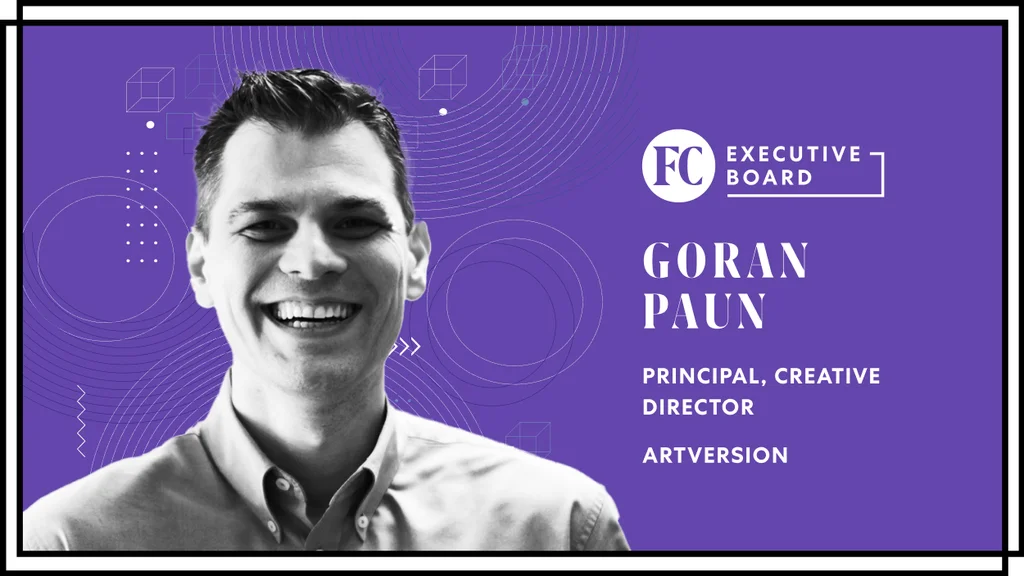

When the Virginia A. Groot Foundation reached out to the digital design agency ArtVersion, Goran Paun and his team saw an opportunity to capture a legacy—that of Candice B. Groot, the nonprofit’s founder.
The nonprofit needed ArtVersion’s help with two projects: the first, a revamp of its main website; the second, a new website showcasing Groot’s personal art collection. Both projects were entrenched in Groot’s story. Groot, an artist and educator, started the nonprofit in 1988 with the goal of supporting sculpture artists. A ceramic sculptor, Groot was passionate about not only creating art but also collecting art.
“The foundation is doing something amazing,” says Paun, ArtVersion’s principal and creative director. “They provide grants to artists; every year, there are three winners and a few runners-up who are provided with funds to pursue their body of work. The money is used as a parachute for an artist to devote their time to creating something amazing and not worry about finances, allowing them to truly focus on art. The foundation also funds art development programs run by other organizations.”
REVAMPING A WEBSITE, REVITALIZING A MISSION
Before digitally archiving Groot’s art collection, the ArtVersion team needed to revamp the foundation’s main website. They knew that by doing so, they could revitalize the foundation’s mission and enable it to continue inspiring and supporting generations of new artists. In February 2022, ArtVersion began working on the Virginia A. Groot Foundation’s main website.
“We started from scratch,” Paun explains. “At the time they approached us, they only had a landing page that was quite static, so we had to do research and analysis to create a comprehensive website as some information was not available on the old site. We knew that what we built would enable the foundation to continue the legacy Candice started.”
ArtVersion has deep expertise in UI/UX design. The team anchors its empathy-driven work on creating human-centered designs that facilitate inclusive user experiences. However, the team understands that great UI/UX alone does not make for websites that move people—stories do.
“We tell stories constantly,” Paun says. “There is always something that we need to uncover on the client’s side, either because they are so accustomed to it that they don’t know how to articulate it or because it’s fallen to the wayside and hasn’t been used.”
The team deeply researched the foundation’s history, interviewing stakeholders and examining historical documents.
“For example, we went through archives at notable art museums and auction catalogs, where some of the foundation’s stories were held, so we could learn and determine how to portray them to users in a visually appealing, tangible way,” Paun says.
He adds that when storytelling, multiple dots must be connected between the factual and emotional elements of a story. Moreover, ArtVersion’s executive director of design, Erin Lentz, stresses that the user pathways and journeys must help tell the story, not interrupt it.
ArtVersion built an intuitive main website for the foundation, where users can learn the story of the nonprofit’s past, present, and future through multimedia and text. The new website went live in May 2022 and received two w3 Awards in October 2022.
But the collaboration between ArtVersion and the nonprofit was far from over.
DOCUMENTING MORE THAN A MASSIVE ART COLLECTION
To say that Groot had an enormous art collection is an understatement—it spanned three residences, according to Paun.
“Before she passed away in 2015, Candice had told her niece Nina Latusek, who is now the president of the Virginia A. Groot Foundation, that she’d like to create an archive of her collection, which was spread across three residences,” he says.
Paun and his team knew that in their goal of digitally capturing Groot’s art collection, they also had to represent her essence—who she was and what she stood for.
“Candice was an incredible person,” Paun says. “What she did in the world of sculpture, nobody did before or after her. The impact that she had on people, even after her death, was more than financial—she gave artists a stepping stone, and some went on to become recognized worldwide. We wanted to create a digital tool that continued her lifelong mission.”
The ArtVersion team started researching Groot’s life. They sat down with the founder’s family and former colleagues, having conversations that shed light on who she was as a person.
“As we worked with the family, we kept getting more ideas,” Paun says. “We decided that Candice’s website should be a biographical platform and cover the micro-stories of her life as an educator, artist, friend, and family member.”
Lentz recalls the reactions of Groot’s family members during the project.
“It was special watching their eyes spark with joy and pride when they saw all the materials we were able to scan, like old family photos and art photos, and then put in one spot where they can easily access them,” Lentz says. “It’s a living legacy for Candice.”
The end result was a website called Art is Everywhere that tells Groot’s story. Users can dive into Groot’s personal art collection—from the amusing to the absurd—and understand her personality and passions. In March 2024, the website won a gold MUSE Creative Award. In April 2024, it won two honors and received one nomination for the 28th Annual Webby Awards.
“It was incredible working on Candice’s website,” Paun says. “This project was much more than just creating a visually appealing, interactive website. We started connecting to this project on a more emotional level because we wanted her legacy to live so more artists could benefit from it. Candice was an amazing person; we felt like we had met her through all this work. Her impact definitely touched our souls.”
Paun emphasizes that generations of students and artists to come will be able to benefit from the documentation of these art pieces.
“Pieces like the ones in Candice’s collection are typically in private collections,” Paun says. “If they are publicly displayed, they’re in museums, galleries, and other exhibitions that not everyone can get to. But now that Candice’s pieces have been captured digitally, they can be accessed around the world. This project has been deeply rewarding.”
THE IMPORTANCE OF DOCUMENTING LEGACIES
The ArtVersion team has continued to work with the foundation to improve both websites. For Paun, doing so is part of capturing a legacy. He believes that capturing heritages digitally is important for all types of organizations.
“Many organizations are sitting on certain archives that are mostly in physical form,” Paun says. “Creating an accessible digital presence for those items, bringing them to life in digital form, is important. Due to ever-changing innovations spurred by technology, the world has gained a new understanding of digital archives and interactions.”
For Paun and his team, whether they’re working with a nonprofit or a corporation, their work ultimately comes down to reach and accessibility.
“Being able to produce work that reaches millions of people around the world is always very fulfilling,” Paun says.