
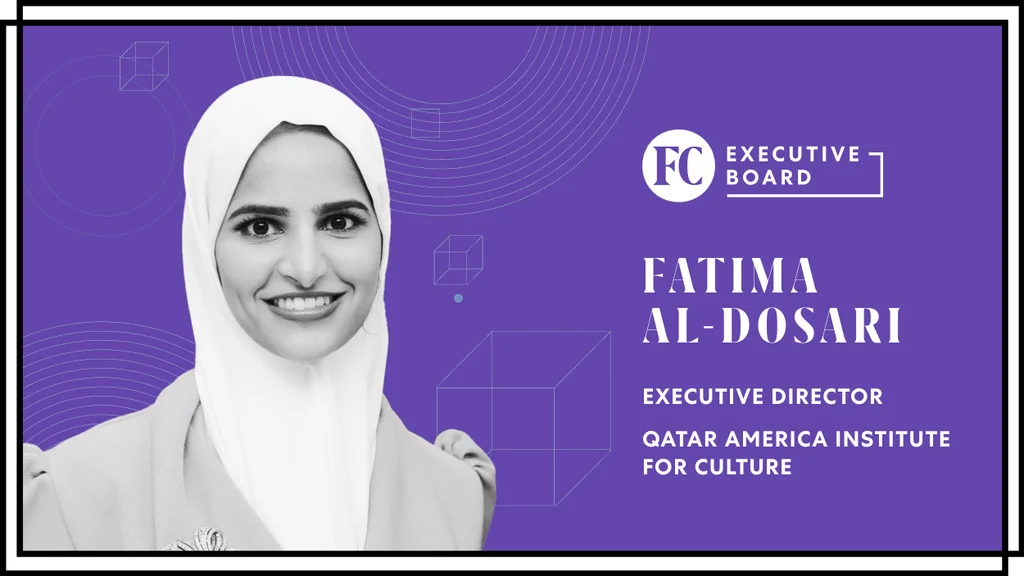

“What’s that perfume you’re wearing?”
This is one of the questions that Fatima Al-Dosari, executive director of the Qatar America Institute for Culture (QAIC), hears most frequently when meeting people for the first time.
“Since I moved to the U.S., this is the question I get from everyone, whether they are an Uber driver or someone in an elevator,” said Al-Dosari. “And I always find it so joyous to answer because my perfume tells my story—the story of my identity, culture, and traditions. I tell them it is a scent from Qatar, and that leads to explaining where Qatar is on the map and the culture I represent. Talking about fragrance has been a great way to start conversations with strangers about my country, religion, and region.”
THE POWER OF SMELL
The sense of smell is closely linked to memory and emotion, according to decades of research. There is a stronger connectivity between the brain’s hippocampus—responsible for processing and retrieving memories—and smell, than other primary sensory areas. In other words, the sense of smell can evoke more intense emotional memories than sight, sound, or touch.
Al-Dosari noticed that scent was a favorite water cooler topic among her colleagues, and this insight inspired their team to experiment with new ways of connecting with QAIC’s audience. What began as a small display evolved into a standalone exhibition and then an entire museum.
“In 2018, we started with a small collection of ‘teeb’ (meaning ‘fragrance’ in Arabic) at the entrance of our office,” said Al-Dosari. “Growing up in Doha, whenever I visited other people’s homes, I was greeted by a mabkhara (incense burner) and a tray with an array of fragrances. It’s a piece of my culture that I wanted to share with people in our space in Washington, D.C. We created a display with perfume bottles and an infographic on the rituals of perfumes in Qatar. Visitors to our space loved it and always asked for more.”
Encouraged by this positive response, Al-Dosari and her team developed the “Aromas of Arabia” experience, an interactive cultural exhibit they debuted at an event with the Embassy of Qatar in 2019. It included traditional artifacts related to perfumery in Qatar and the Arab region, as well as a “test your nose” game for visitors to explore various notes of fragrances, such as floral, oriental, fresh, or woody.
“We received widespread interest and positive feedback from people who engaged with the experience,” said Al-Dosari. “They were eager to learn more about our culture and region through what we now refer to as ‘olfactory art.’ Some people even offered to buy the products we had on display, and this gave us ideas for what our audience may want. As we redefined our mission as an organization, I knew that this sensory experience needed to become a signature program for QAIC. We needed a permanent space for this important form of art, heritage, and lifestyle.”
NAVIGATING PANDEMIC CHALLENGES
QAIC’s goal was to create a permanent museum within its headquarters that told the story of perfumery from Qatar and the broader Arab and Islamic worlds. But as they began to move forward with their vision in 2020, the pandemic abruptly shuttered physical spaces, and museums took a particularly hard financial hit. Despite these challenges, Al-Dosari, with the support of QAIC’s board, stayed optimistic and focused on implementing her long-term vision for the museum.
Al-Dosari and her team spent 2020 doing research and development for their new venture, conducting a SWOT analysis and market research to define their objectives, target audience, and untapped market opportunities. They identified annual themes to guide the goals and deliverables for their programs, including sustainability and technology in the arts, and developed a lab to create their own branded perfume products. They also formed partnerships with organizations with complementary missions in the U.S. and Qatar to develop online and offline content and educational programs, such as workshops, seminars, school tours, and symposia.
“Smell is such a universal shared human experience, but we wanted to express it in a novel way that connects with our mission and values,” said Al-Dosari. “Our goal was to offer niche programs to the public that could help us appreciate our similarities and delight in our differences. The pandemic also shaped our ideation process. We explored the social and health effects on people, such as losing smell and taste, and the impact of social distancing and isolation on people’s desire to be in museum spaces.”
QAIC’s Perfumery Museum opened its doors for a soft launch in May 2021. At first, pandemic restrictions only allowed small groups by appointment only, but as the rules were relaxed, the museum established regular business hours and opened to the public.
The museum has become “a full journey of East meets West,” explained Al-Dosari. Visitors can learn about the history of the Silk Road and the connections between Europe and Asia through fragrance, then explore an installation of contemporary Eastern and Western fragrances. After the pandemic officially ended in May 2023, QAIC expanded the museum with more storytelling and interactive “Instagramable” additions, including a community experience that invites guests to share written reflections about the scents exhibited.
Al-Dosari shared that the Perfumery Museum continued to evolve based on visitor feedback and QAIC’s mission-driven objectives.
“We always conduct surveys and listen to what people like, dislike, and want more of,” she said. “We learned how to balance the perfumery experience at our space with both cultural education and the multi-billion dollar perfume industry. That’s what inspired us to create the reflective experience and open a pop-up shop featuring products from QAIC and our partners. We had initially designed our perfume to be a free gift for visitors. But people kept asking for more, and so we decided that it’s a mission-driven commodity that can help us generate more revenue. Now the sample size is a gift, and the larger sizes are for sale.”
A few key lessons Al-Dosari learned from launching a new venture during challenging times: Start small, stay flexible, and maintain your focus on your organizational goals.
“I hope the perfumery museum will have its own independent place in the near future,” she said. “Whether for its historical or commercial significance, there is value, interest, and demand for a standalone space solely dedicated to this unique form of art and cultural dialogue.”