
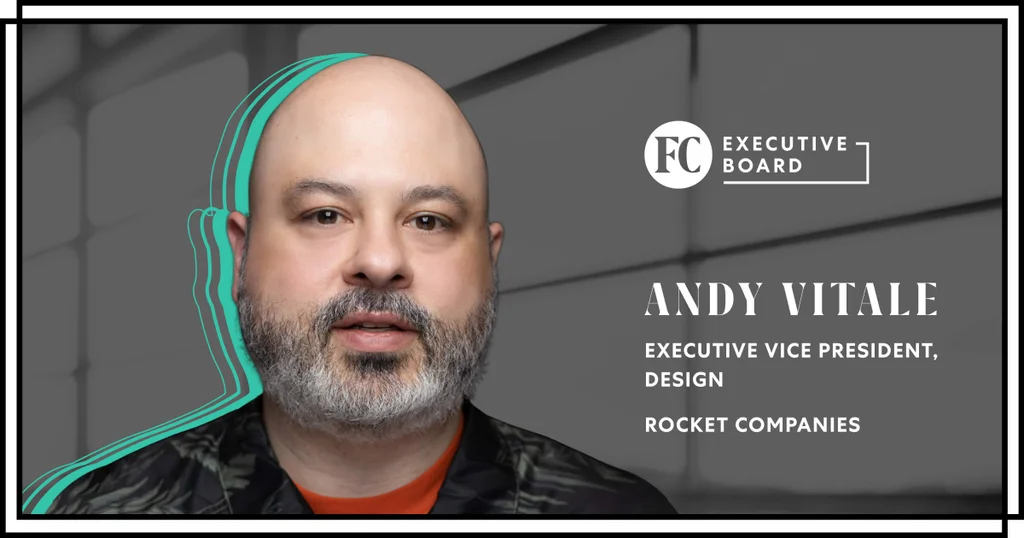

Over the years, design industry leader Andy Vitale has noticed a common misconception among companies that aren’t fully utilizing their design teams. “Companies that lack high design maturity often look at design as something that is just about aesthetics,” he says. “The perception is, ‘Oh, they make things look nice.’ But design is about much more than aesthetics. It’s actually how we solve problems.”
Vitale is the Executive Vice President of Design at Rocket Companies and a general design evangelist—he is the co-host of Surfacing Podcast; a regular adjunct professor at Kent State University; and a member of multiple advisory boards for organizations and educational institutions. In each of these roles, he works to change the way company leaders understand the impact of design on their bottom lines and, by extension, the way these companies work with designers, both their own in-house design teams and external consultants.
Vitale asserts that the design leaders of the next generation are a new breed: They not only understand principles of design, but they also have a clearer sense than their predecessors of designers’ purpose in their respective organizations as a whole. “Design has traditionally been about how we solve problems for people, for users,” he says. “I think we’re starting to see a shift: Design leaders now fully understand the problems a business has to solve, and they can incorporate that mission into what the design team works on.” In other words, the next generation of design leaders isn’t just solving design problems—they’re solving organizational problems, and business problems, through the lens of design.
A SHIFT TOWARD DEEPER COLLABORATION
According to Vitale, the days of designers operating in a silo are over. In their current training, and subsequently, in their work within forward-thinking companies, there is new emphasis on collaboration between design teams and other teams within the organization.
Vitale explains that designers are “collaborative by nature,” and naturally empathetic toward the people they serve. Historically, this has been the end-users. But the new generation of designers, he says, have been trained to “have the same empathy for the people with whom they’re solving problems. And the soft skills that come along with that are not just collaboration, but the ability to gain alignment quickly, and drive outcomes. It’s about meeting our partners where they’re going.”
This hasn’t always been the outlook in the industry. Vitale cites a survey by UserZoom, which showed that only 13% of companies have C-suite representation for design, with 65% relegating design leaders to middle management. Organizations fail to understand the importance of design to their bottom line, or don’t bother to generate actionable insights from often incomplete design data they’ve gathered. “When we talk about design having that seat at the table, you often hear about the triad, which is product, design, and engineering,” Vitale explains. But too often, “design falls under one of those groups, so there’s more of a parent-child relationship. There’s never this true, full-weighted seat at the table, or system of checks and balances.”
CREATING TRANSFORMATIONAL OUTCOMES
Vitale believes that company leaders who are forward-thinking enough to elevate their designers and bring them into the boardroom will find team members with a unique and all-encompassing vision, capable of solving complex problems and transforming products and services. “It’s about outcomes over outputs—it’s not just about deliverables,” he says. “It’s about how we deliver results at all levels. It’s about looking at the entire client journey, whereas in the past, design just looked at a particular screen or application. Now we look at the end-to-end process for our customers. And some of those are not just digital touchpoints; they’re physical touchpoints.” At its best, the design team’s role is to help establish new practices across all teams, using “design as the differentiator” to help transform an organization.
That destination, Vitale says, will vary by organization—but ultimately it must represent the intersection of “delight” and added business value. While in the past 10-15 years, Vitale says, designers have broadened their focus from a “design silo” to understanding and involvement in the business as a whole, the imperative to provide customer delight remains a sticking point. “But delight now comes in different ways, that are no longer purely visual, or what we traditionally think of as the purview of designers,” Vitale says. “Delight comes from solving problems for people. It’s often invisible. And part of what designers have to help other teams understand is what is actually meaningful in order to drive successful outcomes.”
CHANGE AGENTS DRIVING VALUE
When designing consumer solutions, Vitale says, “success often looks like conversion,” which in turn is what financially impacts an organization. Vitale explains the need to “marry” those elegant, yet simple, solutions to a focus on the business, so that the design team’s added value becomes apparent. “At the end of the day, if we’re not providing meaningful value to the people that use our products, we’re not going to get financial value to the organization,” Vitale says.
Vitale asserts that designers, particularly of the new generation, should be viewed (and view themselves) as “change agents” within their organizations: teaching new ways of working, building new products, and identifying new solutions for customers. “It’s about leading more than design,” he says. “Design leaders are starting to lead design-adjacent areas like research, or brand. This allows the design leader to focus on and lead the entire end-to-end experience.”
At some point, he says, as the leader grows and evolves, “they become an organizational leader, not just a design leader. An executive is an executive, capable of leading anywhere in the organization. Having the design lens just ensures it is with a deeper human-centered perspective.”