
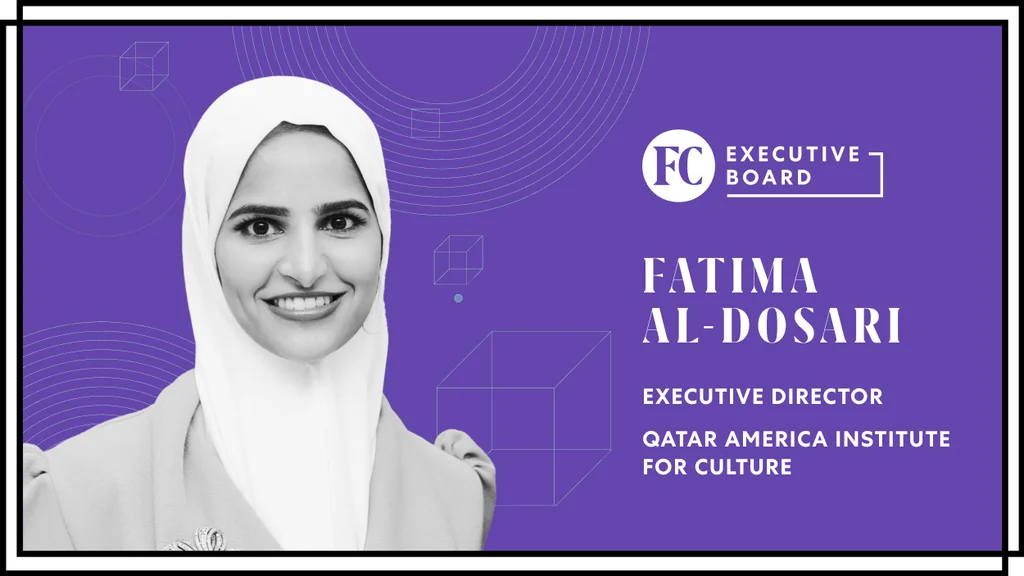

Fatima Al-Dosari began developing her leadership skills from a very young age. As the oldest child in her family, she took an active role in making decisions and managing responsibilities with her parents. She also realized early in life that many people would see her as a representative, not only of her family but also of her country and culture.
“I was born in Qatar, which is a small country with a small population,” said Al-Dosari. “This meant that I needed to take more accountability and initiative to support my community. Whenever we traveled somewhere as a family, it felt important that I reflect well upon my country’s culture and people. I think this experience shaped my personality and the way I carry myself as a leader.”
While Al-Dosari advanced in her career, working in sectors including media, cultural diplomacy, and nonprofits, she often found herself being the “first” in many professional settings as a young, Middle Eastern woman. But she maintained confidence in herself and her unique contributions as she stepped into new leadership positions.
“I learned that when I’m passionate and motivated and offer a unique perspective about the subject matter, those around me develop respect for my capabilities and judgment,” said Al-Dosari. “This helped me grow as a leader in a horizontal way, without necessarily being the top figure of authority in the organization. It showed that I’m willing to take risks, even if that isn’t stereotypically expected of women or people from my background. I wanted to help shape a change in how people perceive women who look like me.”
LEARNING FROM ADVERSITY
Al-Dosari took on her biggest leadership role to date when she was appointed executive director of the Qatar America Institute for Culture (QAIC) in 2019. She led the organization through major changes and challenges, including redefining its mission and values and opening the experiential Perfumery Museum at its Washington, D.C., headquarters.
“I think ‘learning through the bad and difficult’ has been a big part of my leadership philosophy,” said Al-Dosari. “I led an organizational transformation while navigating internal and external challenges, such as strategic misalignment, a regional political crisis, nonprofit legal ambiguities, a pandemic, and most recently, the organization’s sunsetting. Frankly, I sometimes found it hard to see beyond the obstacles, but I learned to step back from any situation and think, ‘What is the lesson to learn here?’ I think this approach of seeing every hardship as an opportunity for education has helped me stay self-motivated and lead with confidence.”
Knowing when to ask for support is also a crucial component of being a good leader, Al-Dosari explained. No individual can be expected to know everything, and leaders who demonstrate a willingness to learn can model positive behaviors for their teams.
“Asking for help is not always easy, especially in circles where you may experience imposter syndrome,” Al-Dosari said. “But it was important to me to identify any knowledge gaps I needed to fill and get more training that could help me talk the talk and walk the walk as a leader. It was also crucial to learn how to balance between delegation and DIY. I was lucky in a way that this was during the pandemic, so I had time to not only develop my own professional capabilities but also those of my team.”
Al-Dosari invested in competencies that would support the organization’s mission, giving team members time and resources to take courses and attend conferences that aligned with their roles and interests. Because she was leading a mission-driven organization with a mixed team of existing and new hires, she put QAIC’s core values front and center.
Al-Dosari developed a list of internal and external values, based on input from the board of directors and funders, as well as issues related to the Qatar National Vision 2030 and the UN’s Sustainable Development Goals. Then her team voted on the values they thought should define the organization’s goals, programs, and culture—which helped build collective trust and buy-in.
LEADING WITH COMPASSION
“I believe in leadership through empathy and collaboration, especially when working in creative industries,” said Al-Dosari. “Humans are complex by nature, and we are all different people from different backgrounds with unique needs and aspirations. Leaders need to understand how and why people behave in certain ways before thinking about job performance. I tend to take this leadership approach to foster better communication and understanding with my team and make space for innovation and problem-solving. Find the balance between listening to your own rationale and instincts and those of others.”
Al-Dosari created weekly and quarterly sessions for collaborative thinking and ideation with the QAIC team to help everyone be heard, see issues from different perspectives, and reach consensus in decision-making. Daily meetings also included “clearings,” opportunities for anyone to share any distractions or stresses that were affecting them, such as fatigue from caring for a sick child or frustration due to waiting for an important sponsor call.
“I’ve also learned throughout my experience that this type of leadership does not work well with everyone,” added Al-Dosari. “Due to past experiences, cultural differences, or ingrained social issues—such as sexism, racism, Islamophobia, and ageism—some may dismiss this approach. Empathetic and collaborative leaders need to learn how and when to use the carrot and the stick. You can be friendly and seek a diversity of opinions about plans and deadlines but still be strong and hold people accountable for their actions.”
She noted that tension and conflict can occur in the workplace, and sometimes people’s diverse backgrounds and life experiences can shape the lens they see you through.
“Since it is Women’s History Month, my advice for other women leaders is to learn to balance their ‘yeses’ and ‘nos’ when evaluating opportunities,” said Al-Dosari. “Women, regardless of industry, are still underrepresented, and so any opportunity for representation is a responsibility. Women may encounter opportunities that intend to ‘tokenize’ them, especially if they are minority leaders, but they can learn to use even these circumstances in an empowering, authentic way.”