
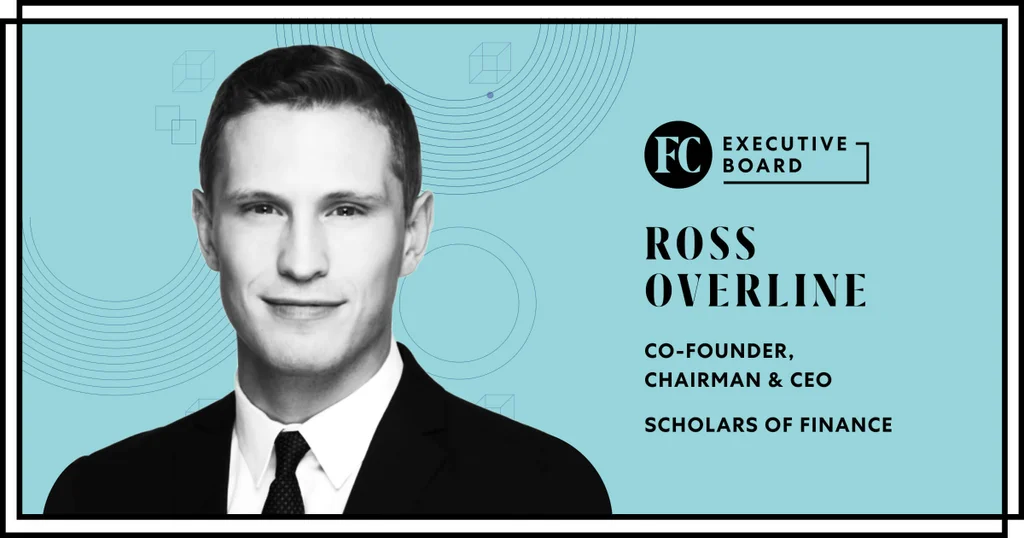

When Ross Overline begins each work day, he sets out to positively impact the world.
Overline is the cofounder, chairman, and CEO of Scholars of Finance, a nonprofit developing character and integrity in the next generation of financial leaders. He says it’s in his and his team’s best interest to serve a purpose greater than themselves. He encourages other leaders to prioritize serving others—even if they don’t run nonprofits. Local business owners and CEOs of multinational corporations alike can make an impact.
“The world needs it,” Overline says. “By serving others, I believe leaders will be more motivated and fulfilled, as will their team members. They’ll have more endurance and resilience and feel like what they do on this earth matters.”
SOLVING THE WORLD’S MOST PRESSING PROBLEMS
Overline explains that when leaders serve a purpose greater than themselves, they get to help other people and, in turn, improve society.
“If the world becomes a better place, we all become better off,” Overline says.
Overline notes that if leaders don’t strive to serve purposes greater than themselves, what’s at stake is that the world’s most pressing problems, such as poverty and climate change, won’t be solved. He emphasizes that leaders can help people directly, and by doing so, they can also help others indirectly, akin to a domino effect.
“Think about all of the people in your circle of influence who you can affect,” he says. “You can help them to thrive, and all of them will be better off. Your net effect on the lives of everyone you directly and indirectly touch can be more healing for the world. Imagine a world where all 8 billion people work equally hard to serve others. We will solve our collective and shared problems much more efficiently and quickly if we all serve others.”
OTHER BENEFITS
Overline stresses that leaders should serve with the goal of helping others and bettering the world rather than benefiting their organizations or themselves; motivation, he believes, is critical.
“Motivation matters because bad motivations can corrupt,” Overline says.
However, he points out that companies that give back do well growth-wise. In a research paper published in 2023, for instance, the authors wrote that their “content analysis results suggest mounting evidence” that “social responsibility, as measured by ESG performance indicators, has a direct positive impact on companies’ financial performance.” Moreover, Overline notes that organizations that do good are more attractive employers. According to a 2022 joint study by Bentley University and Gallup, “55% of employed Americans say they would switch jobs to work at an organization that has a greater positive impact on the world, including 71% of employees aged 18 to 29.”
Then, there are the benefits to leaders themselves.
“The only two true sources of happiness, in my view, are relationships and a higher purpose: service to others,” Overline says.
Consider research published in 2003 that found that giving “help was a more important predictor of better reported mental health than receiving help.” Additionally, in research published in 2017, researchers wrote that their work offers behavioral and neural evidence that “supports the link between generosity and happiness” and that their results “suggest that, for a person to achieve happiness from generous” behavior, the “the brain regions involved in empathy and social cognition need to overwrite selfish motives in reward-related brain regions.”
DISCIPLINE AND HARD WORK ARE VITAL
Discipline and hard work are integral to serving a purpose greater than yourself, Overline explains, adding that without personal development, leaders can’t expect to be able to serve others effectively. As such, he’s designed a personal development program of structure and discipline aligned with his mission, values, and principles.
His mission is to live a life with “the highest probability of the deepest positive impact on the most people possible over the long term.” His values include humility, integrity, compassion, curiosity, and courage, and he has several principles associated with each.
To live a life in accordance with his mission, values, and principles, he regularly takes action. For instance, twice a year, he goes on personal silent retreats where he reflects and assesses himself against his principles. Every week, he conducts a self-check-in of his spiritual, emotional, mental, and physical health, as well as his relationships (including with those he leads), to determine how he’s currently doing in each area and which parts of his life or his responsibilities need more attention in the week ahead.
Approaches will vary from leader to leader, Overline explains, and each person should carve their own approach that enables them to live a life of service to others. However, specific routines aside, he recommends that leaders take three core steps to get started on the path of serving a greater purpose.
“We need to know who we are now, who we want to be in the future, and then do the work to become that person,” he says.
First, Overline says, leaders should cultivate humility, being honest with themselves to understand who they’ve been in the past and who they currently are.
“Cultivating humility helps us understand why we do what we do—it’s about managing and addressing our egos, insecurities, and fears,” he says. “There are two things we have to do to cultivate humility. We have to face and address our fears and then ask ourselves why we do what we do. Is it because we genuinely care, or is it due to other reasons, such as wanting to be successful or make money?”
Once leaders know who they’ve been and who they currently are, they can explore who they want to become, Overline notes.
“Every leader should answer several questions,” he says. “What is the mission that you want to pursue? What values and principles do you want to live by? What do you want to do with your life?”
Next, Overline explains that leaders can focus on routines and discipline.
“Do the constant work that will help you get from where you are to where you want to be,” he says.
He emphasizes that his routines and discipline have enabled him to serve people better—something he believes has been well worth it.
“It seems like a paradox, but if I want to live the best life I can have, I need to forget about myself and focus on others,” Overline says.