
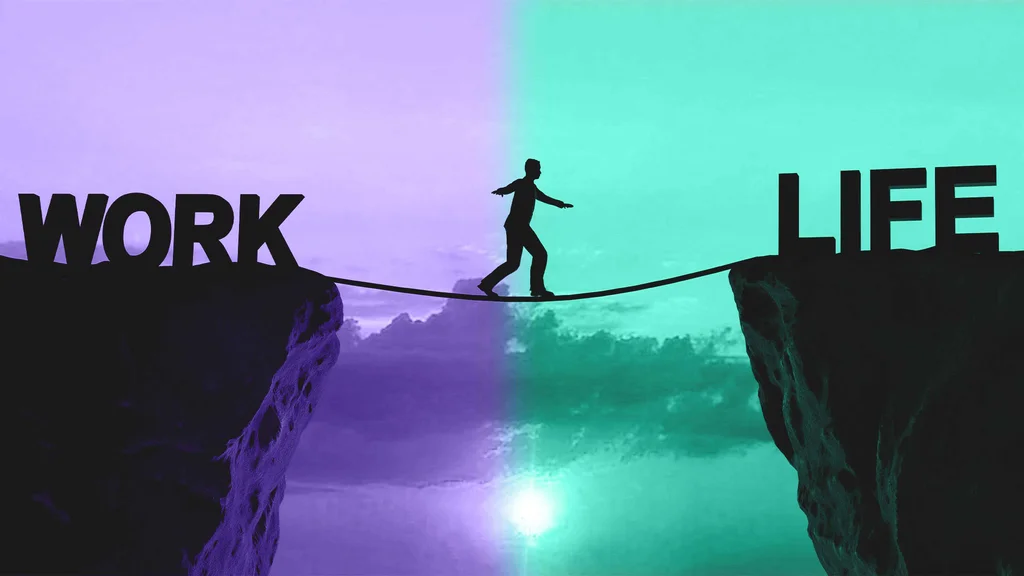

In the age of smartphones, global networking, and the interconnectedness of today’s world, the term “work-life balance” often crops up in conversations. Everyone seems to be chasing this elusive balance. However, a closer look suggests that the term, rooted in the Industrial Age’s corporate 9-5 mindset, might be outdated in the modern world.
Instead, a new idea is emerging: work-life harmony.
WHAT IS WORK-LIFE BALANCE?
Work-life balance is the notion that there should be an equal distribution of time and energy between one’s professional responsibilities and personal life. The concept is painted with clear boundaries—work stays at work, and home stays at home. You clock in, do your job, clock out, and then, after the workday is complete, you engage in personal activities. The idea of this schedule originated when the majority of employment was in factories, where a 9-5 schedule was the norm. A traditional classroom setting with a teacher served as an effective preparation for such employment.
But here’s the conundrum: The moment you find yourself attending to work outside this conventional frame, guilt creeps in. The pressure to fit everything into two distinct boxes can result in higher stress levels. Many individuals internalize this type of stress, mistakenly thinking they are failing at maintaining balance if they attend a work call past 5 P.M. or decide to take a personal day during the week.
THE EVOLUTION TO WORK-LIFE HARMONY
Enter work-life harmony, a concept that acknowledges the modern interconnected nature of our lives. It’s not about segmenting our time into blocks but about allowing work and personal life to flow together, finding harmony in the overlaps and intersections. It’s about recognizing that sometimes work might seep into personal hours and vice versa. And that’s okay—as long as there’s an overall sense of satisfaction and fulfillment across both segments of your life.
With the proliferation of remote work and flexible hours, the boundaries between “work time” and “personal time” have become increasingly blurred. Instead of resisting this change, embracing a 24/7 mindset can lead to a more fulfilling and less stressful life. This approach ensures that both domains support and enhance each other, rather than being in constant opposition.
THE SHIFT IN PERSPECTIVE: FROM BALANCE TO HARMONY
For many, the idea of merging work and life might initially seem counterintuitive. After all, we’ve been conditioned to believe that success means juggling responsibilities effectively without dropping any balls (how’s that juggling act going for you?). But as the landscape of work changes, so too must our perceptions of how we structure our lives.
One of the pivotal reasons for this change is the evolution of technology. Smartphones, instant messaging, AI, and cloud platforms have redefined the workplace, making it more virtual and less location-dependent. The significant shift in the way we work provides an unparalleled opportunity to redesign our work patterns and change how we address workflows in both segments of our days, whether as professionals, parents, partners, or friends.
Recent global events, including the significant push for remote work due to the pandemic and other unforeseen circumstances, have further highlighted the inadequacy of the traditional 9-5 model. People are now realizing that a strict line-in-the-sand between work and leisure is not just unrealistic, but also detrimental to mental health and productivity.
In embracing work-life harmony, we are not only acknowledging the inevitable intertwining of our professional and personal lives but celebrating it. It’s about crafting a life where one’s passion, career, and personal aspirations can come together, leading to a more enriched and satisfying existence.
LOOKING AHEAD
It’s important to state that the move from work-life balance to work-life harmony isn’t about dismissing the importance of personal time. It’s about redefining success and contentment in a world that no longer operates strictly between 9 AM and 5 PM. As the lines between professional and personal continue to blur, it’s essential to focus on creating a harmonious life where work and personal endeavors coexist, complement, and even uplift each other.
Embracing work-life harmony might be the key to breaking free from the cycle of stress and dissatisfaction that the myth of work-life balance often brings. After all, in a world that’s continuously evolving, isn’t it time our approach to work and life evolved, too?
Andreas Pettersson is the CEO of Arcules.