

The marketing landscape is in a period of rapid evolution and has been for quite some time. The rise of AI-driven applications and other technological advancements have changed the way campaigns are ideated, created, delivered, and consumed. Tightened regulatory environments, burgeoning data strategies, more involved requirements, and, of course, changing consumer behaviors have all created a dynamic playing field that is constantly evolving.
As a result, leading industry professionals have to adjust and ask some crucial questions: What does it mean to be a “modern marketer”? And how can 2025’s marketers effectively differentiate themselves and their practices from those of yesteryear?
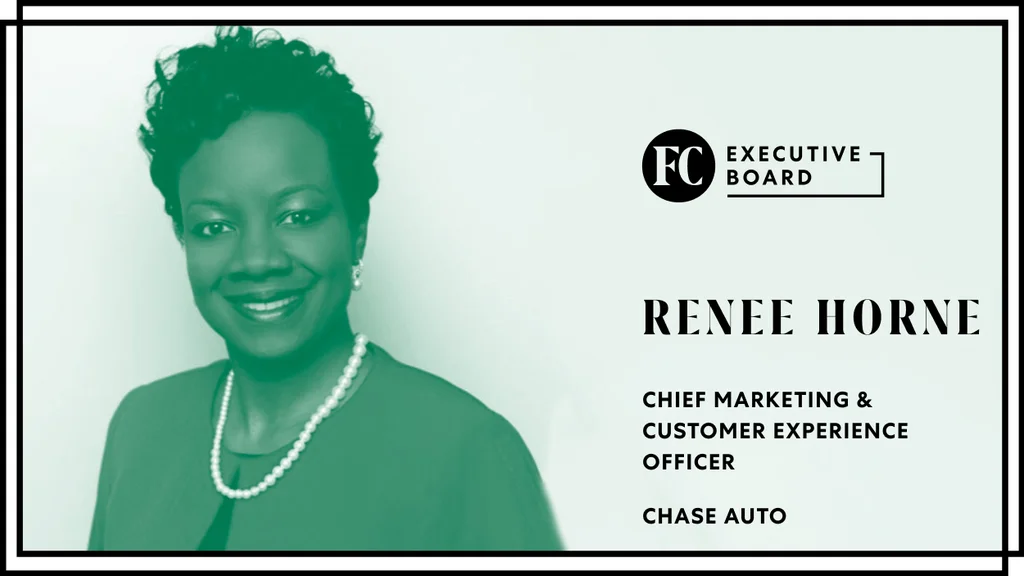
Renee Horne, Chief Marketing and Customer Experience Officer at Chase Auto, has thought about these questions extensively. Gone are the days when companies could simply sell a product or service. Consumers today are more diverse and more demanding. They want the experience, the story, and the lifestyle that the product or service provides. And with more competitors entering the space, marketing must be more innovative, personalized, and dynamic than it ever was before.
In response, Horne likes to recount an “untold story” of Chase Auto Marketing’s role in the automotive supply chain—serving manufacturers, dealers, and consumers—to illustrate that there isn’t a population they cannot reach.
THE NEW ERA OF MARKETING
Chase Auto Marketing prides itself in having successfully wielded a 360-degree approach that includes everything a customer is looking for—allowing them to “serve across the entire spectrum in a unique way.”
How did they do it? The strategy might be complex, but “the story itself is simple,” Horne says. From tech and innovation to utilizing data to personalize the customer journey, the team leverages the Chase-owned assets in their go-to-market strategy.
Chase has, at its discretion, a media network worth billions based on our latest evaluations. Notably, their network contains an array of options that one might not immediately think of as media. “When I say ‘our ad space,’ I’m referring to assets across the firm,” Horne says. These assets include Chase.com, JPMorganChase.com, the company’s mobile app, and a nationwide network of 5,000 branches—with digital merchandising enabled in most of these. Chase also has over 16,000 ATMs nationwide, along with digital out-of-home media, including high-profile locations like Times Square and the Oculus, which they occupy year-round.
“We use these assets strategically,” Horne explains. “For example, within Chase Auto, we have six private label captive finance partners—Subaru, Aston Martin, Maserati, Rivian, Jaguar Land Rover and McLaren—and we act as an extension of their brands, promoting their vehicles and offers. This drives significant brand awareness. We also run targeted direct email campaigns and personalized ATM messaging. If you insert your debit card at an ATM, you might see a message like, ‘Congratulations! You’re pre-approved for a vehicle loan up to X amount,’ seamlessly pulling you into our sales funnel.”
Chase also operationalizes its dealer sales team, Horne says, many of whom are franchise dealers connected to auto manufacturing brands. “We’ve also integrated Salesforce Marketing Cloud, which has enabled about 70% automation in our trigger campaigns,” she says. “Based on specific account characteristics of these dealer services rooftops, we can now automate marketing sequences—such as sending follow-ups based on customer actions. For example, if a customer has low deposit activity, we can automatically place them into a teaser intro CD rate campaign.”
While there are aspects of more conventional marketing in their strategy, Chase ultimately focuses on the whole experience of being a Chase customer and client, going beyond what others may offer. “In the immediate automotive financing space, no one else is doing what we do,” she says. Some captive lenders may have OEM-backed financing, but Chase’s real estate, network, and access to data are what sets them apart. “With 84 million customers, we have the ability to execute across all segments,” she says. “And that’s without even touching the precision we bring to targeting—marrying first-party data, card transactions, and vehicle purchase behavior to build personas and lookalikes.”
The use of data unlocks a new marketing approach that historically was out of reach. Instead of marketing to the masses, Chase is able to use data to get a better understanding of who their customer really is—going beyond the numbers—and building a persona including where they eat, shop, travel, and dine. This allows Chase to know their customers and predict what would resonate best for that specific individual.
Do they have any use for more “conventional” marketing practices? “Our strategy does include more traditional marketing, but that isn’t going to result in brand loyalty. And that is where offering the full breadth of the firm comes into play.”
THE POWER OF THE EXPERIENCE
Chase’s acquisitions over the years “have expanded our reach into travel, dining, sponsorships, and entertainment,” she says. “When combined, these elements create unmatched experiences.” This allows Chase to reach consumers and clients in a way that wasn’t historically available.
Horne explains that at the National Automobile Dealers Association’s yearly gala—which she refers to as “the Super Bowl of our industry”—Chase was able to utilize their travel, dining, and entertainment assets to bring clients together for an unforgettable event, at which they enjoyed world-class dining (through Chase’s connections with top chefs), headline entertainment, and a carefully curated atmosphere.
Horne urges companies to think carefully about the kinds of experiences they create for their clients, to seek out ways to delight, inspire, and make transformative connections with the brand. “The look, the feel, the sound, the energy—it’s all about crafting an unmatched experience that leaves a lasting impact,” she says.
A WINNING STRATEGY
Encompassing the full customer experience and spectrum into a go-to-market strategy has proven successful, yielding a win-win for Chase Auto’s partners through car sales, for the firm through an increase in originations, and for customers by providing them financing for transportation.
Horne asserts that the marketing mindset should always focus on improving targeting and customer reach, which means listening to their feedback. Chase is a customer-centric business, she notes, and the firm uses various feedback sources and digital signals to learn how better to support and work with customers. “Even complaints can become like turning lemons to lemonade when effectively reviewed, and when patterns are established to improve customer experiences across any journey related to car shopping, buying, and financing,” she says.
From a first-time car buyer who uses Chase’s Auto Advice Center to Private Label partners, Chase’s marketing strategy meets customers and clients, providing an all-encompassing approach that has helped redefine what it means to be a marketer.